

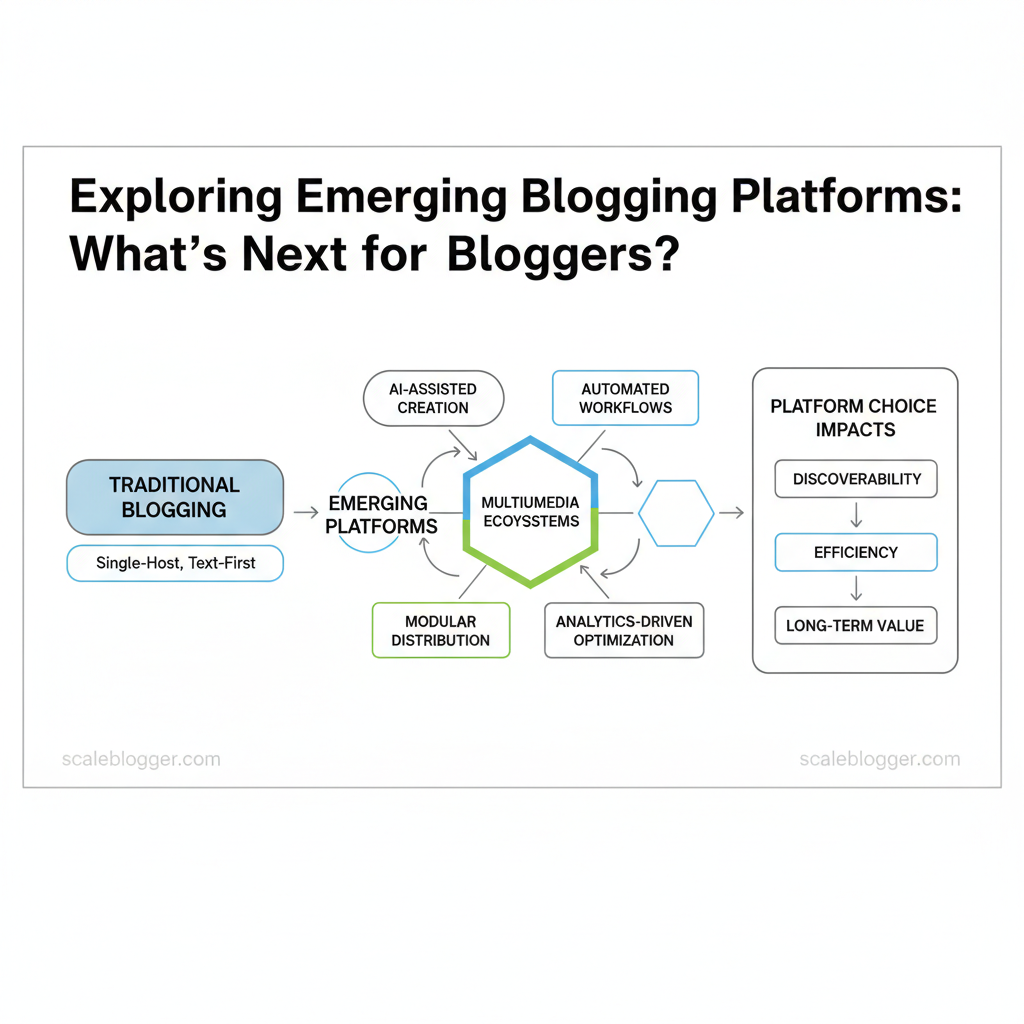
Facing stagnating organic reach and rising content costs, many teams are asking where to publish next. The landscape of blogging platforms is shifting from single-host, text-first sites to ecosystems that blend multimedia, social distribution, and automated workflows.
New entrants and feature-rich updates are making publishing decisions more strategic than technical. Platforms now emphasize AI-assisted creation, modular distribution, and analytics-driven optimization, changing how content teams plan cadence and measure ROI. Industry roundups note that established builders and niche hosts are both evolving to capture different creator needs (Forbes).
This matters because platform choice affects discoverability, team efficiency, and long-term content value. Picture a B2B team moving from sporadic WordPress posts to a system that auto-formats articles for email, social, and AMP pages while tracking engagement.
- How modern platforms handle distribution, discoverability, and ownership
- Where AI and automation reduce repetitive publishing work
- Trade-offs between control, scalability, and audience reach
- Practical signals to choose a platform for the next three years
— The current landscape: Which new blogging platforms are emerging and why they matter
The next wave of publishing platforms blends newsletter-first distribution, decentralized ownership, and AI-native tooling — and that mix is changing how creators build audiences and monetize content. Platforms that look like simple blogging tools are evolving into full content ecosystems: subscription engines, token-led economies, native commerce, and headless publishing pipelines that plug into automation stacks. Below is a practical rundown of who’s rising, who they serve, and why strategy must adapt.
Platform roundup: Profiles and positioning – Substack-style newsletter-hybrid: Focus on direct subscriptions and email-first distribution; excellent for writers building paid newsletters. – Decentralized platforms: Blockchain-backed ownership and token incentives; appeal to creators who prioritize control and new monetization models. – AI-native hosts: Integrated generative tools for drafting, SEO optimization, and on-the-fly localization; speed up content ops for high-velocity teams. – Long-form social publishers: Built-in network effects and discoverability; best for thought leadership and viral long-reads. – Self-hosted CMS: Full ownership and extensibility; preferred when custom workflows, SEO control, and performance matter.
| Platform | Best for | Monetization options | Ownership/control | Unique feature |
|---|---|---|---|---|
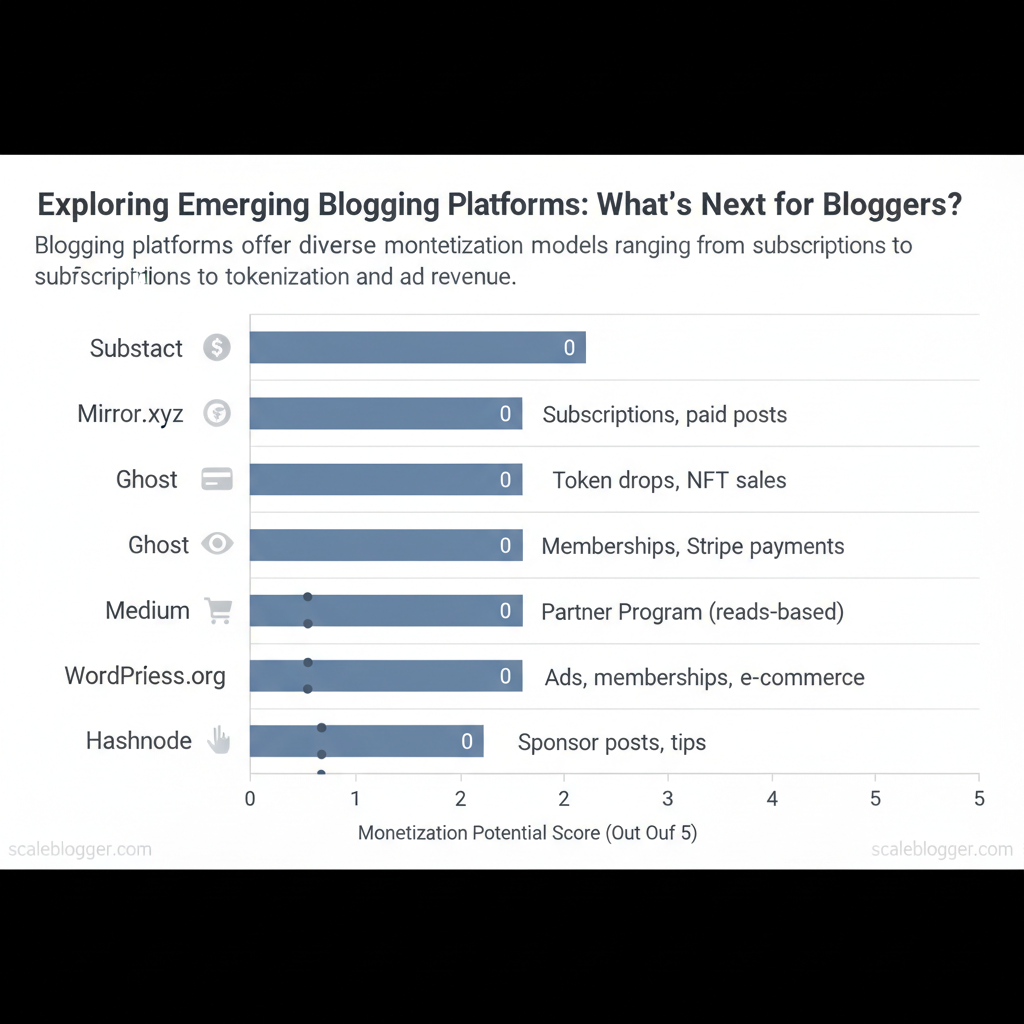
| Substack | Independent writers | Subscriptions, paid posts | Hosted, limited export tools | Email-first subscriptions and simple paid newsletters |
| Mirror.xyz | Crypto-native creators | Token drops, NFT sales | Decentralized (blockchain) | On-chain ownership + tokenization |
| Ghost | Publishers & SMBs | Memberships, Stripe payments | Self-host or Ghost(Pro) | Open-source membership system with Stripe native |
| Medium | Wide-audience long-form | Partner Program (reads-based) | Hosted, limited export | Built-in reader network and curation |
| WordPress.org | Full custom sites | Ads, memberships, e-commerce | Fully self-hosted, total control | Extensible plugins and integrations |
| Hashnode | Dev-focused bloggers | Sponsor posts, tips | Hosted with custom domain | Developer community + SEO for technical posts |
| Notion (public pages) | Knowledge publishing | Indirect (consulting, lead gen) | Hosted, export available | Flexible docs-as-website workflow |
| Vocal/Medium competitors | Storytellers seeking pay-per-read | Tips, platform payouts | Hosted | Per-story payout models and built-in audience |
Macro trends shaping platform growth
- Newsletter monetization becomes mainstream — Platforms prioritize direct-paid relationships over ad revenue. Implication: prioritize email capture and gated content. Takeaway: design a starter free-to-paid funnel that converts within 3–6 issues.
- Decentralized ownership and Web3 mechanics — Creators experiment with tokens and NFTs to align incentives. Implication: new legal and audience-education overhead. Takeaway: pilot token models on low-cost experiments before committing.
- AI-native content workflows — Drafting, summarization, and SEO automation are built into hosts. Implication: faster output but higher revision needs. Takeaway: use AI for first drafts and scale, keep human editing for nuance.
- Headless and modular publishing — CMS decouples content from presentation, enabling omnichannel distribution. Implication: content reuse across email, apps, and AMP. Takeaway: structure posts as reusable `content blocks`.
- Platform discoverability vs. first-party audiences — Network platforms offer audience reach; self-hosting delivers data ownership. Implication: balance both channels. Takeaway: mirror flagship pieces on a network while keeping subscriber-only content on owned properties.
— Choosing the right platform: Frameworks and decision criteria
Pick a platform with a clear map from today’s needs to tomorrow’s scale. The G.O.A.L.S. framework turns that map into a quick, repeatable scoring exercise so teams make defensible choices instead of guessing.
G.O.A.L.S. explained Growth* — Measures discoverability features: SEO controls, RSS support, indexing friendliness, and integrations with newsletters and social. Score 0–3 where 3 = native SEO + analytics + easy syndication. Ownership* — Captures control over content and data: exportability, self-hosting, database access. Score 3 when you can export full site/data and host it yourself. Audience Fit* — How well the platform reaches your target: professional, consumer, long-form readers, or niche communities. Score based on built-in audiences and recommender systems. Longevity/Stability* — Company maturity, funding, open-source community, and update cadence. Prefer platforms with transparent roadmaps; score 3 for established, widely adopted options. Scale/Workflow* — Support for editorial teams: multi-author roles, APIs, automation, publishing pipelines. Score 3 when the platform has APIs, native scheduling, and webhooks.
How to score quickly
Tradeoffs and priorities by creator
- Solo blogger focused on longform: prioritize Ownership and Growth over advanced workflow.
- Agency or multi-author newsroom: prioritize Scale/Workflow and Longevity.
- Niche newsletter-first creator: prioritize Audience Fit and Growth.
| Platform | Growth (0-3) | Ownership (0-3) | Audience Fit (0-3) | Longevity/Stability (0-3) | Scale/Workflow (0-3) | Total Score |
|---|---|---|---|---|---|---|
| WordPress.org | 3 | 3 | 3 | 3 | 3 | 15 |
| WordPress.com | 2 | 1 | 3 | 3 | 2 | 11 |
| Ghost | 2 | 3 | 2 | 2 | 2 | 11 |
| Squarespace | 2 | 1 | 2 | 2 | 1 | 8 |
| Wix | 2 | 0 | 2 | 2 | 1 | 7 |
| Medium | 2 | 0 | 3 | 2 | 1 | 8 |
| Substack | 2 | 0 | 3 | 2 | 1 | 8 |
| Webflow | 2 | 2 | 2 | 2 | 3 | 11 |
| HubSpot CMS | 2 | 1 | 2 | 3 | 3 | 11 |
| LinkedIn Articles | 1 | 0 | 3 | 3 | 0 | 7 |
Decision archetypes: which platform fits which creator
Understanding these principles helps teams move faster without sacrificing quality. When platform choice aligns to a clear archetype and a scored G.O.A.L.S. evaluation, implementation becomes an operational step instead of a strategic risk.
— SEO and discoverability on emerging platforms
Discoverability on new publishing platforms depends less on keywords alone and more on how the platform exposes content to crawlers, internal recommendation engines, and syndication partners. Platform architecture — URL structure, canonical handling, crawlability, and internal linking — determines whether content shows up in search, feeds, or third-party aggregators. Treat each platform as its own search engine: learn its indexing behavior, ranking signals, and sharing model before you optimize.
- Robots and headers: Check `robots.txt` and `X-Robots-Tag` for accidental blocking.
- Canonical behavior: Verify whether the platform sets canonical tags or forces platform-owned canonical URLs.
- Structured data: Confirm support for `article`, `author`, `publisher` schema and OpenGraph/Twitter Card rendering.
- Pagination & feeds: Test whether paginated archives expose rel=”next/prev” and if RSS/JSON feeds are public.
- Server response and redirects: Measure 200/301/404 patterns for edited content and migrated posts.
- Platforms that enforce platform-level canonicals, causing your site to compete with the host domain.
- JavaScript-heavy rendering that hides content from some crawlers or delays indexing.
- No XML sitemap export or private feeds, which prevents discovery by external aggregators.
- Weak author attribution or missing structured data, reducing trust signals for search.
| Platform Type | Top 3 SEO Tactics | Quick Implementation (yes/no) | Key KPI to Track |
|---|---|---|---|
| Newsletter-hybrid platforms | Canonical tags, OpenGraph, email-to-web syndication | ✓ | Publication referrals, CTR from email, indexed pages |
| Decentralized / blockchain hosts | Persistent URLs, content hashes, structured metadata | ✗ | Content retrieval success, external backlinks, on-chain references |
| AI-native blog hosts | Structured schema, readable first 200 chars, model-friendly metadata | ✓ | Recommendation impressions, feed CTR, dwell time |
| Self-hosted CMS | Sitemap XML, canonical control, server performance | ✓ | Organic clicks, crawl budget usage, index coverage |
| Long-form social platforms | Profile authority, internal linking, shareability via cards | ✓ | Profile followers, internal referral traffic, engagement rate |
Understanding these architecture-driven rules shortens the path to consistent discovery across new channels. Applied correctly, the same automation that scales content production can also ensure every publish meets the platform’s discoverability checklist.
— Content strategy: Formats, audience building, and repurposing
Successful content strategy starts with matching format to platform behavior and audience attention. Different platforms reward different signal types: long dwell on owned sites, fast shares on micro-social channels, and repeat consumption via serialized channels. Plan formats so each piece earns attention where that channel amplifies it, then convert that attention into a durable audience through email, community, or subscriptions.
| Content Format | Best Platform Type | Production Effort | Primary Engagement Metric | Repurposing Opportunities |
|---|---|---|---|---|
| Long-form essay | Owned blog / Medium-style platforms | High — research + editing | Time on page / backlinks | Split into newsletter, summary video, micro-posts |
| Serialized newsletter | Email / Substack / LinkedIn Articles | Medium — weekly drafting | Open rate / subscriber growth | Repurpose into blog series, podcast episodes |
| Micro-thread / social post | X / Threads / LinkedIn feed | Low — rapid drafting | Shares / replies / saves | Expand into long-form, carousel, or short video |
| Short explainer video | TikTok / Instagram Reels / YouTube Shorts | Medium — 1–3 min editing | View-through rate / comments | Transcribe to blog post, create clips, quote cards |
| Interactive post / poll | LinkedIn / Twitter / Community platforms | Low — 1–2 min setup | Participation rate / responses | Use results as data for posts, newsletter insights |
Repurposing workflow and distribution calendar — a practical, repeatable system:
Sample 4-week calendar with cadence:
Measurement and iteration: track channel-specific KPIs weekly, threshold triggers for boosting or reworking content, and run A/B tests on headlines and thumbnails. Use automation to push derivatives (an AI content pipeline handles scheduling and basic repurposes), freeing creators to focus on high-impact originals. Understanding these principles helps teams move faster without sacrificing quality. When implemented correctly, this approach reduces overhead by making decisions at the team level.
— Monetization and business models on emerging platforms
Monetization on new publishing platforms isn’t a single switch — it’s a layered strategy that blends direct, indirect, and hybrid revenue streams to balance growth, predictability, and creator freedom. Direct models capture payment from the audience; indirect models monetize attention and influence; hybrids combine both to diversify risk and increase lifetime value.
- Hybrid models — combine the above to smooth revenue swings and unlock premium experiences without excluding free users.
- Test incrementally: launch a low-friction $1–$5 micro-sub offering before full memberships.
- Early KPIs: `MRR` growth rate, 3-month churn, conversion rate (visitor→paid), ARPU, affiliate conversion rate.
- Experiment cadence: run 4–8 week experiments; measure lift vs control cohort.
- Retention focus: aim for 30–45% 90-day retention for paid tiers early on.
- Sponsorship validation: secure 1–2 pilot deals and measure CPM/engagement.
Risk mitigation and scaling tips
- Diversify so advertising never exceeds 50% of revenue.
- Automate subscriber onboarding and content delivery to reduce marginal cost.
- Test pricing using value-based anchors and limited-time offers.
- Protect brand by vetting sponsors — audience trust drives long-term monetization.
| Monetization Model | Revenue Predictability | Implementation Complexity | Scalability | Best For |
|---|---|---|---|---|
| Subscriptions / memberships | High, recurring (`MRR`) | Medium — CMS + billing | High with retention focus | Niche audiences, courses |
| Paywalls / paid posts | Medium — transactional | Low–Medium — paywall tech | Medium | Premium analysis, exclusives |
| Sponsorships / brand deals | Low–Medium, campaign-based | Low — outreach + media kit | Medium | High-traffic, B2B niches |
| Affiliate marketing | Low — performance-based | Low — links + tracking | High (volume dependent) | Product reviews, recommendations |
| Direct commerce / products | Medium — variable seasonality | High — inventory/fulfillment | High with digital products | Merch, info products, tools |
Understanding how to blend these models lets teams prioritize experiments that scale, not just generate short-term revenue. When executed deliberately, diversified monetization stabilizes cash flow and creates optionality for strategic investment.
📥 Download: Blogging Platform Selection Checklist (PDF)
— Migration, interoperability, and future-proofing your content
Start by treating migration as a product launch: the audience, search visibility, and content relationships must survive the move intact. A checklist that preserves SEO and audience continuity is the backbone of any successful migration.
Nginx example for single page
Interoperability and automation reduce manual errors and make future migrations painless. Focus on formats, metadata, and a single source of truth.
- Standardize file formats. Use `markdown` or structured HTML for text, `WebP`/`AVIF` for images, and `JSON-LD` for schema.
- Enforce metadata conventions. Title, `meta description`, `og:` tags, and `twitter:` cards should be part of the publishing payload.
- Automate exports/imports. Use CMS APIs or headless pipelines to move content; avoid copy-paste.
- Version control content. Store content in Git or a CMS with revision history to roll back mistakes.
- Use a canonical content registry. One database or headless CMS must act as the single source of truth for IDs, slugs, and taxonomy.
- Integrate CI/CD for publishing. Automate tests that validate links, schema, and accessibility before going live.
- Implement webhooks and ETL patterns. Push updates to downstream systems (CDNs, analytics, personalization engines) in near-real time.
- Audit interoperability regularly. Run scheduled checks for broken integrations, stale caches, and metadata drift.
Platforms are fragmenting, formats matter, and automation unlocks scale — republishing high-performing newsletters as SEO-optimized posts, turning long-form research into short social clips, and centralizing editorial calendars all reduce cost-per-published-asset while increasing reach. Evidence from teams that layered repurposing workflows onto existing archives shows faster traffic growth and steadier SERP presence; editorial automation also cuts time spent on manual publishing and formatting. To act on this: – Audit existing content for republishable formats and quick wins. – Map a repurposing workflow that assigns formats (post, thread, video snippet) to each pillar topic. – Automate routine publishing tasks so editors focus on strategy, not uploads.
For teams ready to execute, a practical next step is to pilot a small batch of automated publishes and measure lift in impressions and conversions. For professional assistance with implementation, platforms like Scaleblogger specialize in scheduling, format conversion, and publishing pipelines—Try Scaleblogger to automate publishing and scale your content.
