

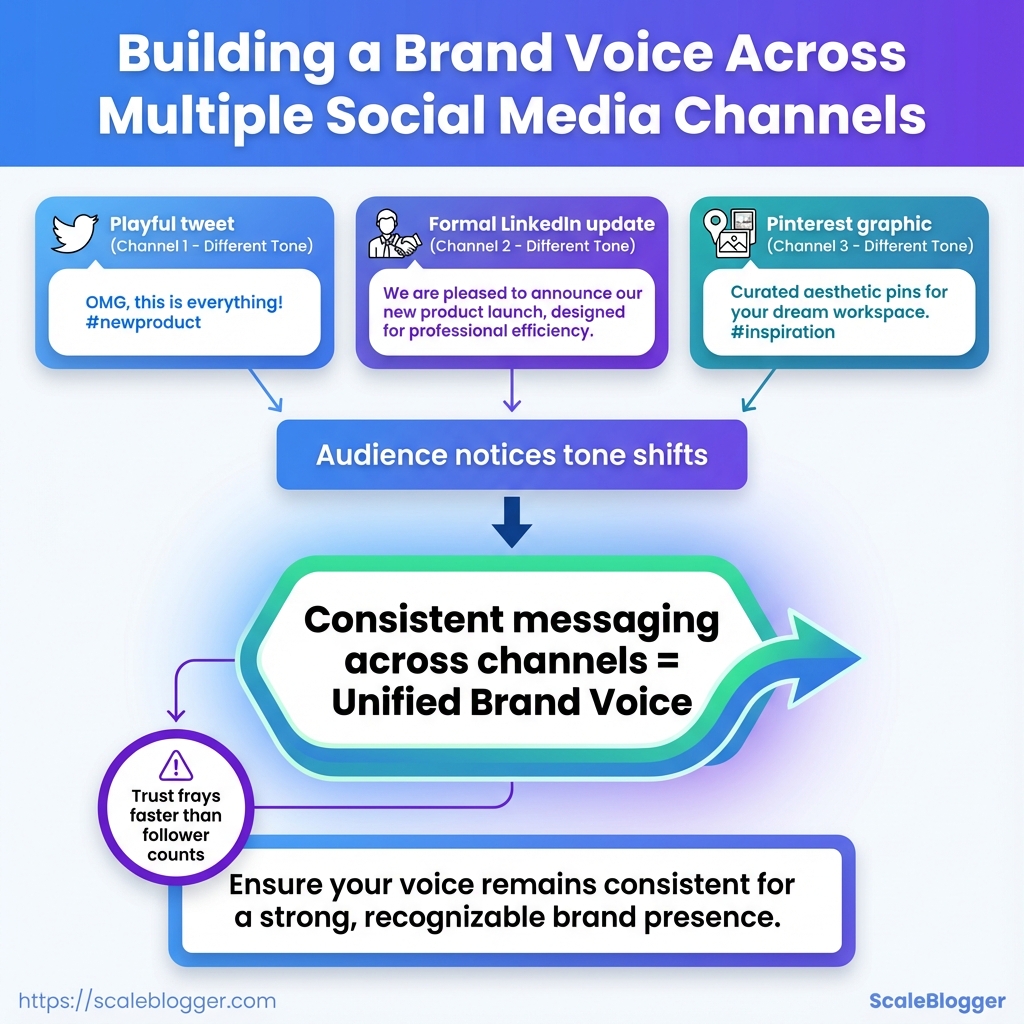
You post a playful tweet, a formal LinkedIn update, and a Pinterest graphic that sounds like a different company — and your audience notices. When the tone shifts across channels, trust frays faster than follower counts, because people remember the personality behind the posts more than any single campaign. That gap is what a coherent brand voice closes.
Crafting unified presence isn’t about forcing every channel into the same mold; it’s about translating a clear voice into formats that fit each platform. Nail the balance between platform-first execution and unwavering consistent messaging, and every caption, bio, and comment becomes an amplifier rather than a distraction.
Start treating social profiles as rooms in the same house, not separate apartments. Small alignment decisions — word choice in replies, visual cadence, the emotion behind headlines — compound into recognizability, higher engagement, and clearer positioning in feeds. Streamline your content workflows with Scaleblogger to turn those alignment decisions into repeatable systems.
What You’ll Need (Prerequisites)
Start with a clear identity and the right access: without brand rules and data, automation produces noise instead of signal. The project moves fastest when a small core team supplies guidelines, account credentials, and a simple tone framework so content pipelines can be built and validated against real metrics.
Prerequisites checklist
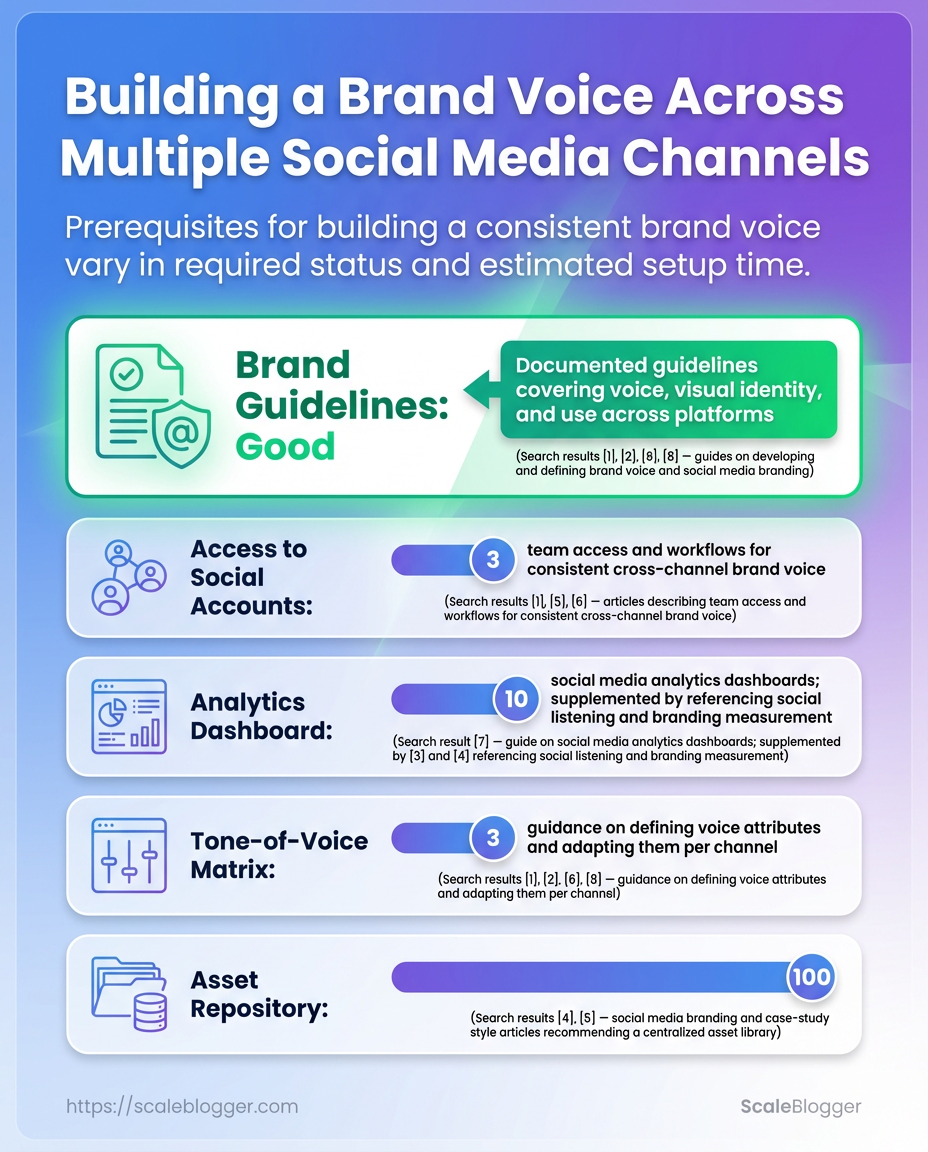
- Brand Guidelines: Logo usage, color palette, typography, and messaging pillars (mission, audience, positioning).
- Brand Questionnaire: Answers on audience segments, value props, banned words, and competitive differentiators.
- Access to Social Accounts: Admin or publishing-level access to primary platforms (Meta, X, LinkedIn, Instagram).
- Analytics Dashboard: Read access to GA4 or equivalent, and to platform analytics for engagement tracking.
- Tone-of-Voice Matrix (recommended): Short matrix mapping audience → voice, sample sentences, and dos/don’ts.
- Asset Repository: Organized folder with logos, product shots, author headshots, and approved images.
- Stakeholder List: Names, roles, review SLAs, and final decision authority for content sign-off.
Tools & materials you should have ready
- Grant publishing-level access to social tools and the CMS, with
editororadminroles. - Share a living brand document (Google Doc or Notion) and a sample content piece that represents the preferred voice.
- Provide an assets folder link with versioned filenames and simple naming conventions (e.g.,
logo_rgb_v2.svg).
Stakeholders
Content Owner: Person responsible for final editorial decisions.
Analytics Lead: Person who validates KPIs and configures tracking.
Designer/Brand Lead: Person who approves visual assets and brand adherence.
Publisher/Community Manager: Person who acts on posting and engagement.
Prerequisite items with status (Required/Recommended), purpose, and estimated setup time
| Prerequisite Item | Required/Recommended | Purpose | Estimated Setup Time |
|---|---|---|---|
| Brand Guidelines | Required | Ensure consistent messaging and visuals | 1–3 hours to gather |
| Access to Social Accounts | Required | Publish and monitor content | 30–60 minutes per account |
| Analytics Dashboard | Required | Track traffic, conversions, and engagement (GA4) |
1–2 hours for read access |
| Tone-of-Voice Matrix | Recommended | Fast validation of voice across formats | 1–2 hours to create |
| Asset Repository | Recommended | Rapid assembly of posts and thumbnails | 1–3 hours to organize |
Quick analysis: Having brand rules, account access, and analytics unlocked up front cuts setup time dramatically. The tone matrix and an organized asset repository aren’t mandatory, but they reduce review cycles and keep automated content sounding human. With these pieces in place the pipeline moves from fragile to repeatable.
Get these elements locked in before you start building automation; they turn guesswork into predictable output and make it far easier to measure impact.
Audit Existing Social Voice
Start by collecting representative posts from each platform and treat this like a behavioral audit: what the brand says, how it says it, and how the audience reacts. The goal is to turn scattered posts into a clear picture of your current brand voice across channels so you can spot mismatches, gaps, and opportunities for consistent messaging.
Access to accounts: Logins or read-only access to each social profile. Export capability: Tools or scripts that can pull post text, date, media links, and engagement. Baseline metrics: Recent 90-day engagement averages for likes, shares, comments, and link clicks.
Tools & materials
- Data export tool: Use native platform exports or a social listening tool.
- Spreadsheet or Airtable: For tagging and sorting samples.
- Simple dashboard: For quick visual comparison of engagement patterns.
- One-page audit template: A reusable summary format for each platform.
- Export or collect representative posts for each platform.
- Choose a rolling sample window (90 days is typical). Export at least 50 posts per high-activity platform and 15–25 for lower-traffic channels.
- Tag each sample for tone, intent, and outcome.
- Create three tags per post:
- Use engagement metrics to prioritize issues.
- Combine raw engagement (likes, shares) with interaction quality (comment depth, sentiment). Rank problems by frequency × impact so recurring tone mismatches that also reduce clicks rise to the top.
- Produce a one-page audit summary per platform.
- Each one-pager should include: top 3 voice strengths, top 3 voice problems, 2 example posts (good/bad) with tags, and 3 prioritized recommendations.
Tone: friendly, formal, witty, brand-promotional, empathetic.
Intent: awareness, conversion, community, customer support, thought leadership.
Outcome: drove conversation, drove clicks, low engagement, negative sentiment.
Practical examples and signals to watch
- Platform mismatch: Brand uses formal, long-form captions on Instagram where short, playful captions perform better.
- Internal inconsistency: Customer support posts use apologetic tone while marketing posts are boastful—this confuses expectations.
- Opportunity: High-performing posts often ask a clear question and include static visuals; replicate that structure.
Consider using an automated content pipeline to accelerate exports and tagging; Scaleblogger.com offers automation for content collection and performance benchmarking if speed and scale are priorities.
Completing this audit turns noisy social feeds into actionable inputs for consistent messaging and measurable experiments. When each platform has its one-page snapshot, decisions about tone adjustments and content tests become straightforward and defensible.
Define Your Brand Voice Pillars
Start by choosing 4–6 actionable voice pillars that describe how the brand communicates, not what it sells. Each pillar should be channel-agnostic and easy to translate into specific behaviors. Pick language you can test: short labels, one-sentence definitions, and clear Do/Don’t rules.
- Pick pillars that matter.
- Helpful: Solve problems clearly and proactively.
- Witty: Use smart, tasteful humor to disarm and entertain.
- Authoritative: Back claims with evidence and confident language.
- Empathetic: Acknowledge emotions and show understanding.
- Concise: Say more with fewer words.
- Translate each pillar into behavioral rules (one-liners that writers can follow).
- Write a
DoandDon'tfor each pillar. - Create 1–2 micro-guidelines for tone, sentence length, and punctuation (e.g., prefer simple sentences; use em dashes for emphasis).
- Add platform translation examples (social post, newsletter subject, blog intro).
- Turn rules into checks in your content brief and editorial checklist so every asset ships with the same constraints.
Practical checklist items to include with each pillar: Voice tests: Single-sentence rewrite in pillar voice. Channel rule: How to adapt (more formal on LinkedIn; shorter, punchier on X). * Measurement: Engagement lift target or readability score threshold.
Map each voice pillar to short examples and platform-specific translation rules
| Voice Pillar | Definition | Do (Examples) | Don’t (Examples) |
|---|---|---|---|
| Helpful | Solve reader problems with clear steps | Blog: “3 steps to fix X”; Email: actionable checklist | Vague promises; generic fluff |
| Witty | Clever, human humor without sarcasm | X: one-liner + emoji; IG caption playful analogy | Long jokes; inside-industry snark |
| Authoritative | Confident evidence-led claims | LinkedIn: data + citation; Blog: expert quote | Unsupported bold claims; hedging language |
| Empathetic | Acknowledge feelings, validate concerns | Email: “We hear you” opening; Support replies calm tone | Dismissive fixes; robotic templates |
| Concise | Maximum meaning, minimum words | X: single-sentence takeaway; Newsletter subject short | Overlong leads; filler adjectives |
Key insight: The table maps each pillar to tangible behaviors writers can follow across channels, turning abstract descriptors into immediate editorial actions. This is where strategy becomes repeatable: writers use the Do/Don’t examples as a fast decision rule when editing or drafting content.
Use these pillars to build brief templates and a one-page voice cheat sheet for contributors. That small artifact makes consistency realistic across dozens of posts and platforms. Scale your content workflow by embedding these rules into brief templates and automated checks so the voice remains stable as output scales.
Build Channel-Specific Playbooks
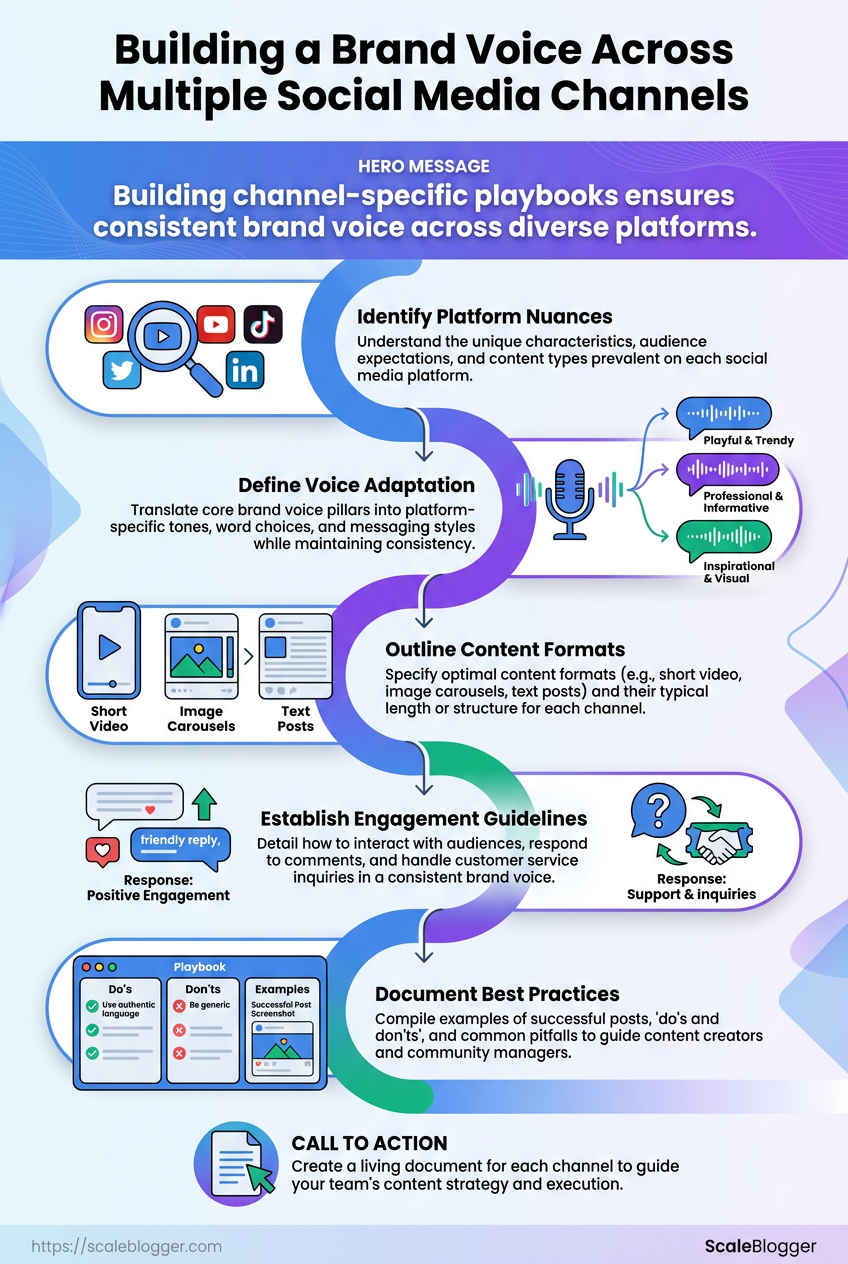
Start by treating each channel as its own mini-publication. A playbook should remove guesswork: who you write for, the exact post structure, three ready-to-publish samples in the brand voice, visual rules, hashtag approach, approval steps, and localization notes. That combination keeps messaging consistent while letting teams scale content quickly.
Showplaybook components and whether they are mandatory or optional across channels
| Playbook Component | Twitter/X | ||
|---|---|---|---|
| Audience Persona | Mandatory — concise persona & tone (160 chars) | Mandatory — persona + aspirational moodboard | Mandatory — professional persona + decision-maker focus |
| Post Structure Template | Mandatory — hook → context → CTA (≤280 chars) | Mandatory — visual lead → caption → CTA (carousel rules) | Mandatory — hook → value → evidence → CTA (long-form allowed) |
| Sample Posts | Mandatory — 3 written samples in brand voice | Mandatory — 3 caption+alt-text samples | Mandatory — 3 article/post samples |
| Visual Guidelines | Optional — image ratio, GIF use | Mandatory — aspect ratios, caption overlays, template files | Optional — header image + brand colors |
| Hashtag Strategy | Optional — topical + branded tags | Mandatory — 5-10 emphasis tags, mixing reach and niche | Optional — topical tags only (2-3) |
What follows are actionable components to drop into templates and hand off to writers and schedulers.
Audience Persona: Compact description of follower needs, pain points, and preferred language.
Post Structure Template: One-sentence pattern to follow. Keep it prescriptive.
Approval Flow: Who, when, and SLA for sign-off.
Localization Notes: Tone, date/number formats, and legal/regulatory flags per region.
- Draft the playbook header with persona and allowed language.
- Add the exact post structure and visual examples.
- Attach three platform-specific sample posts and mark required approvals.
Sample posts (brand voice: confident, practical, slightly witty)
Twitter/X samples 1. “Wrote less, published smarter. Use AI to map topic clusters and cut research time by half. Want the framework? Reply ‘map’ and get the checklist.” 2. “Content teams juggle deadlines — automation doesn’t replace strategy, it amplifies it. Here’s a three-step audit to start today: 1) prune 2) repurpose 3) automate.” 3. “Stop guessing titles. Test three using small paid promos for 48 hours. Winners get full production. Simple split-test math.”
Instagram samples 1. “Old blog + new format = more traffic. Swipe → see our 5-step republish checklist. #content #socialmediabranding” 2. “Behind the scenes: content pipeline in Notion + scheduled posts = calmer launch weeks. Screenshot in carousel. #brandvoice” 3. “Mini case: 1 month, 3 optimizations → organic sessions up. Tap for the template.”
LinkedIn samples 1. “Content ops that scale use automation to surface ideas, not write the strategy. Short thread on aligning content with sales enablement.” 2. “How to turn one pillar post into a quarter’s worth of assets — step-by-step checklist and distribution calendar (downloadable).” 3. “A/B testing headlines with paid promos reduced CPC by 22% in one pilot. Here’s how the experiment was structured.”
Approval and localization notes Approval Flow: Content creator → editor (24h) → compliance/legal (48h if needed) → scheduler.
Localization: Translate CTAs conservatively; adapt idioms; convert dates to local formats; flag regulated claims for regional legal review.
Drop these playbooks into the content pipeline tooling so publishing teams see the exact fields to fill. When playbooks live next to scheduling and performance dashboards—whether using in-house automation or Scaleblogger.com workflows—teams publish faster and keep brand voice consistent across platforms.
Create a Content Production Workflow
Start by mapping who does what and when. A repeatable workflow removes bottlenecks, preserves brand voice, and makes automation safe instead of risky. Designate a clear voice owner, build slim templates, and automate routine steps while keeping humans in the loop for anything voice-sensitive or strategic.
Prerequisites
Editorial calendar: A living schedule with topics, owners, and deadlines.
Brand voice guide: Short reference (tone, banned words, audience cues).
Version control: A place to store drafts and change history.
Tools & materials
- Project manager: Lightweight Kanban (Trello/Asana) or
Notiondatabase. - Content editor: Google Docs with suggestion mode or a CMS draft workflow.
- Scheduler: Native CMS scheduler, Buffer/Hootsuite, or native API automation.
- Automation platform: Zapier/Make or built-in CMS hooks for publishing triggers.
Set up roles
Voice owner: Final authority on tone, metaphors, and sensitive messaging.
Content creator: Crafts the first full draft and applies the template.
Editor: Checks structure, facts, SEO signals, and accessibility.
Approver: Publishes or signs off; often the voice owner for high-stakes pieces.
Templates and naming conventions
Template — Blog Post: Title, one-sentence angle, 3–5 headers, CTA, internal links, meta description.
Filename convention: YYYY-MM-DD_topic_author_v1 keeps chronology and versions obvious.
Automate but guard the voice
- Configure automated tasks that handle routine actions, like assigning drafts, pinging reviewers, and scheduling social posts.
- Use automation to populate metadata and run content scoring tools, but route any post flagged for “voice” or “legal” to human review.
- Create
pre-publishchecks: required fields, image alt text, and broken-link scan.
Track changes and version history
Versioning: Keep major releases as v1, v2 in filenames and maintain a changelog field in the CMS.
Diffs: Use Google Docs suggestions or a CMS that shows change history so reviewers can see precise edits.
Practical example: Automate a new draft creation when a Trello card moves to “Writing.” That draft gets tagged to the writer, fills in the template, and triggers a reviewer notification three days before the due date.
This workflow reduces last-minute edits, protects the brand voice, and makes scaling predictable. Treat it as a living system: start lean, prove value, then extend automation where it safely speeds work.
Train Teams and Onboard Creators
Train people so they create predictable, on-brand content without constant supervision. Start with a short, hands-on module that gets writers, designers, and creators practicing the brand voice, content structure, and SEO habits that matter. Pair exercises with a clear assessment rubric and a sign-off checklist so everyone knows when work meets the bar. Then build a lightweight refresher cadence to keep skills sharp as the voice, offerings, or SEO landscape evolve.
Training Module: hands-on, practical, repeatable
- Warm-up exercise: Two-hour session where creators rewrite a high-performing article into the brand voice.
- Voice drills: Practice three tones — informative, conversational, and sales-adjacent — using the same brief.
- SEO checklist practice: Walk through on-page optimizations (
title,meta description,H2structure) on a live draft. - Cross-functional workshop: One-hour session with product, comms, and SEO to resolve factual or positioning gray areas.
- Publishing run-through: Create, review, schedule, and publish an article to simulate the full pipeline.
Assessment rubric and sign-off checklist
Start every content assignment with a rubric so reviewers score consistently.
Clarity: Content is understandable by the target persona within 30 seconds. Voice match: Tone lines up with the brief across headline, lede, and CTA. SEO basics: Keyword intent matched, H2 hierarchy present, and internal links included. Readability: Paragraphs average 18–22 words; bullets and subheads used. Fact-checking: Product or data claims linked to approved sources.
Use a simple scoring system: 4 = publish, 3 = minor edits, 2 = rewrite, 1 = reject. Attach a signed checklist before scheduling:
- Title and meta optimized.
- Voice-approved by editor.
- SEO checklist completed.
- Images and alt text added.
- CMS fields populated and publish date set.
Ongoing refresher training schedule
- Monthly 60-minute clinics: Quick updates on voice drift or new SEO signals.
- Quarterly deep-dive: Two-hour session covering performance trends and common mistakes.
- Annual audit workshop: Review top and bottom performers; adjust training materials.
For teams using automation, tie refresher triggers to content performance thresholds so training is data-driven. Consistent onboarding plus measured refreshers makes brand voice scalable without losing quality.
Monitor, Measure, and Iterate
Start by treating monitoring as an active conversation with your audience, not a monthly checkbox. A focused KPI dashboard plus a disciplined iteration cycle turns raw metrics into clearer messaging, better reach, and progressively stronger brand voice.
KPI Dashboard: A connected analytics workspace (Meta Insights, X/Twitter Analytics, LinkedIn Page Analytics, Google Analytics for landing pages).
Social listening: A tool that captures sentiment and topical mentions across platforms.
Baseline: At least 3 months of posted content to avoid noise from small-sample volatility.
Building the KPI dashboard
Make the dashboard answer one question: is our messaging consistently increasing awareness and positive perception? Keep it lean.
- Metric selection: Pick 5 KPIs tied to awareness-stage goals—reach, engagement, shares, follows, and clicks.
- Measurement cadence: Update daily for volume, review weekly trends, run monthly audits, and do deep quarterly reviews.
- Mix signals: Combine quantitative indicators with qualitative feedback (comments, DMs, conversation themes).
KPI Dashboard and Iteration Cycle
Recommended KPIs, how to measure them, and target thresholds for awareness-stage social media branding
| KPI | How to Measure | Target (Awareness Stage) | Action if Below Target |
|---|---|---|---|
| Engagement Rate | (Likes+Comments+Shares)/Impressions via platform analytics | 1.0%–3.0% typical for awareness | Test content formats; boost high-performing posts; refine hooks |
| Follower Growth Rate | Net new followers / starting followers (platform analytics) | 3%–6% monthly growth | Increase cross-promotion; run targeted awareness campaigns |
| Sentiment Score | Aggregate positive/negative ratio from social listening tools | ≥65% positive mentions | Address common complaints; adjust brand tone; amplify positive stories |
| Share Rate | Shares / Impressions (platform analytics) | 0.2%–0.6% | Create more utility-driven content and clear share prompts |
| Click-Through Rate | Link clicks / Impressions (platform analytics & GA) | 0.5%–1.5% | Improve CTAs and landing relevance; A/B test creative+copy |
Key insight: The table prioritizes simple, measurable KPIs for awareness-stage social media branding. Use these targets as directional benchmarks—platform, industry, and audience will shift norms, so compare against your historical performance.
Iteration cycle (practical steps)
- Run monthly audits.
- Review KPI trends and spot 3 underperforming themes.
- Ideate 3 content experiments tied to specific KPIs (format, CTA, timing).
- Implement experiments for 4–6 weeks, tagging posts for attribution.
- Do a quarterly review: roll out winners, retire losers, and update dashboard thresholds.
Qualitative signals to include
- Comment themes: recurring praise, confusion, or objections.
- Customer DMs: examples that reveal friction or affinity.
- Share context: who’s sharing and why.
A solid monitoring routine closes the loop between what the brand says and how the market hears it. Over time, those monthly tweaks and quarterly pivots compound into a clearer brand voice and steadily stronger social media branding — and you’ll notice not just more numbers, but better conversations.
Troubleshooting Common Issues
Most voice problems come from process gaps, not creativity. Fixes are operational: tighten inputs, add checkpoints, and make attribution simple so writers know which voice to use. Below are practical, repeatable fixes for the four issues that show up most often and how to implement them without killing creativity.
Multiple-writer inconsistency
Consistency fails when people lack the same reference points.
Create a single living voice doc: Keep one brief guide that includes tone examples, forbidden phrases, and 3 clear archetypes (e.g., expert friendly, straightforward how‑to, brand storyteller). Use examples: Attach 150–250 word model posts for each archetype.
- Audit a sample of 10 recent posts to map variance.
- Assign each writer an archetype and a 30‑minute calibration session.
- Run weekly spot-checks using
content scoringto flag drift.
Localization vs. consistency conflict
Local teams need flexibility without fragmenting brand identity.
Define immutable elements: brand values, primary voice attributes, and mandatory disclaimers. Allow flexible elements: cultural references, idioms, and local examples.
Practical approach: build a two‑layer template—global copy blocks (locked) and local copy blocks (editable). Use comment fields to explain why a locked sentence exists.
Automation-related voice drift
Automation amplifies small errors quickly. Guardrails win.
Use prompt templates and output checks. Templates should include desired tone, first-person/third-person instruction, and a 1‑sentence style constraint like “avoid corporate buzzwords.” Example: feed automation with a 2–3 sentence brand primer before any generation.
- Version prompts in a shared repo.
- Run weekly A/B comparisons between human and generated drafts.
- Add a pre-publish human review for any automation output.
Sudden PR or crisis voice adjustments
Crises require fast, consistent shifts.
Establish an emergency voice playbook with pre-approved phrases, escalation paths, and a single approver role. Keep short canned responses ready for social channels.
Step process:
- Pull the playbook and lock public copy blocks.
- Route any proposed message through the approver within 30 minutes.
- Log every outgoing message and capture reactions for a 24-hour review.
If automation is in play, pause scheduled generations and switch to templated human drafts.
Scaleblogger.com can help automate the scoring and checkpointing steps if you want faster calibration. Fixing voice problems early saves rework and protects brand credibility—do those small process changes now and the content team will thank you next quarter.
📥 Download: Brand Voice Consistency Checklist (PDF)
Tips for Success and Pro Tips
Start by naming who owns the brand voice and cadence, then build systems around that person. Without a living owner, “consistent messaging” becomes a hope instead of a repeatable process. Set pragmatic rules, automate what’s safe, and keep humans in the loop where nuance matters.
Governance, ownership, and training cadence
Voice owner: A single accountable person who approves new pillar content, voice updates, and escalations.
Training cadence: Schedule model- and team-training every 4–8 weeks to keep examples fresh and correct drift.
- Assign the voice owner and document their responsibilities.
- Collect 20–40 representative content pieces and annotate tone, audience, and intent.
- Retrain or fine-tune models and run a validation pass with the voice owner before publishing.
- Review post-launch performance and iterate on failures.
- Clear roles: Define who creates, who reviews, and who publishes.
- Small batch updates: Release voice changes in waves to limit surprises.
- Audit logs: Keep a changelog of prompts, templates, and model versions.
Localization, automation guardrails, and repurposing
Localization should adapt examples while keeping pillar intent intact. Translate frameworks, not literal sentences.
- Localized context: Swap local names, currencies, and use cases during adaptation.
- Pillar preservation: Keep the original intent and CTA consistent across markets.
- Human validation: Always route final localization checks to a regional reviewer.
Automation speeds scale but needs guardrails. Implement human-in-the-loop checkpoints for subjective areas: claims, legal language, and competitive comparisons.
- Safety nets: Blocklist phrases, require approvals for sensitive topics.
- Metrics-driven: Use content scoring to flag low-performing drafts for review.
- Repurposing templates: Build modular copy blocks (intro, body, CTA) so one long-form post can spawn social posts, emails, and outlines quickly.
Practical pro tip: run a quarterly content audit that pairs performance data with the voice owner’s notes. That links brand voice decisions to measurable outcomes and makes iterative training meaningful.
Keep systems small, measurable, and reviewable — automation should amplify disciplined processes, not replace them. For teams ready to scale that pipeline, consider tools that automate scheduling, benchmarking, and semantic optimization like
Appendix: Templates, Checklists, and Example Copy
This appendix collects ready-to-use assets: pillar templates, playbooks, audit checklists, and exact sample posts you can copy or adapt. These files are organized so the moment a topic is approved, the content pipeline can start without guesswork.
- Pillar template: outlines target audience, intent, subtopics, and internal linking plan.
- Playbook: stepwise promotion calendar, channels, and repurposing ideas.
- SEO audit checklist: on-page, technical, and backlink items to verify before publish.
- Content brief sample: headline formulas, angle, primary keyword, and CTA.
- Example post copy: short-form social, long-form blog intro, and email nurture snippet.
File types explained
.xlsx: Use for editorial calendars, keyword matrices, and performance dashboards. .docx: Draft long-form posts where editors leave tracked changes. .md: Final blog content for CMSs or static sites that accept Markdown. .csv: Bulk upload lists (tags, authors, redirects). .png/.svg: Visual assets and branded templates.
File naming convention
Format: YYYY-MM-DD_topic_channel_version.ext
Example: 2025-03-12_ai-content-pipeline_blog_v1.md
This keeps files sortable and reduces duplication.
- Create a new folder for the campaign and add the pillar template.
- Fill the pillar template with audience, intent, and 6 subtopics.
- Duplicate the content brief, update headline and primary keyword.
- Draft the post in
docxormd, then run the SEO audit checklist. - After QA, export the final file using the naming convention and update the editorial calendar
.xlsx.
Sample copy snippets you can paste and tweak:
- Blog intro: “Most teams drown in ideas and starve for execution. This post maps a repeatable AI-powered process that turns topic clusters into traffic-ready posts in days.”
- Social post: “Struggling to scale content? Use a pillar playbook to turn one core idea into five channel-ready assets. Here’s how.”
- Email subject: “How our content pipeline saved 12 hours/week — a simple playbook”
Practical tips: keep versions small (v1, v2), lock the approved file with _PUBLISHED suffix when live, and store master templates in a shared drive with clear permissions.
For automating these workflows, consider tools that integrate editorial calendars with publishing. Scale your content workflow offers templates and automation patterns that match this structure.
These assets shave hours from planning and reduce revision cycles — use them to make consistent messaging and brand voice feel effortless.
Conclusion
You now have a working roadmap: audit where your voice drifts, lock down three to five brand voice pillars, and translate those into channel-specific playbooks so a tweet and a LinkedIn post read like the same company. Remember the example where a playful Twitter update confused enterprise buyers while the company’s LinkedIn stayed formal — that mismatch cost engagement and trust. Practical steps — documenting tone rules, building a simple approval checklist, and training creators — move this from theory to habit.
If questions pop up — like “What if my team is small?” or “How quickly will consistent messaging affect performance?” — start small: apply the playbook to one channel, measure lift, then scale. Expect early clarity in brand perception within weeks and measurable engagement improvements over one to three months as creators adapt. For immediate momentum, create a single-channel playbook this week, run two weeks of aligned posts, and measure click, share, and sentiment shifts. To streamline this process, platforms like Streamline your content workflows with Scaleblogger can help automate templates, approvals, and analytics so teams focus on voice, not chores. Take that first step: pick one channel, apply the playbook, and watch consistent messaging start rebuilding trust.
