

Creators consistently express frustration about a recurring issue.
A creator makes a niche review site, ranks it, and earns affiliate revenue for one or two seasons.
Then, they see the rankings fall until the site can’t even pay for hosting.
One affiliate forum thread frames the question bluntly: is the build, rank, and watch it die cycle inevitable?
Search updates keep arriving, so their timing isn’t the real surprise.
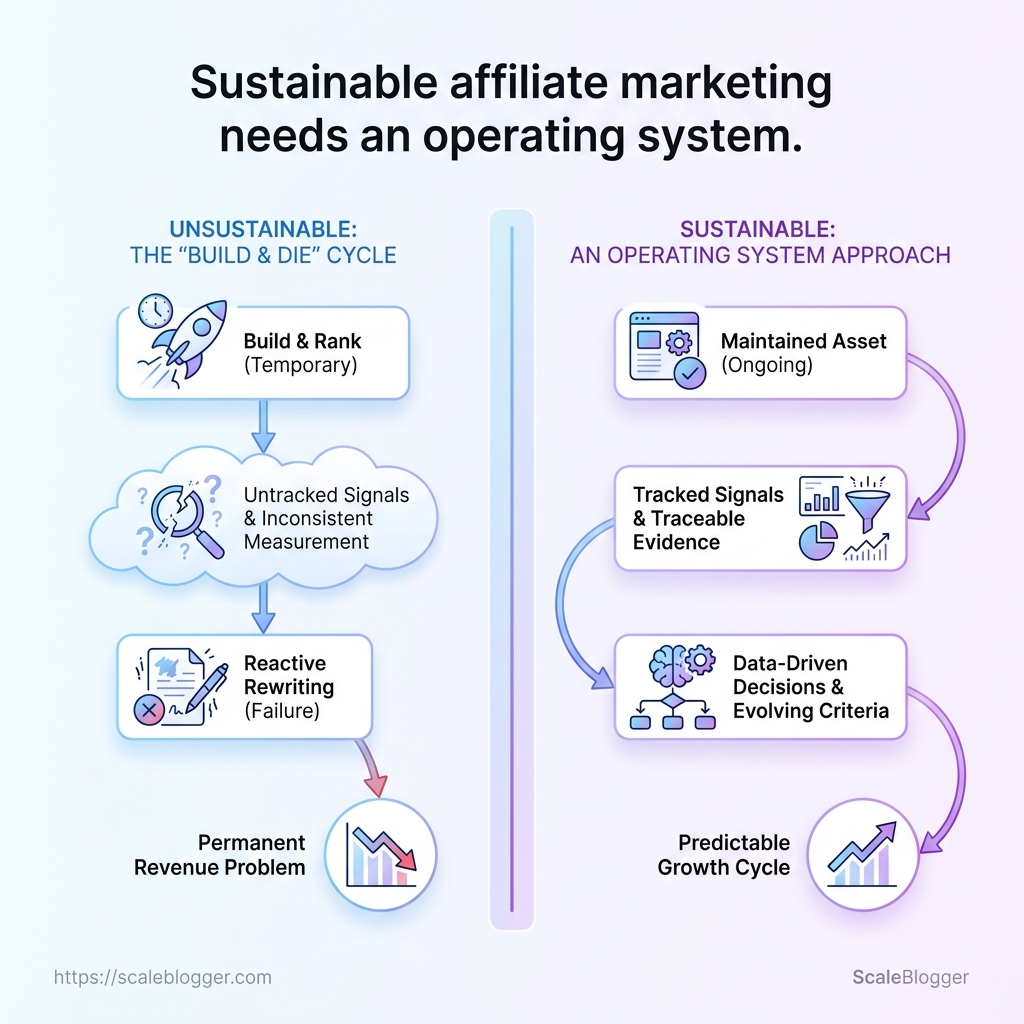
The cycle is a systems problem, not a weather event.
Even if updates could be exactly predicted, a model that relies mainly on early search visibility is weak.
The moment performance falls—due to competition, changing user needs, or shifts in search results—the site can no longer support itself.
The “season or two” part isn’t luck; it’s what happens when maintenance and measurement lag behind ranking volatility.
Sites that succeed do the work that failing ones avoid.
They monitor progress so they see decline early, not just when affiliate revenue has already dropped.
Quick Answer: The “build, rank, and watch it die” cycle in affiliate marketing is not inevitable and can be mitigated through proactive strategies.
By implementing systems for ongoing maintenance, tracking performance, and regularly updating content, creators can sustain their revenue and avoid the pitfalls of content decay.
Engaging with nine advanced strategies can enhance long-term success and trust in an ever-evolving digital landscape.
Is the “build, rank, and watch it die” cycle really inevitable in affiliate marketing?
A creator posts a comparison article, sees it reach page one, earns commissions for seven months, then checks their analytics and finds traffic cut in half.
So they publish a replacement.
The pattern repeats.
On Reddit, one affiliate site builder described this exact loop as a problem from the past that keeps resurfacing, framing it bluntly: build, rank, and watch it die.
It is not inevitable.
This cycle isn’t merely a perception; it stems from genuine and consistent search volatility.
The real damage happens underneath — research nobody revisits, product recommendations that quietly go stale, and zero monitoring between publish day and decline day.
This difference affects what you need to fix.
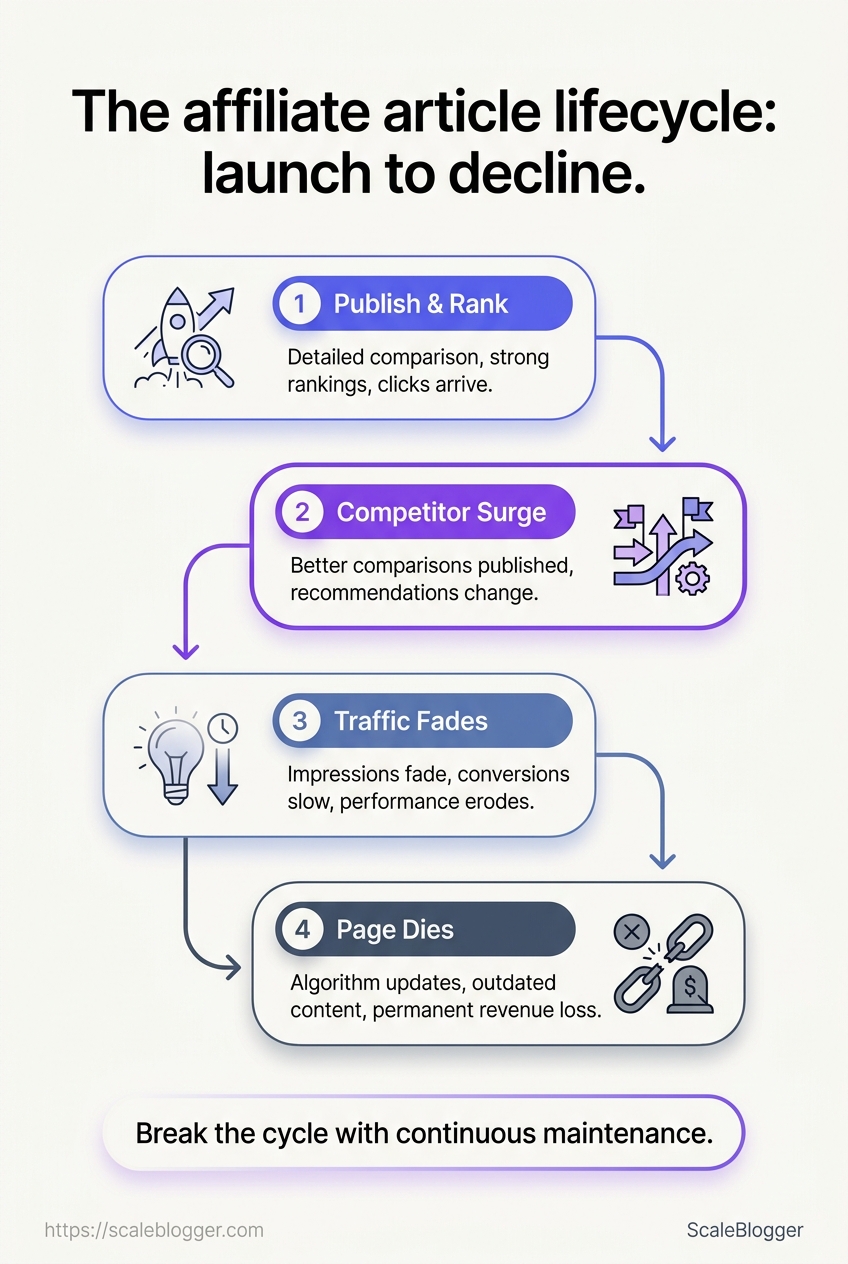
The loop has four recognizable stages:
- Publish: the article goes live with a target keyword and affiliate links.
- Rank: visibility builds, typically over three to six months.
- Decay: competitors update, merchants change pricing, and rankings slip.
- Replace: a fresh piece gets built while the old one is left to rot.
Stage four is where the trap closes. impact.com’s 2025 creator guide makes the point directly: advanced affiliate marketing strategies move past link drops and promo codes into scalable, repeatable systems, and “post and wait” is the bare minimum.
Treating affiliate content as a one-time publishing project guarantees the loop.
Treating it as a system — measured, benchmarked, and scheduled for review — breaks it.
Over the next sections, we trace the specific failure points that cause most affiliate decay: weak evidence tracking, missing benchmarks, stale decision criteria, and irregular maintenance.
Every one of them is fixable.
Most affiliate sites do not have a traffic problem first—they have a content decay problem
Most affiliate sites do not have a traffic problem first—they have a content decay problem
The dashboard shows a slide, so the instinct is to blame the algorithm.
That explanation is often misleading.
Before publishing anything new, determine if the drop is a temporary ranking shift or structural content decay.
Temporary loss usually looks like a short ranking dip after a core update, then partial recovery.
Structural decay behaves differently: the page can hold its position while its commercial value erodes.
The comparison gets outdated, the pricing table is incorrect, and the introduction no longer fits what searchers want.
One is weather.
The other is rot.
Five signals that an affiliate article is entering decline
Most creators notice decay only after revenue falls, when compounding loss has already had time to stack up.
These signs appear sooner.
| Signal | Likely cause | Evidence to check | Recommended response |
|---|---|---|---|
| Impressions fall while rankings remain stable | Search demand shifted or a subtopic lost relevance | Search Console impressions trend over 90 days | Refresh headings and add missing subtopics |
| Clicks fall after search-result changes | AI overviews or new SERP features absorbing clicks | CTR comparison before and after the SERP change | Rewrite title and meta to win the click back |
| Commercial sections get little engagement | Readers skip the pitch; intent mismatch | Scroll-depth and time-on-section in analytics | Move the offer higher and tighten the match |
| Affiliate clicks drop despite steady traffic | CTA placement or link placement has aged | Affiliate network click reports by page | Reposition CTAs and test new anchor copy |
| Conversions fall after product or pricing changes | The merchant changed terms you never updated | Affiliate dashboard conversion rate by product | Reverify pricing, terms, and availability |
Publishing volume cannot hide this: if you don’t track which pages are slipping, new posts decay in the same unmonitored loop.
The fix isn’t less publishing—it’s adding maintenance.
Follow one affiliate article from launch to decline
A creator publishes Best Standing Desks for Home Offices in January.
By March it holds position 4 for its main query.
By June, it may have earned approximately $800 a month in commissions.
By November it sits at position 9.
Earnings have fallen to about $150.
Nothing broke.
The article simply stopped being maintained.
That timeline is ordinary, and the interesting part is what happened between June and November.
Three signals fired, and all three went unread because nothing in the workflow was built to read them.
Search intent shifted while the page stayed fixed.
Results increasingly favor comparison tables and visible pricing over long prose reviews.
The article still opens with 400 words on why ergonomics matter.
Product evidence went stale.
Two desks in the roundup were discontinued in August.
A third dropped its price by $90.
The page still quotes the old figures.
No benchmark existed.
With no baseline for a healthy click-to-purchase rate on that page, a slide from 3.1% to 1.4% looked like normal variance instead of a failure.
The recovery path runs backward from the obvious fix.
Rewriting every paragraph is expensive and usually unnecessary.
Update the decision framework first: define which signals trigger an update, set a numeric threshold for each, and assign a review date before the page goes live.
Then you rewrite only the sections that failed a check.
impact.com’s 2025 creator guide makes a related point — that “post and wait” is the bare minimum, and that sustainable affiliate marketing strategies depend on systems rather than one-off link drops.
An article rarely decays because an algorithm chose to punish it.
It decays because nobody scheduled the moment when it would be checked.
A page can keep attracting visitors while becoming less valuable to the business
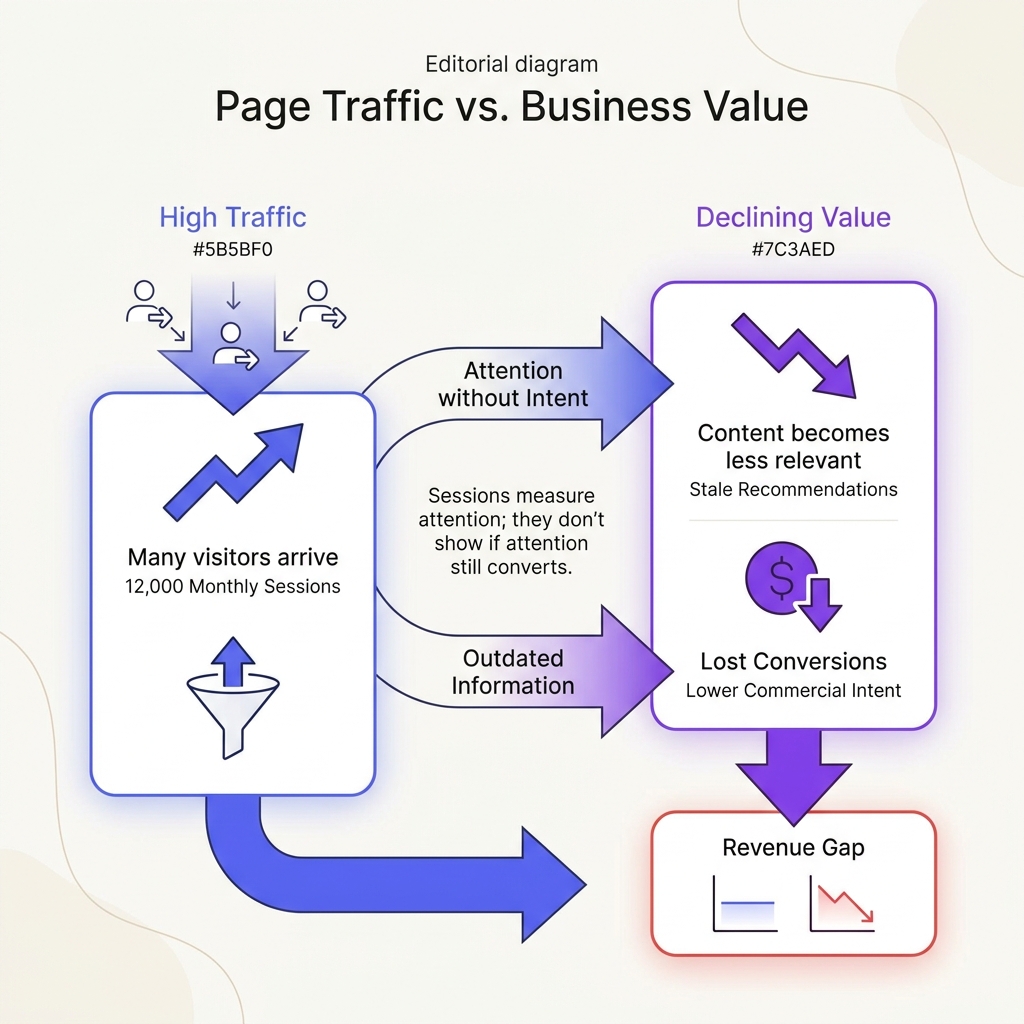
Two affiliate pages can hold the same 12,000 monthly sessions and earn revenue that differs by more than half.
This gap appears in real accounts often—it’s not just a rounding error.
Sessions measure attention; they don’t show whether that attention still converts.
Traffic is not a reliable metric for affiliate marketing and should not be viewed as the only useful measure.
Sessions rise when a page ranks for a broad informational query, even if readers arrive to research, not buy.
A quieter page with lower traffic can carry higher commercial intent and outperform it on commission.
When sorted by sessions, a dashboard masks this change: a page can lose buyer intent while maintaining traffic, and a traffic chart won’t indicate this.
One scorecard, several dimensions
Use a scorecard that reads visibility, engagement, and revenue together, with a review rhythm attached to each.
Publish it next to the page list so maintenance decisions use the same numbers every time.
| Dimension | Metric | What it reveals | Review cadence | Warning sign |
|---|---|---|---|---|
| Visibility | Impressions and qualified rankings | Whether the page remains discoverable for relevant queries | Weekly or monthly | Impressions decline across multiple related queries |
| Engagement | Click-through rate from search; scroll depth | Whether the arriving visitor is the person you wrote for | Monthly | CTR drops while impressions hold steady |
| Commercial intent | Affiliate link click rate per session | Whether the page still routes buyers toward merchants | Biweekly | Link clicks fall while sessions stay flat |
| Revenue | Commission per 1,000 sessions | Whether traffic still turns into income | Monthly | Earnings fall faster than traffic |
| Offer accuracy | Out-of-stock, price, and discontinued-product flags | Whether recommendations match what merchants actually sell | Quarterly | Merchant pages repeatedly show unavailable items |
| Query fit | Ranking position on the head query versus surrounding long-tail terms | Whether you still rank for buying terms, not just research terms | Monthly | Rankings hold on informational terms and slip on commercial ones |
| Refresh status | Days since the last product, price, or claim check | Whether maintenance debt is accumulating | Quarterly | No update across two or more product cycles |
Falling revenue with stable sessions points to offer drift or lost commercial intent, not an algorithm penalty.
Falling impressions points to visibility; both can share the same traffic number.
Set the thresholds before you need them
Decide what triggers action now, since a common pattern is to wait for a dramatic drop before reviewing—by then, the decline is already three months old.
Use concrete thresholds: earnings per 1,000 sessions down 20% (audit offers and links), CTR down for two consecutive months (revise title and intro), two or more ranked terms slipping five positions (investigate visibility), or link clicks falling while sessions hold (check whether search results now serve a different intent).
Thresholds turn maintenance from a judgment call into a scheduled task, so a page that trips one gets reviewed within a week.
The answer is not to publish faster—it is to design for change
Search for affiliate marketing strategies and you will find the same ending everywhere: publish more, and publish faster.
That advice collapses the moment a page starts slipping.
Speed does not repair a structure built to expire, and most affiliate articles are built exactly that way—around spec sheets, prices, and “best of” claims that go stale inside a quarter.
Instead, we should adapt our designs for change, helping to flatten the decay curve without increasing output.
Four design choices carry most of the weight:
- Anchor the article in durable decision criteria. Someone choosing a standing desk wants to know about wobble at height, warranty length, and return shipping. Those criteria outlive any specific model. Write the piece so the reader can make the decision even when today’s featured offer disappears.
- Isolate what expires from what should stay. Keep evergreen explanations (how to evaluate, what to compare, what tradeoffs matter) separate from time-sensitive material like current pricing, availability, and rotating “best” recommendations.
- Make updates cheap and specific. Structure sections so new data can replace old data without rewriting the entire page. When a page slips, you should be able to swap the failing elements—prices, claims, or examples—without disturbing the reasoning.
- Treat performance drift as a signal, not a reason to restart. A falling page isn’t only “behind”—it’s telling you which components have aged. When you respond by redesigning for change, the page stops decaying as quickly because its core framework remains valid.
Imagine your top affiliate page loses half its clicks after a competitor publishes a better comparison
When a competitor publishes a superior comparison post, your top affiliate page may suddenly experience a significant drop in clicks.
This shift could be alarming, yet it’s crucial to respond with a structured analysis rather than immediate edits.
Begin by checking your Google Search Console for shifts in impressions and clicks associated with the affected queries.
Differentiating between a drop in traffic and engagement metrics will guide you in diagnosing the underlying issue correctly.
Assess whether the ranking has changed alongside clicks.
A loss of visibility often indicates that adjustments need to be made to align with current search intent or competitor strategies.
Looking at the week following the drop, thoroughly review the structure of the competitor’s content to discern what elements they improved, which may include updated comparisons, more engaging formats, or enhanced data presentation.
Also, check merchant pages for any changes in product availability or pricing that may have influenced user engagement.
This careful review will help find the best updates and changes needed to restore visibility and keep audience engagement.
What should a sustainable affiliate marketing strategy measure every month?
Most decay appears in metrics that aren’t reviewed regularly.
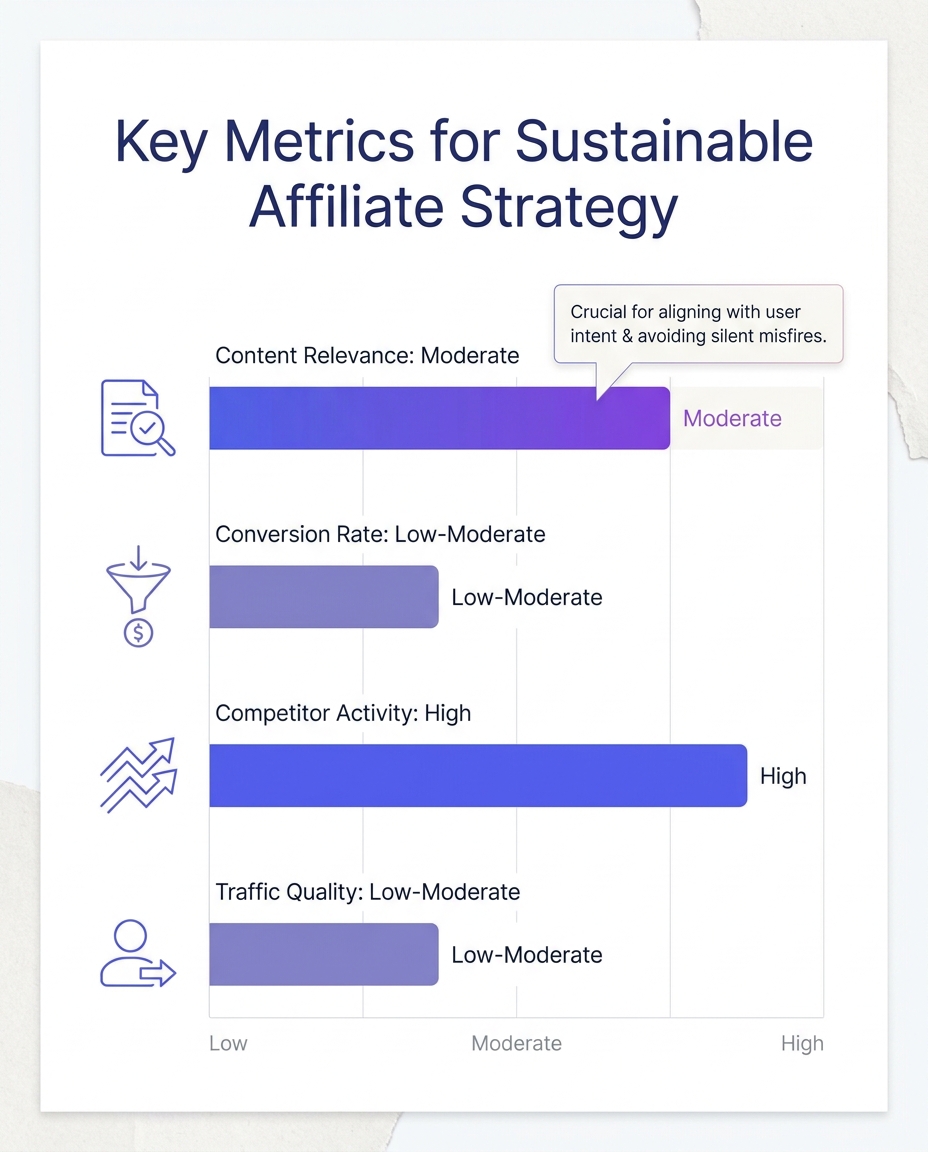
A sustainable affiliate marketing strategy checks five things every month, not weekly: rankings, query relevance, engagement, outbound clicks, and commissions.
These metrics can provide insights into a page’s performance, indicating whether it may be healthy, drifting, or in decline.
Rankings measure where you sit for your main query—simple position tracking that signals whether visibility is holding.
Query relevance tests whether the results page still matches your page’s intent.
It’s a guardrail for “silent misfires,” where traffic can change before the reason becomes obvious.
Engagement adds the behavior layer: time on page, scroll depth, and return visits.
Outbound clicks reveal whether readers still trust your recommendations enough to leave your site.
Commissions then close the loop by tying performance back to revenue per thousand sessions—the number that ultimately funds the work.
To make these signals useful, track them all in one place.
Five tabs of scattered data is how reviews get skipped, and skipped reviews are where problems grow teeth.
Ownership matters as much as the metrics.
What is the best affiliate marketing strategy?
The best affiliate marketing strategy involves proactive ongoing maintenance and tracking performance rather than simply building and ranking new content.
Implementing systems to update content regularly and address decay can help sustain revenue and enhance trust in a creator’s niche.
What is the 3-3-3 rule for marketing?
The 3-3-3 rule for marketing isn’t detailed in the content provided, but successful marketing often focuses on immediate, actionable strategies that include regularly assessing content value, audience engagement, and adapting to changes in consumer behavior.
What is the 80/20 rule in affiliate marketing?
The 80/20 rule in affiliate marketing suggests that 80% of results come from 20% of efforts, signifying that focusing on a small number of high-performance articles or products can lead to the majority of revenue.
Identifying and optimizing these key areas can significantly enhance profitability.
How do I start affiliate marketing as a beginner?
To start affiliate marketing as a beginner, first choose a niche and build a review site focused on your audience’s interests.
Then, create high-quality, evergreen content that can be continually updated, while also monitoring performance to adapt strategies as needed for sustained success.
Decay Is a Design Flaw, Not a Verdict on Your Niche
When a competitor shares a better comparison and your top page loses half its clicks, that drop is information—not a penalty from an algorithm.
The creators who absorb it well are the ones who already wrote down what the page was supposed to do, which queries it owned, and which numbers would signal trouble before revenue did.
That is the shift worth carrying forward: affiliate marketing strategies stop feeling fragile the moment they include a maintenance schedule.
Check your top five pages every month—impressions, click-through rate, conversions per visitor, and the last time each page was meaningfully updated.
Nothing elaborate.
Just a decision criterion written before you need it, so a decline triggers a revision instead of a panic.
When rewriting becomes a bottleneck, Scaleblogger is a tool we created to keep the flow going.
Even so, start with the audit: pick your highest-earning page this week and compare it against a competitor’s newest version.
Update one section, re-date it, and log the baseline numbers you’ll hold yourself to next month.
