

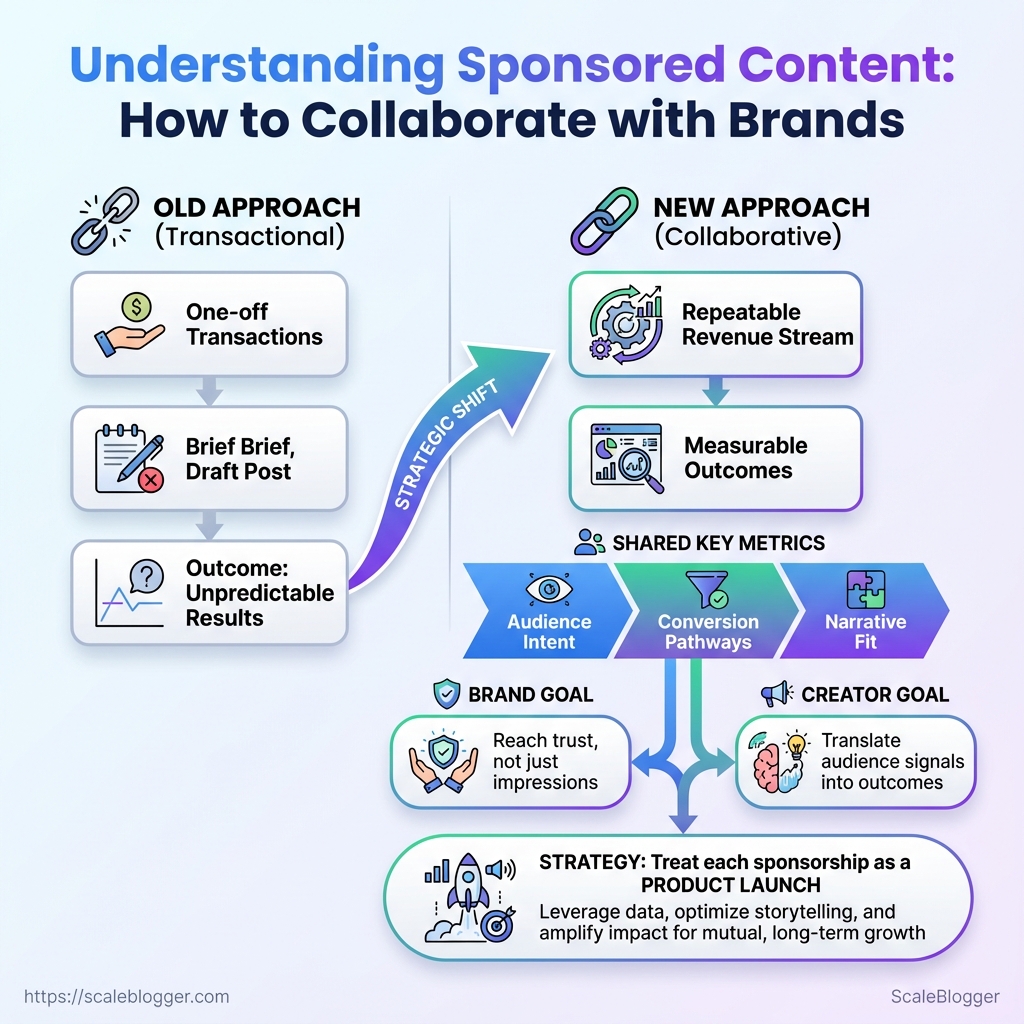
Learning how to collaborate with brands can turn one-off sponsored opportunities into valuable, long-term partnerships.
Successful brand collaborations require more than creating content and sending an invoice. Brands want partners who understand their audience, communicate value clearly, and deliver content that supports campaign goals.
That means knowing how to find suitable brands, pitch your ideas, negotiate rates, define deliverables, manage disclosures, and report campaign results.
With the right sponsored content process, creators can build stronger relationships, demonstrate their value, and create more opportunities for recurring partnerships.
What You’ll Need (Prerequisites)
First, identify your target audience. Next, evaluate your available resources. Finally, figure out what skills you need to pitch sponsored content. Clear audience data, a brief asset package, and basic technical and legal knowledge speed up negotiations and protect brand value.
Below are concrete items to gather and the order to prepare them for a scalable sponsored-content workflow.
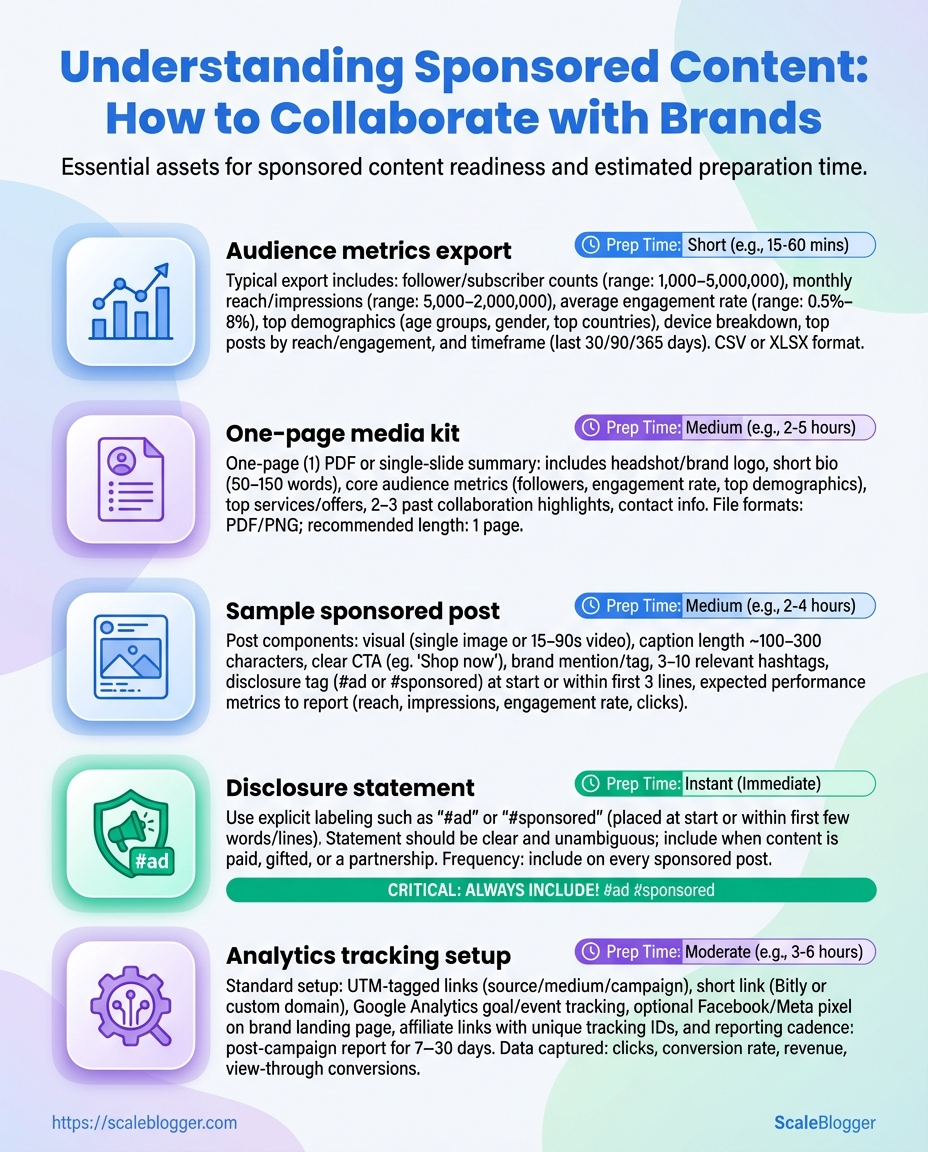
Audience metrics export: Export recent traffic and audience data from Google Analytics or platform insights, including monthly sessions, top pages, and demographic breakdowns.
One-page media kit: A single-sheet that lists audience size, engagement rates, content formats available, and past partner examples.
Sample sponsored post: A live or staged post showing integration style, disclosure placement, and creative flexibility.
Disclosure statement: A standard FTC-compliant disclosure snippet you use at the top of sponsored posts.
Analytics tracking setup: GA4 events or UTM conventions tied to sponsored campaigns for attribution.
- Gather raw audience data from analytics and platform dashboards.
- Build a one-page media kit and match it to each prospect’s needs.
- Produce or update a sample sponsored post demonstrating the integration style.
Tools & capabilities you’ll want ready:
- CMS familiarity: Know how to create, schedule, and edit posts in
WordPress,Squarespace, or your CMS. - Basic SEO skills: Ability to run keyword checks and title/meta description.
- Analytics literacy: Comfortable interpreting engagement metrics and export CSVs.
- Legal awareness: Understand FTC rules on disclosures and basic contract terms.
Common negotiation friction comes from unclear expectations rather than price. Having a rate card helps, but being able to show how sponsored content performs is the real. Contracts should at least cover usage rights, exclusivity windows, and content ownership—legal counsel for high-value deals is recommended.
Required vs. nice-to-have assets for sponsored content readiness
Table: What You’ll Need (Prerequisites) — Asset, Required? (Yes/No), Action to Prepare & more
| Asset | Required? (Yes/No) | Action to Prepare | Estimated Time |
|---|---|---|---|
| Audience metrics export | Yes | Export last 90 days from GA4 and platform insights | 1–2 hours |
| One-page media kit | Yes | Design PDF with audience, rates, formats, case studies | 2–4 hours |
| Sample sponsored post | Yes | Publish or stage a live example with disclosure | 3–6 hours |
| Disclosure statement | Yes | Create standard FTC-compliant text and placement rule | 30 minutes |
| Analytics tracking setup | Yes | Implement UTM, conversion events, reporting dashboard | 2–6 hours |
Key insight: Having these five items eliminates most early-round questions from brands and shortens negotiation cycles; the media kit plus tracked sample post both prove capability and build trust.
Where a content automation partner makes sense, integrate AI-powered reporting and publishing to keep media kits current—Scale your content workflow with automated exports and template media kits. Understanding these pieces lets teams respond to sponsor requests quickly and with confidence.
Step-by-step: Finding and Pitching Brands
The right partners align with your audience, not just your brand size. Focus on brands whose products match your content pillars and audience intent; this alignment makes your pitches more convincing and measurable. Below are concrete steps to find, qualify, pitch, follow up, and track outreach so sponsored content becomes a repeatable revenue channel.
Research and shortlist
- Identify high-fit categories by analyzing top-performing posts and extracting audience intent (purchase, learn, compare).
- Use competitor backlink lists, affiliate disclosures, and social ad libraries to find brands already working with creators in your niche.
- Score each brand on audience overlap, campaign budget signals (recent influencer activity), and creative fit; keep only the top 15% for outreach.
Craft the pitch
- Write a personalized subject line that references a specific asset:
Quick idea for your [campaign/product] — data-backed
- Open with a one-sentence credibility line (traffic, audience demo) then a two-sentence value proposition: what you’ll create, and the measurable outcome.
- Include three concrete metrics: average monthly sessions, email list size/engagement, and conversion examples (e.g., “Research from topgrowthmarketing.com shows that generated 1.8% affiliate conversion on product roundup.”).
- Attach a short case study (one paragraph) and a clear call to action: request a budget range or propose two campaign windows.
Follow-up cadence
- Send first follow-up at 3 business days.
- Second follow-up at one week with a fresh creative angle.
- Final nudge at two weeks offering a limited slot or reporting template.
Track responses and iterate
- Create a tracking sheet with status, contact, pitch version, replies, and next step.
- Tag outreach by pitch variant to see which subject lines and value props convert best.
- Roll successful messaging into templates and automate sequencing where scale justifies it.
Practical tips:
- Personalization: Reference a recent campaign or product launch.
- Clarity: Propose deliverables and timelines in bullets.
- Proof: Include a screenshot or link to a live sponsored post.
Outreach channels (email, LinkedIn, influencer platforms, PR agencies) for conversion likelihood and effort
Table: Step-by-step: Finding and Pitching Brands — Channel, Conversion Rate (expected), Effort Level & more
| Channel | Conversion Rate (expected) | Effort Level | Best Use Case |
|---|---|---|---|
| Email outreach | 10–25% (warm lists) | Medium | Direct brand contacts, high-value deals |
| LinkedIn messaging | 5–15% | High | B2B partnerships, senior marketing contacts |
| Influencer marketplaces | 3–12% | Low | Transactional placements, standardized briefs |
| PR agency outreach | 15–30% | Very High | Large integrated campaigns, retainer deals |
| Cold social DMs | 1–5% | Low | Emerging brands, quick tests |
Key insight: Email and PR agency outreach generally yield higher conversion when relationships or budgets exist, while marketplaces and DMs scale quickly but convert at lower rates. Track channel-level win rates to allocate effort proportionally.
Using this framework turns one-off pitches into a machine that learns which messages and channels produce revenue. When implemented correctly, this approach reduces overhead by making outreach data-driven and repeatable.
Step-by-step: Negotiation and Pricing
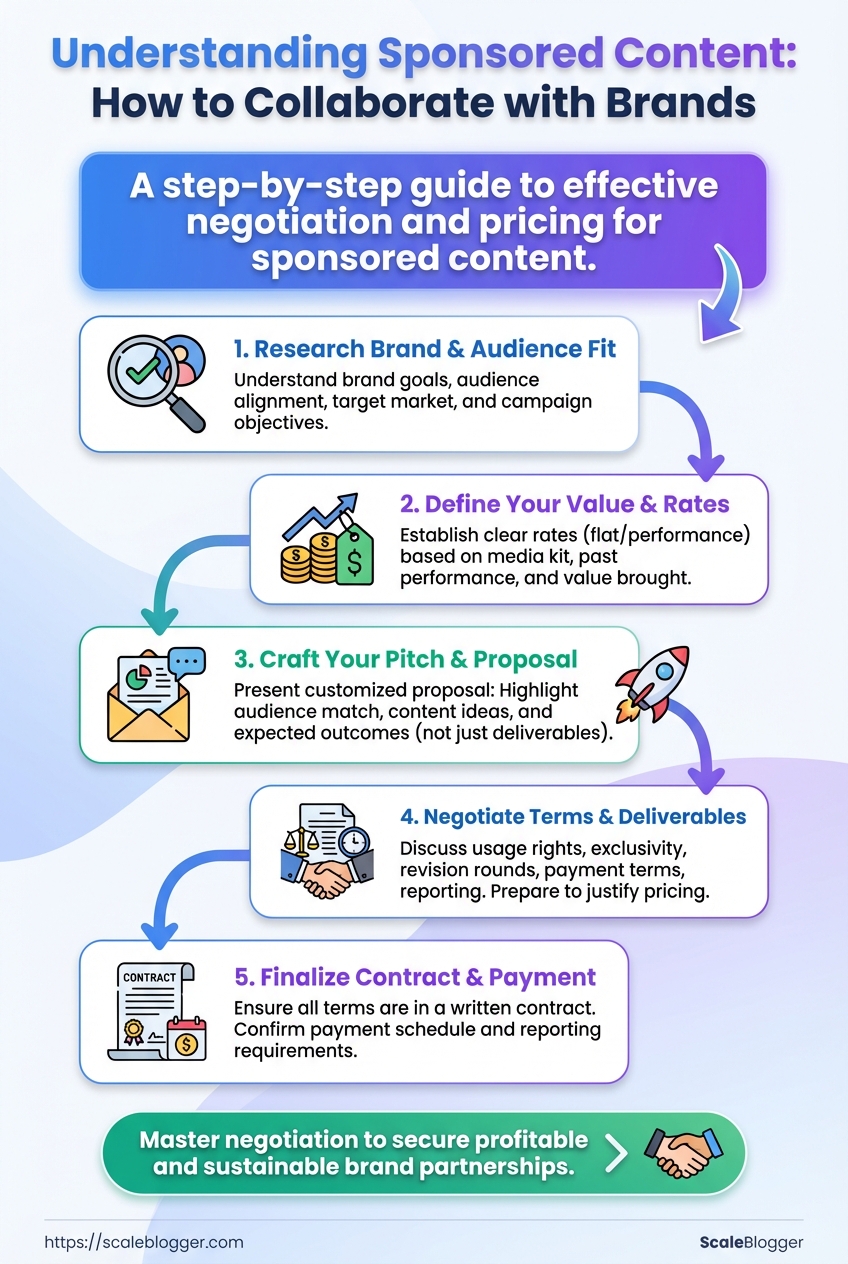
Negotiation and pricing transform months of audience-building into reliable income. Begin by turning your time, expenses, and value into clear rate formulas. Then, use these numbers to create a straightforward proposal and simple contract terms to protect both sides. Clearly state deliverables, revision limits, usage rights, and payment schedules.
This helps keep negotiations focused on trade-offs: more exposure for lower fees, quicker turnaround for higher rates, or exclusive usage for premium pricing.
Use transparent math and preset concessions to avoid ad-hoc discounts that erode margins.
Rate calculations, formulas, and examples
- Calculate your baseline hourly cost.
- Estimate annual income target and divide by billable hours:
Hourly = Annual target / Billable hours.
- Convert hours to project rates.
- Multiply estimated hours by
Hourlyand add a 20–40% buffer for research, revisions, and coordination:Project = Hours Hourly 1.25.
- Add value-based premiums.
- For sponsored content, add a traffic premium tied to monthly UV (e.g., +10% per 50k UV) and an exclusivity multiplier (×1.5 for 30-day exclusivity).
- Package rates into deliverables (use the table below for examples).
- Round to clean numbers and set a cadence for review (quarterly).
Example calculation: if Hourly = $100, estimated work = 8 hours, buffer 25% → Project = 8 $100 1.25 = $1,000. According to social media collaboration data, add a traffic premium of 20% for mid-range audience → final = $1,200.
What to include in a compact proposal
- Project scope: Exact deliverables and word counts.
- Timeline: Draft, revision, and publish dates.
- Usage rights: Duration and channels (web, syndication, social).
- Performance expectations: Optional KPIs or reporting cadence.
- Payment terms: Deposit %, milestones, and late fees.
Common negotiation tactics and concessions
- Anchor high: Start above your target so concessions land at acceptable levels.
- Bundle strategically: Offer add-on social packages instead of blanket discounts.
- Limited concessions: Trade a small price discount for a longer usage term or backlink.
- Walk-away clarity: Have a minimum acceptable rate and be ready to decline.
Contract basics and payment schedules
Scope: Define deliverables, revisions, and excluded work.
Revisions: Typically 1–2 rounds included; additional rounds billed hourly.
Payment terms: Standard is 50% deposit, 50% on delivery; alternatives include Net 15/30 for trusted partners.
Usage rights: Specify exclusive vs. non-exclusive, time limits, and resale permissions.
Sample rate card showing typical prices by blog size, content type, and deliverable
Table: Step-by-step: Negotiation and Pricing — Blog Size (monthly UV), Sponsored Blog Post, Social Package (IG/Twitter) & more
| Blog Size (monthly UV) | Sponsored Blog Post | Social Package (IG/Twitter) | Video/Long-form Content |
|---|---|---|---|
| 5k–20k | $500–$1,000 | $200 (3 posts) | $1,200–$2,500 |
| 20k–100k | $1,200–$3,000 | $400 (5 posts + assets) | $2,500–$6,000 |
| 100k–500k | $3,500–$8,000 | $800 (content + paid promo) | $6,000–$18,000 |
| 500k+ | $10,000+ | $1,500+ (strategy + ads) | $20,000+ |
| Niche-specialist premium | $2,500–$15,000 | $500–$2,000 (targeted amplification) | $5,000–$25,000 |
Key insight: Rates scale with reach and niche expertise; social add-ons and exclusivity materially increase price, and video/long-form work commands a significantly higher premium due to production costs and distribution value.
Understanding these mechanics makes negotiations far less emotional and far more strategic. When pricing and contract terms are tight, teams move faster and partnerships start on clearer footing. This is why precise rate formulas and compact proposals are core to turning content into reliable revenue.
Key Takeaway: Begin with a focused creative brief. Then, ensure quality control during production and follow disclosure rules.
Step-by-step: Creating Sponsored Content that Converts
Begin with a focused creative brief. Then, ensure quality control during production and follow disclosure rules. Check each asset for search intent and start tracking performance from day one. These five steps will convert a partnership idea into tangible business results.
- Creative brief essentials
Write the brief as a decision document, not a wish list.
Objective: Single sentence that ties the post to a business goal (awareness, leads, or sales).
Target audience: Persona, pain point, and intent.
Primary message: One clear claim the sponsor must own.
Deliverables & formats: List assets (long-form post, social snippets, carousel).
Tone & creative constraints: Examples of language to use and avoid.
Provide one concrete KPI and an acceptance checklist so approvals are not subjective.
- Production QC checklist
Use a pre-publish checklist to eliminate rework and legal risks.
- Headlines: match the brief and include the sponsor value proposition.
- Fact-checks: verify claims, product names, and specifications.
- Assets: alt text, image credits, and license proof.
- Formatting: headings, schema, and internal links.
- Brand alignment: sponsor logos, colors, and approved quotes.
Include a final proofread pass and a timestamped sign-off from editorial and legal.
- FTC disclosure best practices
Make disclosures obvious, proximal, and in plain language.
Disclosure: This post was sponsored by SponsorName.
Place disclosure at the top of the article and again before any affiliate or purchase links. Use verbatim phrases like sponsored by or paid partnership rather than vague wording. For social, use platform-specific tags plus clear text in the caption.
- SEO optimizations for sponsored posts
Treat sponsored posts like any high-value content but with added constraints.
- Keyword alignment: target a low-competition, high-intent phrase that complements the sponsor’s funnel.
- On-page: include keyword in title, first 100 words, H2s, and meta description.
- Schema: use
Articleschema andsponsorproperties where supported. - Internal links: link to relevant core content and evergreen hubs to boost topical authority.
Consider using an AI content pipeline to scale versioning and rapid A/B headline tests.
- Measurement setup (UTMs & KPIs)
Instrument every link before publish. Use utm_source, utm_medium, and utm_campaign consistently, and add utm_content for creative variants. Track traffic, engagement (time on page, scroll depth), leads, and conversion value.
Set up goal funnels in analytics and mirror them in the sponsor’s dashboard for shared transparency.
Understanding these production, legal, SEO, and measurement disciplines closes the loop between creative work and commercial outcomes. When teams adopt this sequence, sponsored campaigns move from a one-off effort to a predictable revenue channel.
Key Takeaway: Start by treating post-delivery as the start of the campaign’s commercial lifecycle, not the finish. The following steps move a completed asset through quality assurance, early performance reporting, a structured debrief with the brand, and a…
Step-by-step: Deliverables, Reporting, and Renewals
Start by treating post-delivery as the start of the campaign’s commercial lifecycle, not the finish. The following steps move a completed asset through quality assurance, early performance reporting, a structured debrief with the brand, and a renewal pitch that scales into a case study. This sequence protects revenue, builds trust, and creates reusable proof for future deals.
- Step 16 — Delivery checklist: final QA, assets, and handoff
- Step 17 — Week 1 report: initial performance snapshot and quick optimizations
- Step 18 — Week 2–4 follow-up: engagement analysis and iterative improvements
- Step 19 — Week 4–8 full report and debrief: narrative report, ROI metrics, and creative notes
- Step 20 — Week 8+ renewal outreach and case study creation
Delivery QA items: Content integrity: Confirm headline, body, CTAs match the approved brief and brand voice.
Asset completeness: Ensure image sizes, captions, metadata, and UTM-tagged links are present.
Technical checks: Verify page load, schema markup, and canonical tags where applicable.
Tracking: Confirm analytics events, conversion pixels, and campaign UTM parameters are firing.
Report structure and metrics to highlight
- Executive snapshot: Two-line conclusion and a one-paragraph recommendation. Exposure: Impressions, referral traffic, and earned media placements. Engagement: Time on page, scroll depth, social shares, and comment sentiment.
- Conversion: Click-throughs, lead form fills, coupon redemptions, and assisted conversions. Value: Estimated media value and comparative CPM/CPA where applicable.
How to request and use brand feedback
- Be specific: Ask for reaction to creative, CTA clarity, and perceived fit with audience.
- Provide context: Attach heatmaps or short clips showing user behavior before asking for opinion.
- Close the loop: Incorporate feedback into a single updated deliverable and call out changes in the follow-up report.
Positioning for renewals and long-term deals
- Lead with impact: Use early wins (top metrics) to justify next-phase investment.
- Offer options: Present 3 renewal tiers — continuity, optimization, and expansion — with clear outcomes.
- Lock timing: Propose renewal outreach 2–4 weeks before contract end to avoid churn.
Case study creation
- Permission: Secure rights to publish results and customer quotes.
- Narrative: Problem → approach → metrics → creative lessons.
- Assets: Pull screenshots, campaign timeline, and a 2-slide summary for quick sales use.
Post-campaign timeline from delivery to renewal pitch
Table: Step-by-step: Deliverables, Reporting, and Renewals — Day/Week, Action, Responsible Party & more
| Day/Week | Action | Responsible Party | Deliverable |
|---|---|---|---|
| Delivery day | Final QA & asset handoff | Content lead | Final assets, tracking checklist |
| Week 1 | Initial performance snapshot | Analytics specialist | 1-page quick report |
| Week 2–4 | Follow-up & optimization | Campaign manager | Update with A/B insights |
| Week 4–8 | Full report & debrief | Account director | Narrative report + recommendations |
| Week 8+ | Renewal outreach | Sales/Partnerships | Renewal proposal + case study draft |
Key insight: A structured post-delivery timeline turns transient campaign data into negotiation; delivering quick wins in week 1 and a compelling narrative by week 4–8 materially improves renewal close rates.*
For repeatable workflows, standardize the checklist in your CMS or use an AI content pipeline like Scaleblogger.com to automate tracking and reporting. Implemented cleanly, this sequence minimizes friction and converts campaign output into sustained partnerships.
Key Takeaway: Most production slowdowns come from predictable friction points: mismatched expectations, broken automation, SEO regressions, quality drift, and legal or platform conflicts. Address each quickly with the same pattern—diagnose, apply an immediate…
Troubleshooting Common Issues
Most production slowdowns come from predictable friction points: mismatched expectations, broken automation, SEO regressions, quality drift, and legal or platform conflicts. Address each quickly with the same pattern—diagnose, apply an immediate corrective step, use a short communication script for stakeholders, escalate if needed, and add one prevention tactic so it doesn’t recur.
Five frequent problems and how to fix them (diagnose → immediate fix → communication → escalate → prevent)
1) Mismatched editorial expectations Diagnose: Deliverables differ from brief; tone or scope is off. Immediate fix: Re-issue a concise brief and assign a single editor to rework the top-priority pieces. Communication template: “There’s a gap between the brief and the current draft on X.
” Escalation: If repeated, escalate to content lead with documented brief vs. final examples. Prevention: Standardize a one-page brief-template and require sign-off before assignment.
2) Automation failures (publishing pipeline breaks) Diagnose: Jobs fail at export, formatting, or CMS ingest steps. Immediate fix: Restart the pipeline step where logs show ERROR; push the content manually if needed. Communication template: “Automated publish failed at step X due to Y.
” Escalation: Open a support ticket with the automation provider and attach error logs. Prevention: Add synthetic smoke tests and alerting on publish_error events; keep a manual publish SOP.
3) Sudden organic traffic drop (SEO regression) Diagnose: Identify pages with traffic loss and check recent edits, canonical tags, and robots rules. Immediate fix: Revert the last content/markup change on the highest-impact page and re-run indexing. Communication template: “Observed ~X% traffic decline on pages A–C after recent update.
” Escalation: Contact the SEO tooling vendor or platform support if re-indexing stalls. Prevention: Use staging audits and automated SEO checks before push.
4) Quality drift / inconsistent voice Diagnose: Multiple authors diverge on brand voice markers. Immediate fix: Run a voice-check pass: unify headlines, intro, and CTAs; appoint a single reviewer for the batch. Communication template: “We found voice inconsistencies across the batch.
” Escalation: Schedule a calibration session with writers and leadership. Prevention: Maintain a living style guide and integrate content-scoring checks in the CMS.
5) Legal or brand-safety flags (claims, trademarks, sponsored content issues) Diagnose: Copy contains unverifiable claims or inadequate disclosure for paid content. Immediate fix: Remove or qualify the claim and add or fix the sponsored disclosure. Communication template: “Flagged language in section X needs citation or removal.
” Escalation: Escalate immediately to legal and platform support with time-stamped assets. Prevention: Add a pre-publish legal checklist and require sponsored field populated in the CMS.
Practical escalation steps (when to call it in)
- Document the incident with screenshots, timestamps, and error logs.
- Notify the platform/vendor via their support channel and provide the documented evidence.
- Loop in legal or compliance only when content has potential regulatory or contractual risk.
- Switch to a manual workflow and label affected assets as
on_holduntil resolved.
Common prevention tactics:
- Automated tests: Smoke tests for publishing, SEO, and accessibility. Single-owner edits: One person signs off on voice and facts. Pre-publish checklists: Include legal, sponsored disclosures, and canonical checks.
- Runbook: Keep an editable incident runbook for recurring failure modes.
Using these steps keeps incidents short and makes resolution repeatable. When teams adopt the same troubleshooting pattern, operations scale without creating bottlenecks, and creators focus on impact rather than firefighting. For teams seeking automation to reduce manual steps, consider integrating an AI content automation pipeline to handle smoke tests and content scoring.
Tips for Success & Pro Tips
Treat content as a repeatable process: document every decision point, measure outcomes constantly, and automate routine tasks to let people concentrate on creativity. Teams that scale content successfully operate with tight SOPs for ideation → production → distribution, a data-first feedback loop that nudges topic selection and format choices, and a sponsorship pipeline that treats partners as repeat collaborators, not one-off checks. Build predictable throughput by codifying handoffs, enforcing brief templates, and instrumenting every asset with performance signals so optimization becomes routine rather than reactive.
SOPs to standardize content production
Create crisp, single-source-of-truth SOPs that minimize context switching and reduce review cycles.
- Draft an editorial brief template and require it before ideation.
- Create a production checklist that includes
target intent,primary keyword,cluster links,visual assets, andCTA.
- Define a single canonical review process with timed rounds (draft → subject-expert review → SEO pass → legal check).
- Brief-first approach: Ensure every brief defines target persona and KPI.
- Time-boxed reviews: Limit each review round to 48–72 hours to keep cadence.
- Content scoring: Use a simple 0–100 rubric for completeness, SEO, and originality.
Content Score: A numeric rubric combining on-page SEO, topical coverage, and readability to prioritize refreshes.
Editorial Brief: A concise doc that states goals, angle, keywords, and desired distribution channels.
Scaling partnerships and sponsorships
Systemize sponsor ops so deals scale without ad-hoc chaos.
- Build a sponsor handbook with tiers, deliverables, and pricing bands.
- Create reusable creative blocks (sponsored intro, mid-roll CTA, branded sidebar) that map to tiers.
- Automate invoicing and reporting with templates that pull performance metrics.
- Repeatable packages: Offer three predictable tiers to reduce negotiation friction.
- Transparent metrics: Share baseline performance and uplift targets in the pitch.
- Long-term cadence: Propose rolling 3–6 month programs, not single posts.
Sponsorship Pipeline: A CRM view of prospects with lifecycle stages (prospect → pitch → contract → live → renewal).
Data-first optimization habits
Instrument every post with measurable signals and iterate weekly.
- Event tagging: Track micro-conversions like time-on-section and CTA clicks.
- A/B small bets: Test headlines, intro hooks, and meta descriptions first.
- Refresh triggers: Prioritize updates when organic traffic drops 10% or engagement falls 15%.
AI content automation to scale repetitive tasks and to predict content performance before publishing: topic clustering and semantic optimization reduce guesswork and accelerate experimentation. When performance data feeds editorial decisions, resources allocate to what actually moves metrics.
Compliance & transparency
Document affiliate relationships, disclose sponsored content clearly, and maintain an approvals log for legal reviews.
- Clear disclosure: Place disclosures where users naturally look (above-the-fold or within the intro).
- Recordkeeping: Keep signed agreements and creative approvals in a shared folder.
- Audit cadence: Run quarterly compliance reviews with legal and editorial stakeholders.
Understanding these patterns makes scaling predictable and sustainable, freeing the team to invest time in higher-value strategic work. When systems are in place, growth happens by design rather than by luck.
Quick reference table of templates and where to host/download them
Table: Appendices: Templates, Checklists, and Resources — Resource, Format, Purpose & more
| Resource | Format | Purpose | Suggested Host |
|---|---|---|---|
| Outreach email template | .docx / .txt | Standardize pitch messaging | Google Drive |
| Media kit template | .pptx / .pdf | Present audience and packages | Dropbox |
| Contract clause snippet | .docx | Legal disclosures & usage rights | Google Drive |
| Campaign report CSV | .csv | Importable campaign metrics | GitHub Gist / Google Drive |
| UTM builder guide | .md / Spreadsheet | Enforce campaign naming conventions | Scaleblogger.com |
Key insight: Host canonical copies in a shared, version-controlled location so contributors always pull the latest templates. Standardized headers in CSVs and strict utm_ naming cut analysis time and reduce attribution errors.
Understanding these assets and where to keep them helps teams move faster without sacrificing quality. When implemented correctly, this approach reduces overhead by making decisions at the team level.
Conclusion
Treat brand partnerships as a repeatable system rather than a one-off hustle. Make your pitch consistent, focus on important metrics like engagement and conversions rather than just reach, and clearly outline deliverables so brands understand what they are purchasing. com/blog/branding-for-bloggers/” class=”internal-link”>sporadic deals into predictable revenue streams — for example, a niche food blogger who moved from ad-hoc bids to a three-tier sponsorship menu and doubled renewal rates within six months.
Use these sponsored content tips to refine how you collaborate with brands and to make monetizing blog partnerships a predictable part of your editorial calendar.
