

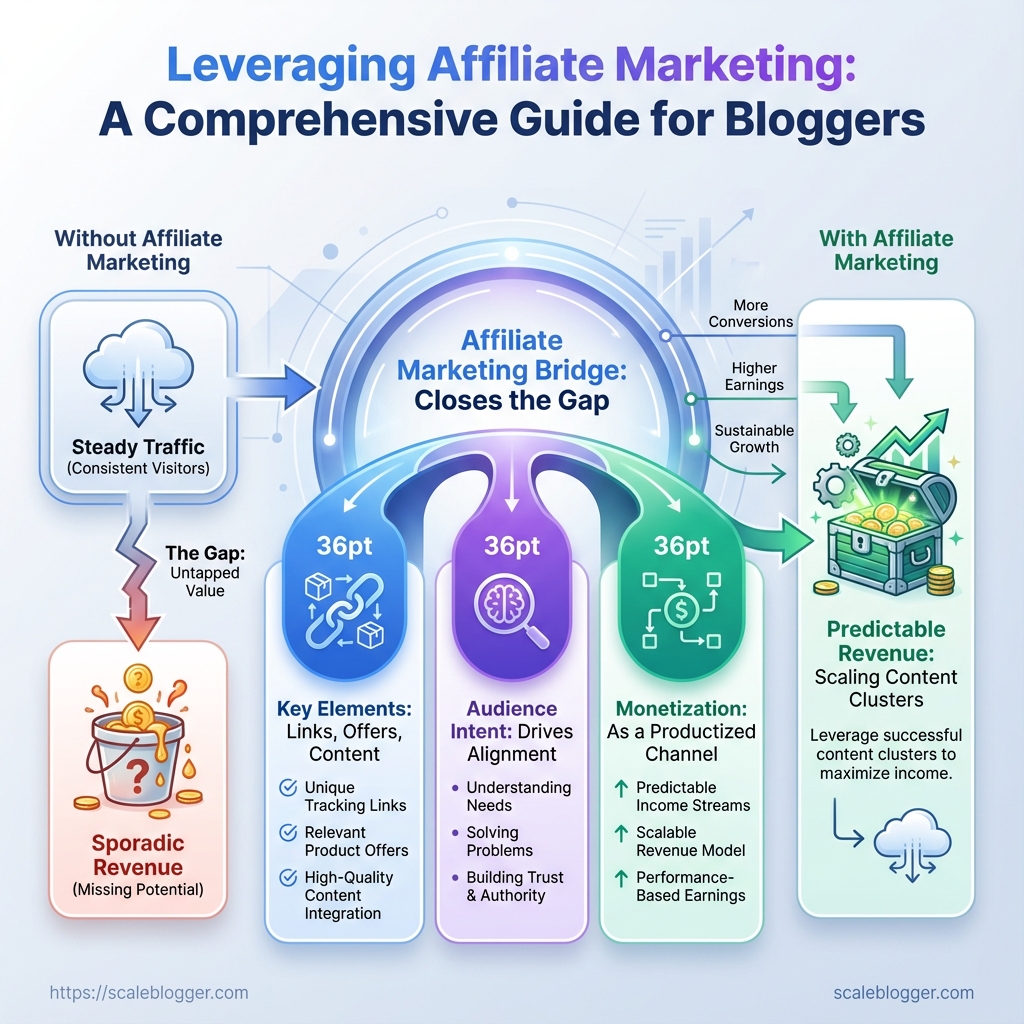
Leveraging affiliate marketing can turn consistent blog traffic into revenue by connecting readers with products and services that genuinely match their needs.
Success isn’t about adding affiliate links wherever they fit. A strong affiliate marketing strategy connects audience intent with relevant offers, useful content, and well-placed recommendations.
From selecting the right affiliate programs to creating comparison content, tracking conversions, and optimizing CTAs, every part of the process should help readers make informed decisions.
When done well, affiliate marketing can create a sustainable revenue stream without sacrificing the trust and editorial quality that brought readers to your blog in the first place.
Table of Contents
Prerequisites & What You’ll Need
Starting an affiliate-ready blog requires clear ownership, effective measurement, and reliable tools. Start by securing control of the publishing environment, tracking user behavior with GA4, and registering with one or two affiliate networks — then layer in email capture and basic SEO/copy skills so content converts.
Blog CMS: You need ownership of your CMS and hosting, along with the ability to install plugins and edit theme files.
Analytics (GA4): A GA4 property and GTM/snippets installed site-wide for event tracking and conversion funnels.
Email provider: An ESP account configured with list segments and at least one automated welcome sequence.
Affiliate accounts: Registered and verified accounts with networks you plan to use (Amazon Associates, ShareASale, Impact).
Link management: A link-shortening / cloaking plugin or service to track clicks and handle redirects.
Practical checklist to get started
- Domain & hosting: Own the domain and a hosting account with FTP/cPanel access.
- Admin-level CMS access: Install plugins like SEO, caching, and link management.
- Analytics and tracking: Configure
GA4and set up conversion events.
- Email capture: Embed forms and connect to an ESP; create a basic lead magnet.
- Affiliate registration: Complete tax verification and payment setup for networks.
Step-by-step initial setup
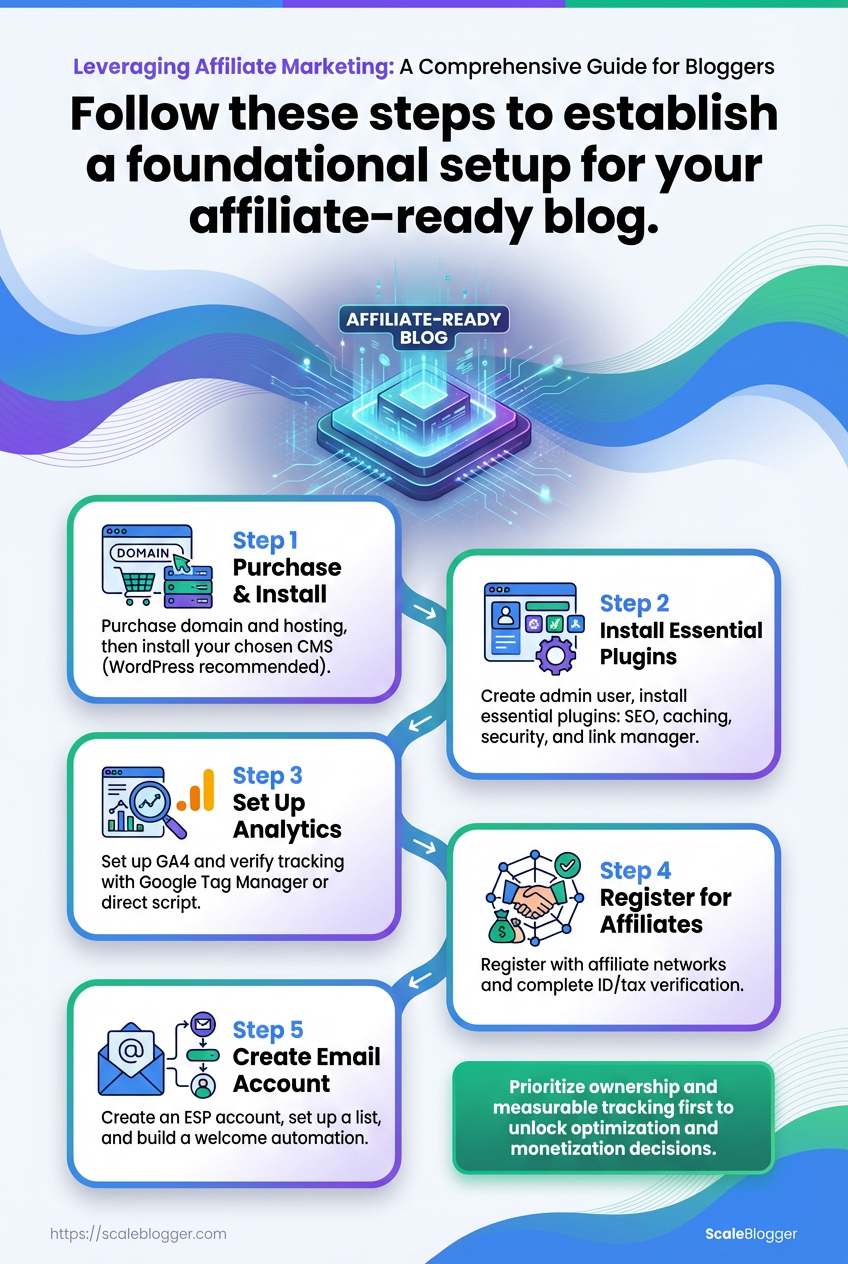
- Purchase domain and hosting, then install your chosen CMS (WordPress recommended).
- Create admin user, install essential plugins: SEO, caching, security, and link manager.
- Set up
GA4and verify tracking with Google Tag Manager or direct script. - Register with affiliate networks and complete ID/tax verification.
- Create an ESP account, set up a list, and build a welcome automation.
Required tools and accounts with why each is needed and approximate setup time
Table: Prerequisites & What You’ll Need — Tool/Account, Purpose, Required action & more
| Tool/Account | Purpose | Required action | Estimated setup time |
|---|---|---|---|
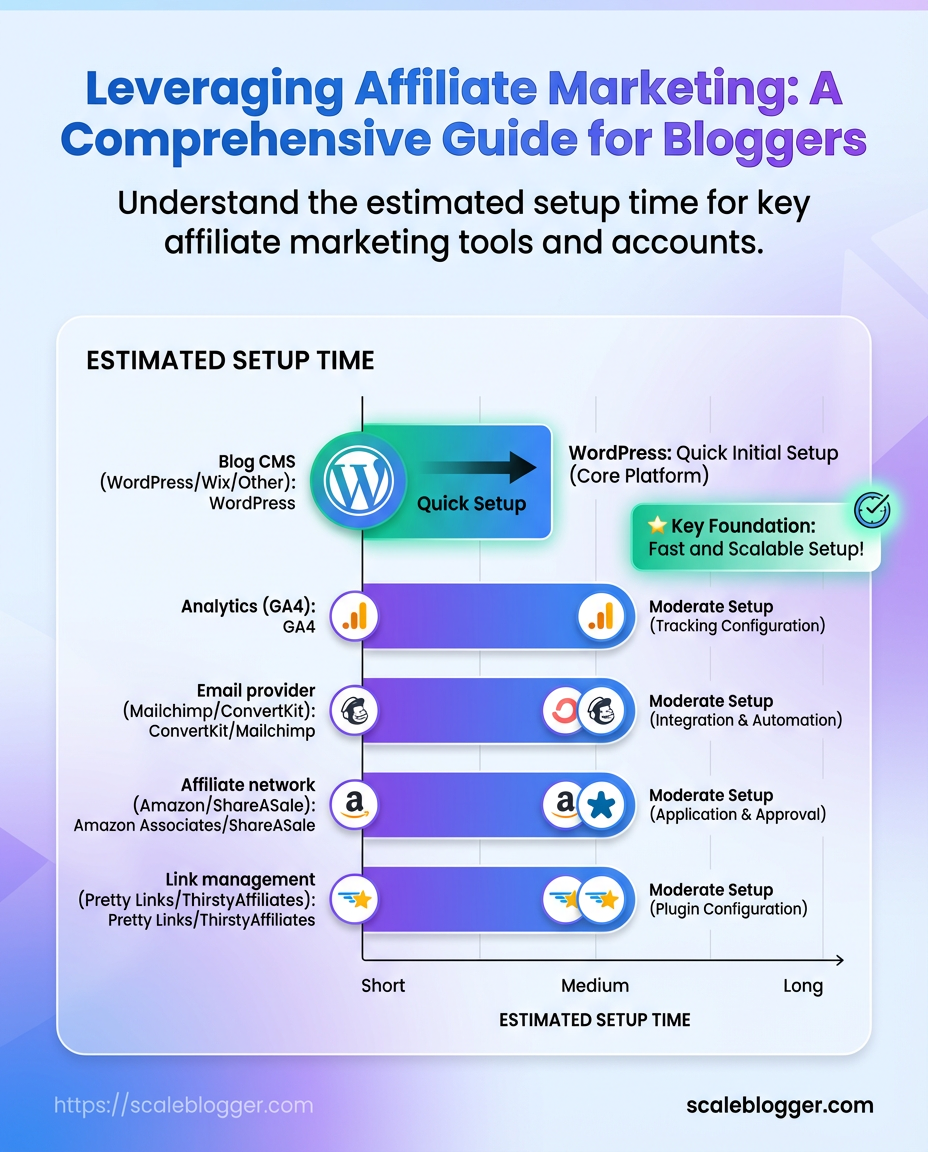
| Blog CMS (WordPress/Wix/Other) | Publish and manage posts; plugin support | Install CMS, configure theme, enable plugins | 1–3 hours |
| Analytics (GA4) | Track traffic, events, conversions | Create property, add tag or GTM, verify events | 30–90 minutes |
| Email provider (Mailchimp/ConvertKit) | Capture leads, automate nurture | Create account, embed signup forms, build sequence | 1–2 hours |
| Affiliate network (Amazon/ShareASale) | Monetization, product sourcing | Register, verify tax/payment, get links | 1–4 hours |
| Link management (Pretty Links/ThirstyAffiliates) | Manage affiliate redirects and tracking | Install plugin, configure redirect patterns | 15–45 minutes |
Key insight: Prioritize ownership (domain/CMS) and measurable tracking (GA4) first — they unlock optimization and monetization decisions that follow.*
Understanding these prerequisites lets teams move faster without sacrificing quality, and creates a stable foundation for automation and scaling. Scale your content workflow by automating repetitive setup tasks where possible.
Step-by-step: Selecting Profitable Affiliate Programs
Focus first on niche relevance rather than just high commission rates. A lower-commission product that fits your audience will convert better and have more long-term value than a mismatched expensive product. Assess brand reputation and policy stability next, then run conservative revenue math to rank programs by expected return, not by promise.
- Research niche fit and audience intent.
- Check program stability and merchant reputation.
- Calculate a conservative revenue estimate for each program.
- Prioritize programs by expected monthly revenue per 1,000 targeted visitors.
- Test conversion with a small content campaign and iterate.
Program fit: Match the product category to your content intent and audience purchase stage.
Brand reputation: Confirm merchant support, refund policy, and payout reliability.
Conservative revenue estimate: Use conservative conversion and AOV figures to avoid optimism bias.
Use these practical checks when evaluating each opportunity:
- Audience alignment: Does this solve a clear problem readers already search for?
- Payout clarity: Are commission terms, cookie duration, and minimums transparent?
- Recurring vs one-time: Recurring revenue favors long-term content investment.
- Sales funnel compatibility: Does the product require heavy pre-sale education or is it impulse-friendly?
- Compliance & policy fit: Can the program be promoted with your existing content and ad rules?
Side-by-side comparison of top affiliate programs for quick selection
Table: Step-by-step: Selecting Profitable Affiliate Programs — Program, Commission Rate, Cookie Duration & more
| Program | Commission Rate | Cookie Duration | Best for (product type) | Notes |
|---|---|---|---|---|
| Amazon Associates | 1–10% (category dependent) | 24 hours | Physical products (ecommerce) | Massive SKU range, high conversion, low rates |
| ClickBank | 10–75% (many 50% offers) | 60 days | Digital products (courses, ebooks) | High commissions, variable product quality |
| CJ Affiliate | Varies by advertiser | Varies (typically 30–90 days) | Mixed (brands & retailers) | Enterprise network, strong reporting |
| ShareASale | Varies by merchant | Varies (30–90 days common) | Small-to-mid ecommerce brands | Good for niche merchants and specialty equipment |
| Impact | Varies by advertiser | Varies | SaaS, subscription, commerce | Enterprise-friendly tracking and partner management |
| PartnerStack | 10–30% recurring | 30–90 days | SaaS monthly subscriptions | Focused on B2B SaaS partnerships and recurring payouts |
| Rakuten Advertising | Varies by retailer | Varies | Retail & branded goods | Large retailers, stable brand partnerships |
| Awin | Varies | Varies | Mixed (travel, retail, finance) | Global reach with many vertical-specific programs |
| Course creators (direct) | 20–50% | 30–90 days | Digital courses | Higher AOV, requires trust-building content |
| High-ticket software (direct offers) | $200–$2,000 per sale or 20–50% | 30–90 days | High-ticket software / consultants | Big payouts, lower conversion — best with demo/trial funnels |
Key insight: Programs that convert depend on match to audience and funnel complexity. High commissions mean little if the product requires months of B2B selling; recurring SaaS offers and well-reviewed digital products often outperform single high-ticket referrals when content drives ongoing trust.
When running the numbers, use conservative conversion rates (0.5–2% for awareness content) and realistic average order values; that discipline separates guesswork from prioritised, testable program selection. Integrate automated tracking into your content pipeline so decisions are data-driven and repeatable—this is how teams scale affiliate revenue without overcommitting to unproven partners.
Step-by-step: Content Strategy & Funnel Design
Design content that converts by mapping formats to user intent and instrumenting conversion events at each stage. Start by separating Top (awareness), Middle (consideration), and Bottom (decision) funnel outcomes, then assign formats, CTAs, and measurement for each. This reduces wasted effort and creates predictable pipelines from search to sale.
- Define funnel outcomes and target metrics.
- Map audience intent to content formats and CTAs.
- Build topic clusters that progress users from broad queries to purchase-ready pages.
- Add conversion mechanics (email capture, trials, product comparisons) at mid/bottom funnel nodes.
- Automate publishing and measurement, then iterate on gaps.
Top-funnel: Create discoverable content that educates and ranks for broad queries. Format: long-form guides, explainers, listicles. Primary goal: traffic and awareness.
- CTA: soft engagement — follow, download a checklist, sign up for updates.
Mid-funnel: Turn curiosity into consideration with comparative content and lead capture. Format: how-to series, comparison posts, interactive quizzes. Primary goal: capture intent signals and emails.
- CTA: gated templates, email-subscription sequences, webinar sign-ups.
Bottom-funnel: Convert by removing friction and proving value. Format: product reviews, case studies, ROI calculators. Primary goal: final purchase decision.
- CTA: demo request, discount code, direct checkout link.
Practical example — affiliate-style review funnel:
- Top: “Best blog software for scaling” (guide).
- Mid: “Tool A vs Tool B — features & pricing” (comparison with gated spreadsheet).
- Bottom: “How I set up revenue-driving blog automation with Tool A” (case study + affiliate CTA that includes discount).
Implement email capture in the mid- and bottom-funnel by testing at least two mechanisms:
- Inline opt-in: short form near useful content.
- Gated asset: high-value checklist or template.
- Behavioral trigger: exit intent or time-on-page popup tied to
utmparameters.
Measure using a simple funnel metric set: organic visits → engaged sessions (time or scroll) → email captures → trial/sign-ups → purchases. Automate the workflow where possible; link your content scoring and performance dashboard to publishing so underperforming topics get re-optimized automatically. Tools and approaches range from editorial calendars with rules to full AI pipelines that draft,, and publish — for teams looking to scale, Scale your content workflow provides AI-powered automation and performance benchmarking.
Understanding these steps enables the team to target the right format for intent, capture leads where they’re most receptive, and shorten the path to conversion. When implemented correctly, this reduces wasted content and accelerates measurable ROI.
Key Takeaway: High-converting affiliate posts start with a clear reader-first promise and end with a frictionless path to purchase. Begin by deciding the single outcome you want from the page—clicks to a product, email signups that unlock an offer, or direct buys…
Step-by-step: Creating High-Converting Affiliate Content
High-converting affiliate posts start with a clear reader-first promise and end with a frictionless path to purchase. Begin by deciding the single outcome you want from the page—clicks to a product, email signups that unlock an offer, or direct buys through your link—and design every element to reduce friction toward that outcome. That means transparent disclosures above the fold, concise recommendations where readers expect them, and multiple, well-placed CTAs that respect intent across the funnel.
- Identify the single conversion objective for the post and write a 1-sentence promise that appears in the intro.
- Place a transparent affiliate disclosure within the first 100–150 words so it’s clearly visible above the fold.
- Create a scannable headline and a short intro that states the problem, stakes, and the exact recommendation.
- Use
comparisonanduse-casesections to match reader intent: quick-buyers, researchers, and bargain hunters.
- Insert the primary affiliate link next to the explicit recommendation (button + short rationale) and ensure it opens in a new tab with tracking parameters.
- Add at least one in-line anchor text link in a high-attention paragraph that names the specific product and benefit.
- Build a concise closing CTA that repeats the recommendation, places the primary affiliate link, and offers a simple next step (e.g., “Check current price” or “Start free trial”).
- A/B test CTA wording, placement, and link behavior; check link redirects,
rel="nofollow noreferrer noopener"where required, and monitor click-to-conversion lag.
- Headline clarity: Use benefit-driven language, not gimmicks.
- Social proof: Include short, attributable quotes or metrics near the recommendation.
- Comparison tables: Show 3–5 competitors with clear differentiators.
- Technical checks: Confirm link tracking, new-tab behavior, and mobile tap targets.
Effective CTA wording, placement, and expected conversion intent
Table: Step-by-step: Creating High-Converting Affiliate Content — CTA Text, Placement, Intent (funnel stage) & more
| CTA Text | Placement | Intent (funnel stage) | Estimated lift |
|---|---|---|---|
| Buy now — Best price | Primary recommendation button (intro) | Bottom-funnel (purchase intent) | 12–35% |
| See full review | In-line anchor text link (mid-article) | Mid-funnel (research to decision) | 6–15% |
| Compare plans | Sidebar product box | Mid-funnel (comparison shoppers) | 4–10% |
| Try free — No card | Footer CTA | Bottom-funnel (trial signups) | 3–8% |
| Get deal in email | Email newsletter CTA | Top-to-mid funnel (lead gen) | 8–20% |
Key insight: Primary buttons placed near clear recommendations drive the largest lifts because they meet intent with low friction, while in-line links capture readers who are still evaluating. Sidebar and footer CTAs are supplementary and should reinforce the main action rather than compete with it.
For teams that want to scale this process, integrate an automated content pipeline to enforce disclosure placement, CTA templates, and link-testing checks—tools that Scale your content workflow can provide. When implemented consistently, this approach reduces revision cycles and improves conversion predictability. Understanding and applying these steps speeds production without sacrificing credibility or conversion.
Key Takeaway: Set up measurement tools to ensure every action on your content links to a business result. Unreliable tracking leads to uncertain optimization.
Step-by-step: Tracking, Analytics & Optimization
Set up measurement tools to ensure every action on your content links to a business result. Unreliable tracking leads to uncertain optimization. Recent research indicates that the goal: capture channel attribution, on-page events, and conversion outcomes, then iterate tests that raise CTR, conversion rate, and EPMV.
Analytics account: GA4 property and Google Tag Manager (GTM) configured for the site.
Affiliate network access: Reporting credentials or API access for affiliate link performance.
Baseline dashboard: At least 30 days of traffic and revenue data for reliable A/B testing.
Tools & materials (choose 3–5)
- GTM: centralizes tags and event wiring. GA4: for event-driven analytics and conversion modeling. Affiliate network dashboard: conversion confirmation and payout data.
- UTM builder: enforce consistent campaign tagging. com) for automated content pipelines and performance benchmarking.
- Set consistent UTM standards.
- Create
utm_source,utm_medium, andutm_campaignconventions and document them in a single spreadsheet. - Append
utm_termorutm_contentto distinguish placement (in-body, sidebar, CTA button). - Implement event tracking in GTM.
- Define events:
affiliate_click,email_capture,cta_view,cta_click. - Push events to GA4 with
event_categoryandevent_labelfields to capture page slug and offer ID. - Map key events to conversions in GA4.
- Mark
affiliate_conversionandemail_signupas conversions and set conversion windows per affiliate terms. - Build a dashboard and set benchmarks.
- Monitor the metrics in the table below and set alerts for meaningful deviations.
- Run iterative tests using a simple hypothesis.
- Example hypothesis: “Changing CTA copy from ‘Buy now’ to ‘Get the deal’ increases affiliate link CTR by 15%.” Run a 2-week A/B test, collect at least 1,000 visitors per variant, then accept/reject and roll out winners.
Key metrics to watch (3–7 items)
- Pageviews: traffic volume and seasonal trends. Affiliate link CTR: percentage of visitors who click tracked affiliate links. Affiliate conversion rate: conversions per affiliate click or per visit depending on network reporting.
- EPMV: earnings per 1,000 visitors; use to prioritize pages. Email capture rate: contributes to long-term monetization.
Provide a sample analytics dashboard with key metrics and target benchmarks
Table: Step-by-step: Tracking, Analytics & Optimization — Metric, Sample value, Target benchmark & more
| Metric | Sample value | Target benchmark | Action if below target |
|---|---|---|---|
| Pageviews | 45,000/month | 50,000/month | Improve content promotion and update top-performing posts |
| Affiliate link CTR | 2.1% | 3.0% | A/B test CTA copy, placement, and visuals |
| Affiliate conversion rate | 5.5% (of clicks) | 7.0% | landing content and match intent |
| Earnings per 1,000 visitors (EPMV) | $18 | $30 | Test higher-value offers and increase average order value |
| Email capture rate | 1.8% | 3.5% | Test lead magnets and reduce friction in forms |
Key insight: The dashboard highlights low CTR and EPMV as the highest- problems. Focus first on increasing affiliate clicks with copy and placement tests, then landing-level conversions to lift EPMV.*
Understanding these principles helps teams run experiments that move revenue rather than vanity metrics. When executed consistently, the measurement-and-iterate loop makes content decisions fast and evidence-driven.
Key Takeaway: Start by expanding what already performs best and then hedge risk by adding complementary programs. Prioritize pages and keywords with the highest EPMV (earnings per thousand visitors), use that data to negotiate exclusive deals, and split…
Step-by-step: Scaling & Diversifying Affiliate Revenue
Start by expanding what already performs best and then hedge risk by adding complementary programs. Prioritize pages and keywords with the highest EPMV (earnings per thousand visitors), use that data to negotiate exclusive deals, and split investment across at least three distinct affiliate networks or merchant categories to prevent revenue concentration. Practical scaling is sequential: winners, systematize production, then diversify promotion channels.
EPMV: Current revenue divided by traffic, normalized to per-1,000 visits. Top-performing content list: Pages with highest conversions and click-throughs. At-least-3-program rule: Minimum of three affiliate partners across different verticals.
- Audit current inventory and rank pages by EPMV.
- Expand top 10% of pages with highest EPMV first.
- Run controlled experiments (A/B variants) on calls-to-action and placement.
- Negotiate rates with merchants using performance data as.
- Clone successful content formats into adjacent keyword clusters.
Scale using these parallel levers:
- Content expansion: Add long-form, intent-focused pages around high-EPMV keywords.
- Promotion diversification: Add email, YouTube, and paid social to cut dependency on organic.
- Commercial optimization: Replace generic CTAs with product-specific comparisons and
best-forlists. - Partnership negotiation: Use conversion and click data to request higher commissions or exclusive coupons.
- Operational automation: Automate briefs, publishing cadence, and link checks with an AI content pipeline such as AI content automation.
Example tactical sequence
- Identify 5 pages with highest EPMV and map 3 adjacent keywords each.
- Create 2 expanded pillars per page: one comparison and one deep-buying guide.
- Publish and promote via an email drip and a short-form social campaign.
- Monitor conversion rate and CPC uplift; iterate after 14 days.
- Use 60-day performance to negotiate a better commission with top merchant.
90-day scaling plan with milestones and expected outcomes
Table: Step-by-step: Scaling & Diversifying Affiliate Revenue — Week, Primary goal, Key actions & more
| Week | Primary goal | Key actions | Expected outcome |
|---|---|---|---|
| Weeks 1-2 | Data consolidation | Export EPMV, CTRs, RPC by page; build winner list | Clear priority list of pages to scale |
| Weeks 3-4 | Rapid expansion | Produce 6 long-form variants; add 3 comparison pages | +20% content coverage on high-EPMV topics |
| Weeks 5-8 | Promotion diversification | Launch email sequence, 2 short video ads, paid social test | +15–25% referral traffic; new audience signals |
| Weeks 9-12 | Commercial optimization & deals | Negotiate 1–2 improved commission terms; add exclusive coupon pages | +10–30% RPM uplift on negotiated offers |
| Post-90 day review | Consolidate & repeat | Analyze wins, drop low-performers, plan next quarter | Scalable blueprint and prioritized backlog |
Key insight: The plan focuses first on high-return content, then on distribution and commercial, creating compound growth while reducing concentration risk.
Understanding and sequencing these steps lets teams scale revenue predictably while keeping operational overhead manageable. When implemented correctly, this approach frees creators to focus on format and conversions rather than repetitive execution.
Troubleshooting Common Issues
Low conversions, rejected links, and compliance issues often come from three main problems: mismatched audience intent, broken affiliate paths, and unclear disclosures. Start by isolating whether the problem comes from audience fit, technical flow, or legal visibility, then apply targeted fixes that restore trust and measurable performance.
Diagnose whether the problem is traffic, intent, or technical
Traffic vs. intent: High sessions with low conversions points to intent mismatch—topical relevance or keyword targeting is off. Technical issues: Sudden drops or inconsistent affiliate earnings often indicate link problems or redirect loops.
Compliance gaps: Complaints, blocked monetization, or legal notices usually trace back to absent or buried disclosures.
Fix: Low conversions (audience and intent problems)
- Audit landing pages for mismatch between ad/keyword promise and page content. 2.
Run a quick A/B of headlines and first-fold CTAs to align expectations. 3. Re-segment traffic: push TOFU visitors to educational content and BOFU visitors to product comparison or direct offers.
- Add micro-conversions (email capture, content upgrades) to salvage intent and build remarketing pools.
Example — Content tweak: Rewrite the top 100 words to address the searcher’s likely question and include one clear CTA; conversion tests often move metrics within two weeks.
Fix: Rejected links and broken affiliate paths
- Verify each affiliate URL manually and via a link-checker at least weekly. 2.
Confirm redirects use 301 where permanence is intended; avoid multiple chained redirects. 3. Test cookies and post-click landing load times—slow pages kill conversion and attribution.
- If a network rejects an event, capture and log the full redirect chain for debugging.
Example — Debugging: Use a browser dev console to inspect network calls and spot where rel="nofollow" or header-level blocks are injected.
Fix: Compliance issues Disclosure: Place a clear disclosure above the first fold and in the footer on monetized pages.
Advertising Policy: Keep tracking and tagging consistent and store proof of disclosures in your CMS logs.
Example — Compliance control: Automate disclosure insertion via your CMS template or an automation tool so disclosures are never omitted during publishing.
Internal tool note: For teams scaling this work, consider integrating an AI-powered content pipeline like Scale your content workflow to automate link verification and disclosure checks.
Understanding these practical fixes reduces friction and restores predictable revenue and compliance quickly. When teams treat diagnosis like a routine sprint, issues get smaller and conversions recover faster.
Tips for Success & Pro Tips
Maximizing affiliate revenue starts with treating affiliate content as a conversion funnel: attract intent-driven visitors, keep them on-page longer, and remove friction to clicking and buying. That means using comparative assets, short demos, and data-backed negotiation tactics to lift both click-through rates and average order value. Below are tactical, field-tested moves that convert readers into buyers without degrading editorial trust.
- Use comparison tables: Create concise product matrices focused on decision factors readers care about—price, best use case, standout feature.
- Embed short demo videos: Ninety-second walkthroughs increase conversion by showing value quickly and lowering hesitation.
- Prioritize intent signals: Place highest-commission or highest-fit offers on pages with transactional search intent.
- Test CTA placement: Try sidebars, inline buttons, and anchored CTAs to see which drives more clicks for each audience.
- Track micro-conversions: Measure clicks, video plays, and time-on-page, not just last-click revenue.
- Negotiate after performance: Prove value with data before asking for better rates.
- Prepare performance data.
- Create a one-page portfolio with top pages, traffic sources, conversion rates, and sample earnings.
- Reach out to the affiliate manager with a specific ask (e.g., +2% on category X or temporary exclusive coupon).
- Offer a trial: propose a 60–90 day higher-commission window in exchange for traffic targets.
- If approved, document the agreement and run A/B tests to validate incremental revenue.
Product comparison table: Use a table that highlights three to five decision criteria, includes thumbnail images, and adds a single recommended pick per user-need row to reduce choice paralysis.
Demo video: Keep videos under 120s; open with the problem, show the solution in one clip, and finish with a clear CTA and timestamped chapters for skimmers.
Practical example — convert an informational “best X” article by adding a comparison table at 30% scroll depth, embedding a 90s demo below the first table, and negotiating an exclusive 5% uplift with the vendor; track results for 90 days and scale the winner.
Combining comparison assets, short videos, and performance-based negotiation consistently increases affiliate ARPU. When implemented in a disciplined workflow—ideally automated by an AI content pipeline—you scale wins while preserving editorial integrity. This approach frees creators to focus on quality recommendations that readers trust.
Legal, Disclosure & Ethical Best Practices
Begin with clear disclosures and a solid privacy policy so your content strategy can grow without legal issues. Disclose affiliate relationships early in posts, maintain up-to-date site-level policies, and keep a simple bookkeeping trail for affiliate payments and sponsored content. This reduces risk, preserves reader trust, and makes audits or tax time straightforward.
FTC disclosure: Place a concise, plain-language statement at the top of posts that include affiliate links or sponsored content. Privacy policy: Publish a site-level policy that explains cookies, tracking pixels, data retention, and third-party processors. Recordkeeping: Keep a running log of affiliate payments, dates, amounts, and deliverables for tax reporting and internal audits.
Why this matters: regulators expect transparency, readers respond positively to honesty, and documenting payments protects the business.
Practical disclosure checklist
- Early placement: Put the disclosure within the first 100–200 words of the post. ”
- Site-level visibility: Link to your disclosure and privacy policy in the footer and on author bios.
- Prominent on video: Include spoken disclosure in the first 15 seconds and display text on-screen.
- Consistent tone: Align disclosure language across posts to avoid mixed messages.
- Draft a one-sentence disclosure and insert it at the top of relevant posts.
- Publish or update the site privacy policy to reflect current tracking and processing practices.
- Log each affiliate payment in a spreadsheet or accounting system with date, partner, and gross/net amounts.
- Review contracts for exclusivity clauses, usage rights, and content ownership before accepting deals.
- Train writers to flag any content that contains a promotional relationship before publishing.
Affiliate record: Storing affiliate_id, payout date, and contract reference simplifies accounting and compliance.
of common issues include buried disclosures, ambiguous phrasing, and mismatched verbal vs. written statements. Fix these by standardizing disclosure templates, auditing live content quarterly, and integrating disclosure checks into the editorial workflow.
Mentioning automation: use AI systems to detect undisclosed affiliate links and auto-insert standardized disclosures at publish time; services like Scale your content workflow can help integrate these checks into existing pipelines.
Following these practices keeps legal exposure low and reader trust high; when teams adopt them, content programs scale more predictably and with less overhead.
Conclusion
You now have a clear sequence to turn traffic into reliable commissions: pick programs that fit your audience, build content that answers purchase questions, instrument tracking for iterative gains, and scale by diversifying offers and formats. Evidence from practice shows this works — for example, a niche tech blogger who refocused on long-form comparison posts doubled conversion rates in three months, and a health-and-wellness blog raised average order value by testing bundled offers. Expect early progress in content-driven clicks and measurable uplift once analytics are in place; tracking conversions and average order value answers the obvious “is this earning?” question, while A/B tests answer “which creatives convert best?”
