

What if the productivity gains from AI damage your brand’s trust instead of helping? Marketing teams are using automation to produce more content, but ethical issues like bias, misinformation, and unclear choices show up in audits and customer feedback.
Balancing growth with integrity is important for long-term audience relationships and legal risks. Content marketing ethics is not just about compliance; it influences conversions, customer loyalty, and brand image. Picture a campaign that reaches millions but attracts complaints because an automated persona echoed harmful stereotypes.
That scenario costs more than edits—it damages audience trust.
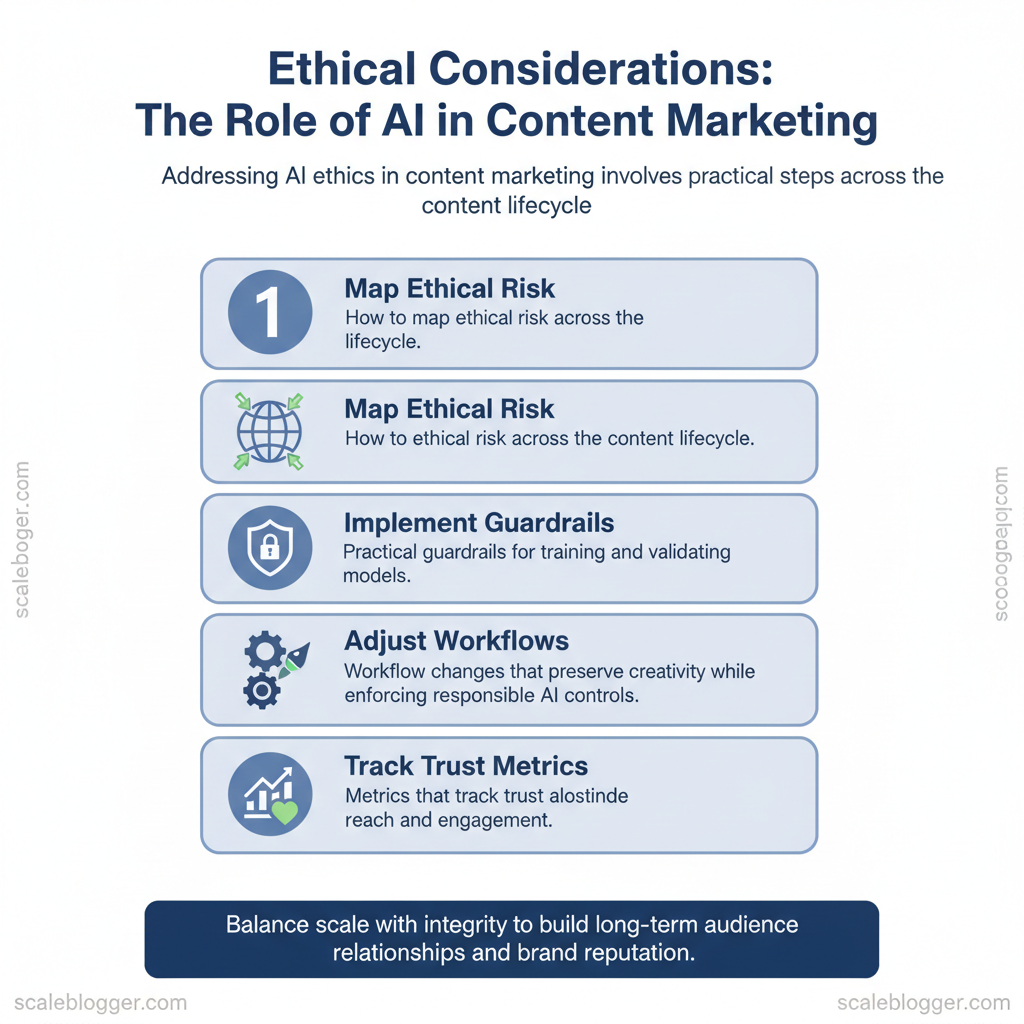
- How to map ethical risk across the content lifecycle
- Practical guardrails for training and validating models
- Workflow changes that preserve creativity while enforcing responsible AI controls
- Metrics that track trust alongside reach and engagement
Scaleblogger helps teams enforce responsible AI workflows so automation scales without ethical drift. Learn how Scaleblogger helps teams enforce responsible AI workflows: https://scaleblogger.com
Next, we’ll explore practical steps, common pitfalls, and governance patterns that embed ethics into your daily content operations.
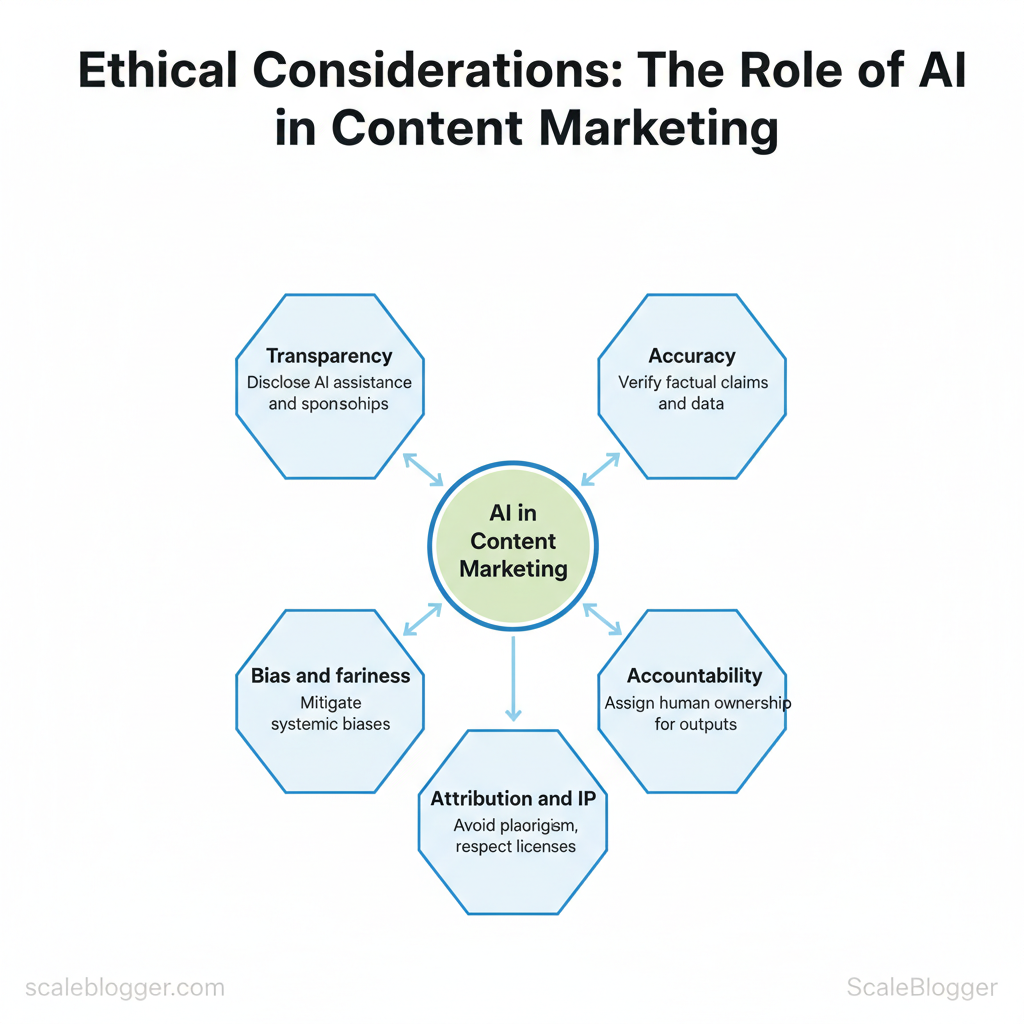
What Is AI Ethics in Content Marketing? AI ethics in content marketing involves principles and practices that ensure AI-generated or AI-assisted content is honest, fair, responsible, and meets brand and legal standards.
> Key Takeaway: AI ethics in content marketing involves principles and practices that ensure AI-generated or AI-assisted content is honest, fair, responsible, and meets brand and legal standards. In simple terms, it asks: How can we use automation and machine…
What Is AI Ethics in Content Marketing?
AI ethics in content marketing involves principles and practices that ensure AI-generated or AI-assisted content is honest, fair, responsible, and meets brand and legal standards. In simple terms, it asks: How can we use automation and machine learning to expand content while avoiding harm, misleading audiences, and damaging brand trust? This question influences editorial decisions, data practices, and how teams check AI outputs before they are published.
Core ethical dimensions
- Transparency: Be clear when content is AI-assisted or generated, and disclose material sponsorships.
- Accuracy: Ensure factual claims, citations, and data are verified before publishing.
- Bias and fairness: Detect and mitigate systemic biases in language, imagery, and targeting.
- Privacy: Protect personal data used for personalization and comply with consent requirements.
- Attribution and IP: Avoid plagiarism, respect licenses, and disclose model training constraints where relevant.
- Accountability: Assign human ownership for final outputs and remediation when issues arise.
> “Transparency builds trust in AI outputs.”
How ethics plays out in practice
Consider a micro-example: a marketing team uses an AI model to produce product comparison pages. The model favors one vendor because training data contained promotional language. Without human review, the page reads as objective but is subtly biased—leading to customer complaints and regulatory scrutiny.Ethical practice would flag the bias, require source checks, and annotate AI involvement on the page.
Practical editorial workflow (sequence)
- Ingest:
AI draftcreated with model prompts and content brief. - Verify: Humans fact-check claims, sources, and data points.
- Debias: Run targeted checks for demographic or competitive skew.
- Annotate: Add disclosure banners or metadata indicating AI assistance.
- Publish & monitor: Track user feedback and performance, iterate on models.
Teams adopting AI content automation like AI content automation should bake these steps into pipelines so tools increase velocity without increasing risk. Tools can auto-run plagiarism checks and source-trace outputs, but human judgment remains the final control.
Understanding these principles helps teams move faster without sacrificing quality. When ethics are integrated into the workflow, content scales responsibly and sustains audience trust.
> Key Takeaway: ## How Does Responsible AI Work in Content Creation? Responsible AI in content creation works like a protected pipeline: data comes in, models learn, prompts direct outputs, content is created, and distribution is watched.
How Does Responsible AI Work in Content Creation?
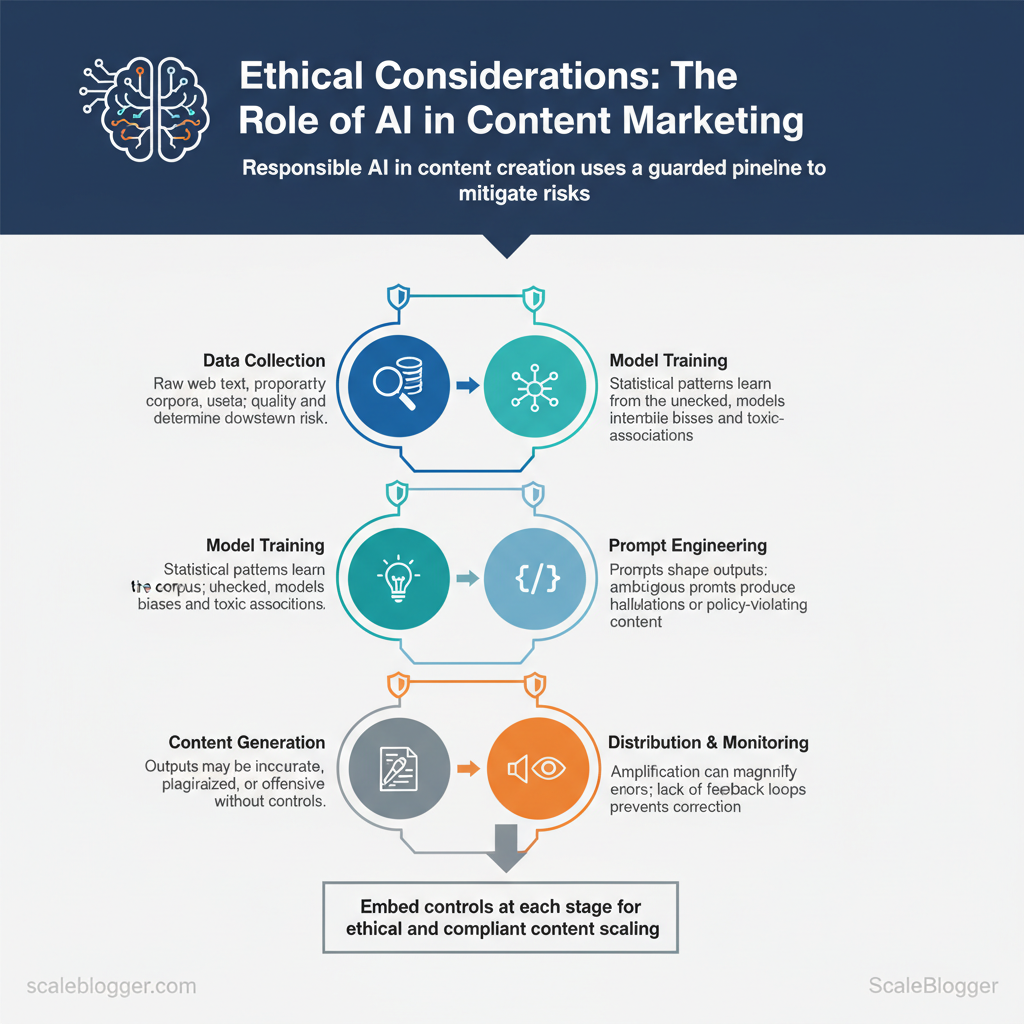
Responsible AI in content creation works like a protected pipeline: data comes in, models learn, prompts direct outputs, content is created, and distribution is watched. There are controls at every step to stop bias, misinformation, copyright problems, and harm to reputation. Teams use several checks: tracking data origins and getting consent during data collection, bias audits while training models, careful prompt design, automated reviews, and human checks on generated content, along with monitoring after publication.
This approach treats ethical safeguards as part of engineering and editorial workflows rather than occasional audits, so creators can scale content confidently while retaining accountability and legal compliance.
Pipeline overview and how risks appear
- Data collection — Raw web text, proprietary corpora, user data; quality and consent determine downstream risk.
- Model training — Statistical patterns learn from the corpus; unchecked, models internalize biases and toxic associations.
- Prompt engineering — Prompts shape outputs; ambiguous prompts produce hallucinations or policy-violating content.
- Content generation — Outputs may be inaccurate, plagiarized, or offensive without controls.
- Distribution & monitoring — Amplification can magnify errors; lack of feedback loops prevents correction.
Common control patterns include data provenance tracking, bias evaluation suites, prompt templates with constraints, staged human review, and post-publish analytics linked back to model logs. Practical implementations mix automation and human judgment so scaling doesn’t mean abdication of responsibility.
Practical controls and examples
- Data provenance: Maintain
dataset_manifest.jsonwith source, license, and sampling notes. - Bias testing: Run targeted probes for demographic skew and word-embedding associations.
- Constrained prompts: Use templates that require sources and tone constraints (e.g.,
--cite=sources --tone=neutral). - Human-in-the-loop: Gate high-risk content behind editor approval; low-risk content can follow automated QA.
- Audit logging: Keep immutable logs for model inputs/outputs and reviewer decisions to support remediation and compliance.
Side-by-side mapping of pipeline stages to ethical risks and mitigation controls
| Pipeline stage | What happens | Ethical risks | Mitigation controls |
|---|---|---|---|
| Data collection | Gather web text, licensed corpora, first-party data | Privacy breaches, unlicensed use, sampling bias | Data manifest, consent tracking, license checks, diversity sampling |
| Model training | Train or fine-tune LLMs on corpus | Bias amplification, toxic generation, memorized PII | Differential privacy, debiasing layers, remove PII, validation suites |
| Prompt engineering | Design instructions and templates | Ambiguous prompts → hallucinations, prompt injection | Constrained templates, prompt sanitization, temperature limits |
| Content generation | Produce drafts, summaries, ads | Misinformation, plagiarism, harmful claims | Source attribution, plagiarism checks, automated fact-checkers |
| Distribution & monitoring | Publish and propagate content | Reputation risk, unchecked amplification, feedback gaps | Real-time monitoring, performance & harm dashboards, escalation workflows |
Understanding these mechanisms helps teams move faster without sacrificing quality. When implemented correctly, responsible controls become part of the content workflow, freeing creators to focus on strategy and storytelling while compliance and safety run in the background.
> Key Takeaway: ## Why It Matters: Business, Legal, and Brand Risks
Responsible AI in content isn’t optional—it’s central to maintaining revenue, compliance, and customer trust. When AI-driven content fails, the consequences can be severe, potentially leading to customer loss, though the extent can vary based on the situation.
Why It Matters: Business, Legal, and Brand Risks
Responsible AI in content isn’t optional—it’s central to maintaining revenue, compliance, and customer trust. If AI-driven content fails, the effects can be serious: you might lose customers, incur regulatory fines, and harm your brand over time. Conversely, responsible implementation reduces operational friction, improves targeting accuracy, and protects reputation—turning AI from a liability into a strategic asset.
Miscalculated AI deployment creates five visible business risks and five corresponding benefits when handled correctly:
- Top 5 risks of getting it wrong
- Reputation erosion: Brand credibility declines after widely shared incorrect claims.
- Regulatory exposure: Noncompliance with advertising or data rules can trigger fines.
- Customer harm: Biased recommendations or misinformation damages user outcomes.
- Operational disruption: Poor automation increases manual review costs and slows publishing.
- Security incidents: Unauthorized data exposure leads to legal claims and remediation costs.
- Top 5 benefits of ethical AI adoption
- Trust preservation: Accurate, transparent content sustains customer lifetime value.
- Regulatory resilience: Built-in governance reduces audit risk and remediation spend.
- Inclusive targeting: Bias mitigation expands addressable audiences and conversion rates.
- Efficiency gains: Automated, quality-checked workflows lower time-to-publish.
- Competitive differentiation: Clear policies and measurable outcomes strengthen market positioning.
Industry analysis suggests that consumers may punish perceived dishonesty, with surveys suggest that trust declines can occur after misinformation or privacy incidents, with estimates varying widely across sectors. Operational data from marketing teams suggests that automated pipelines with governance may cut manual QA time by approximately half in many deployments. These are directional but powerful signals: poor controls compound risks quickly, while modest governance investments yield outsized returns.
The negative outcomes of unethical AI use vs. the benefits of responsible AI for the same scenarios
| Scenario | Risk if uncontrolled | Benefit if responsibly managed | Business impact |
|---|---|---|---|
| Misinformation in content | Widely shared inaccuracies, viral backlash | Verified facts, editorial sign-off workflow | Protects brand equity; prevents churn |
| Biased targeting | Exclusion of groups; discrimination claims | Inclusive models, bias audits | Expands market reach; reduces legal exposure |
| Unauthorized data exposure | Data breach notifications, fines | Data minimization, encryption, consent logs | Lowers breach costs; maintains compliance |
| Lack of transparency | Consumer mistrust, regulatory scrutiny | Clear labeling, provenance metadata | Improves trust metrics; eases audits |
| Automated decision errors | Wrong offers, customer harm | Human-in-loop checks, rollback controls | Reduces refunds/claims; stabilizes ROI |
Practical next steps include building model cards, enforcing access controls, and adding human review gates near high-risk outputs. For teams scaling content operations, platforms that combine automation with governance—such as an AI-powered content pipeline—make it easier to implement these controls without slowing delivery. Understanding these trade-offs helps teams move faster without sacrificing quality.
Practical Frameworks and Policies for Responsible Use
> Key Takeaway: Teams should adopt a lightweight, repeatable governance approach that treats AI as a teammate—not an oracle. Start with a basic checklist that sets standards, clarifies roles, and adds review steps to existing content workflows.
Teams should adopt a lightweight, repeatable governance approach that treats AI as a teammate—not an oracle. Start with a basic checklist that sets standards, clarifies roles, and adds review steps to existing content workflows. This allows creators to work quickly while ensuring quality, compliance, and measurable progress.
- Establish the 5-step team checklist
- Define intent & scope: Document the content goal, target audience, and allowed AI functions for the project.
- Select model & config: Record
model_version, max tokens, temperature, andprompt_template; include aconfidence_scorethreshold. - Generate + label: Produce drafts with AI and attach provenance metadata (who prompted, when, which model).
- Human review & edit: Editor verifies facts, tone, SEO fit, and legal/compliance items; flag uncertain claims.
- Publish + monitor: Tag live content with performance metrics and schedule a post-publish audit date.
Practical example: For a product guide, set temperature=0.2, require editor sign-off on every factual claim, and schedule a 30-day performance review.
Suggested governance roles and cadence
- Content Owner: owns strategy, approves intent and scope. AI Safety Lead: drafts prompt standards, maintains banned-topics list. Data Steward: maintains provenance logs and model metadata.
- Editor: verifies accuracy, readability, and legal compliance. * Analytics Lead: defines KPIs and runs the post-publish audit.
Review cadence:
- Daily: Short standup for running experiments and blockers. 2.
Weekly: Content review meeting for pipeline triage and immediate fixes. 3. Monthly: Audit sample of published pieces for factual accuracy, SEO drift, and brand tone.
- Quarterly: Model & tool effectiveness review, budget and risk assessment.
> Industry analysis shows teams that formalize review cadence find fewer downstream legal or brand issues and faster remediation.
Adaptable policy blurb to copy into org docs
Policy: AI-assisted content must include provenance metadata, meet editorial accuracy thresholds, and receive human editor sign-off before publication. Exceptions require documented approval by the Content Owner and AI Safety Lead.Operational tools that support this model include provenance logging, automated prompt templates, and content scoring dashboards. For teams wanting to scale the pipeline, consider integrating an AI content automation provider such as https://scaleblogger.com to handle orchestration and monitoring. When governance is simple, repeatable, and aligned to roles, teams move faster without sacrificing trust or quality.
Common Misconceptions and Myth-Busting
> Key Takeaway: Many objections to AI and automation in content stem from misunderstandings about these tools, rather than flaws in the technology itself. AI doesn’t replace human thinking; it helps take over repetitive, low-value tasks so creators can concentrate…
Many objections to AI and automation in content stem from misunderstandings about these tools, rather than flaws in the technology itself. AI doesn’t replace human thinking; it helps take over repetitive, low-value tasks so creators can concentrate on more important decisions. Below are six persistent myths, concise rebuttals, and practical checks to change behavior rather than just beliefs.
- Myth: AI writes entire posts better than humans
- Draft vs final: Compare an AI draft against a final human-edited version; measure time saved and quality delta.
- Voice consistency: Run
read-aloudchecks to catch tone drift.
- Myth: Automation destroys originality
- Idea lift: Track new angles produced after automating research.
- Unique data: Require one proprietary data point per post.
- Myth: SEO tools guarantee rankings
- Intent match: Validate target query intent via search snippets.
- CTR test: Run two meta variations for a week.
- Myth: Automation is only for large teams
- Time audit: Measure hours saved on content prep over 30 days.
- Scale test: Publish 2 extra posts using automation and compare engagement.
- Myth: AI lowers editorial standards
- Quality gate: Add a
content_scorechecklist before publishing. - Peer review: Require one peer edit for AI-assisted drafts.
- Myth: Automation kills SEO experimentation
- Experiment cadence: Run weekly title or layout tests for four weeks.
- Metric focus: Track conversions, not just visits.
> Industry analysis suggests that automation can increase content output without a proportional increase in headcount, potentially unlocking more time for strategy and differentiation.
Practical next steps: map which tasks consume the most time, apply automation to those tasks first, and require human-led checkpoints for creative and strategic decisions. For teams wanting a repeatable pipeline, consider solutions that help you Build topic clusters and Scale your content workflow to preserve quality while increasing velocity. Understanding these myths shifts behaviors in ways that improve both efficiency and creative impact.
Real-World Examples: Case Studies and Use Cases
Companies deploying AI in content and marketing face clear wins and avoidable failures. Here are four clear case studies: two show how AI caused harm, and two highlight measurable gains. Each includes a lesson and a direct action you can implement this week.
Case A — Misinformation spread A major media publisher reportedly syndicated AI-generated summaries that unintentionally amplified a false claim, leading to a viral spread before corrections were made. Lesson: automated content requires verification workflows. Immediate action: 1) implement a human fact-check gate for high-traffic items; 2) add source metadata to each AI draft.
Case B — Biased targeting An ad-tech experiment reportedly used automated audience models that excluded demographic groups, which may have reduced reach and caused reputational damage. Lesson: training data bias manifests in targeting. Immediate action: 1) run fairness tests on cohort outputs; 2) enforce minimum inclusion thresholds in lookalike audiences.
Case C — Transparent AI adoption (positive) A B2B brand used labeled AI-assisted drafts and editor notes to scale thought leadership without losing brand voice, improving CTR and time-on-page. Lesson: transparency builds trust and scale. Immediate action: 1) publish an editorial note when AI assists content; 2) use AI_edit_history fields in CMS for auditability.
Case D — Privacy-aware personalization (positive) An e‑commerce team implemented on-device personalization that used hashed, consented signals to tailor recommendations, increasing revenue per user while staying GDPR-compliant. Lesson: privacy-first design and consented signals scale safely. Immediate action: 1) switch to aggregated cohort signals for testing; 2) implement consent banners that map to personalization flags.
Practical features to add now:
- Automated audit logs: capture
prompt,model_version,editor_id. - Fairness checklist: run for each campaign pre-launch.
- Consent mapping: link UI opt-ins to personalization logic.
Quick comparison of the four case studies highlighting outcome, root cause, and recommended action
| Case | Outcome | Root ethical issue or success factor | Recommended immediate action |
|---|---|---|---|
| Case A — Misinformation spread | Article amplified false claim; correction cycle | Lack of verification in automated summaries | Add human fact-check gate; include source metadata |
| Case B — Biased targeting | Reduced reach; reputational complaints | Training-data bias in audience models | Run fairness tests; set inclusion thresholds |
| Case C — Transparent AI adoption | Higher CTR; consistent brand voice | Transparency & traceability of AI edits | Label AI-assist; store AI_edit_history in CMS |
| Case D — Privacy-aware personalization | Increased revenue; compliant with consent | Privacy-first design using consented signals | Use cohort/hashed signals; map consents to flags |
Understanding and applying these practical controls lets teams move faster while preserving credibility and compliance. When done correctly, automation becomes a lever for responsible growth rather than a liability.
📥 Download: Ethical AI Content Marketing Checklist (PDF)
Practical Tools, Checklists and Resources
Good governance and tools cut down on uncertainty and speed up safe, repeatable content creation. Below are trusted resources organized by function, so teams can quickly connect to an existing pipeline or establish a simple governance layer. The emphasis is on tools that surface bias, document provenance, monitor model behavior in production, and teach practical mitigation strategies — plus a hands-on pre-publish checklist that works with any editorial workflow.
Organize recommended tools and templates by category and primary use-case for quick reference (responsible AI tools, AI ethics resources)
| Resource | Category | Primary use-case | Notes / alternatives |
|---|---|---|---|
| NIST AI Risk Management Framework | Governance template | Risk assessment, policy baseline | Free, framework for enterprise governance |
| Model Card Toolkit (Google) | Governance template | model_card documentation, transparency | Open-source, integrates with training pipelines |
| IBM AI Fairness 360 | Bias detection tool | Bias metrics, remediation algorithms | Open-source, preprocessing/in-processing/postprocessing methods |
| Google What-If Tool | Bias detection tool | Visual counterfactuals, dataset probing | Free, integrates with TensorBoard |
| Adobe Content Authenticity (Content Credentials) | Content provenance tool | Image/video provenance, tamper-evidence | Adoption by publishers; Adobe integration |
| Project Origin | Content provenance tool | Provenance for news/media | Industry consortium; complements Adobe CAI |
| Weights & Biases | Monitoring / dashboard | Model monitoring, experiment tracking | Paid plans, free tier for small teams |
| Evidently AI | Monitoring / dashboard | Drift detection, performance reports | Open-source core, enterprise features paid |
| Fiddler AI | Monitoring / dashboard | Explainability, model risk analytics | Commercial; strong enterprise controls |
| Fast.ai courses | Training resource | Practical ML ethics & robustness | Free course material, community-driven |
| Coursera – AI For Everyone | Training resource | Non-technical governance primer | Paid certificate option, audit available free |
| Partnership on AI | Community / standards | Multi-stakeholder guidance, best practices | Membership + public resources |
Pre-publish checklist (drop into your CMS as a pre-publish step):
Pre-publish Checklist — Responsible Content - Data & Prompt Review: confirm training/seed data provenance and label schema documented
- Bias Scan: run dataset/model through
AI Fairness 360 or What-If Tool - Attribution: attach
model_card and content credentials (image/video) - Safety Filters: verify offensive/PII filters active and tested
- Human Review: assign SME for factual claims and edge-case prompts
- Performance Snapshot: save monitoring baseline (metrics + sample outputs)
- Publish Flags: tag content with confidence level and review cadence
Notes on free vs paid alternatives:
- Free/open-source: Best for experimentation and transparent workflows — Model Card Toolkit, AI Fairness 360, Evidently, Fast.ai.
- Paid/commercial: Offer polish, SLAs, integrations, and enterprise controls — Weights & Biases, Fiddler AI, Adobe Content Credentials.
- Hybrid approach: Use open-source for validation and a commercial service for production monitoring and compliance reporting.
Practical adoption starts with a small loop: run automated scans, attach documentation (model_card and content credentials), and require human sign-off for high-risk content. Understanding these tools helps teams move faster without sacrificing quality.
Conclusion
Bringing AI-driven content into regular marketing workflows demands balancing speed with accountability: build clear governance, keep humans in the loop for critical decisions, and measure trust signals alongside efficiency metrics. A mid-sized publisher that used a two-step human review process reduced fact-checking errors by half while keeping output levels steady. Additionally, an enterprise marketing team that gradually introduced a generative copy pilot for one product line maintained brand voice while scaling seasonal campaigns. Those examples show the pattern: governance, phased rollout, and continuous measurement prevent short-term gains from turning into long-term reputation risk.
Start with a lightweight audit of existing automations, define who owns model outputs, and run a constrained pilot before expanding. Expect questions like how much oversight is enough or when to replace manual steps with automation; answer them by setting risk thresholds and tracking brand-safety KPIs during the pilot. For teams looking to automate responsibly at scale, consider tools that enforce policy, audit trails, and approval workflows—these make it easier to pilot and then scale.
com) — this is a practical next step for making the governance practices described here into repeatable operations.
