

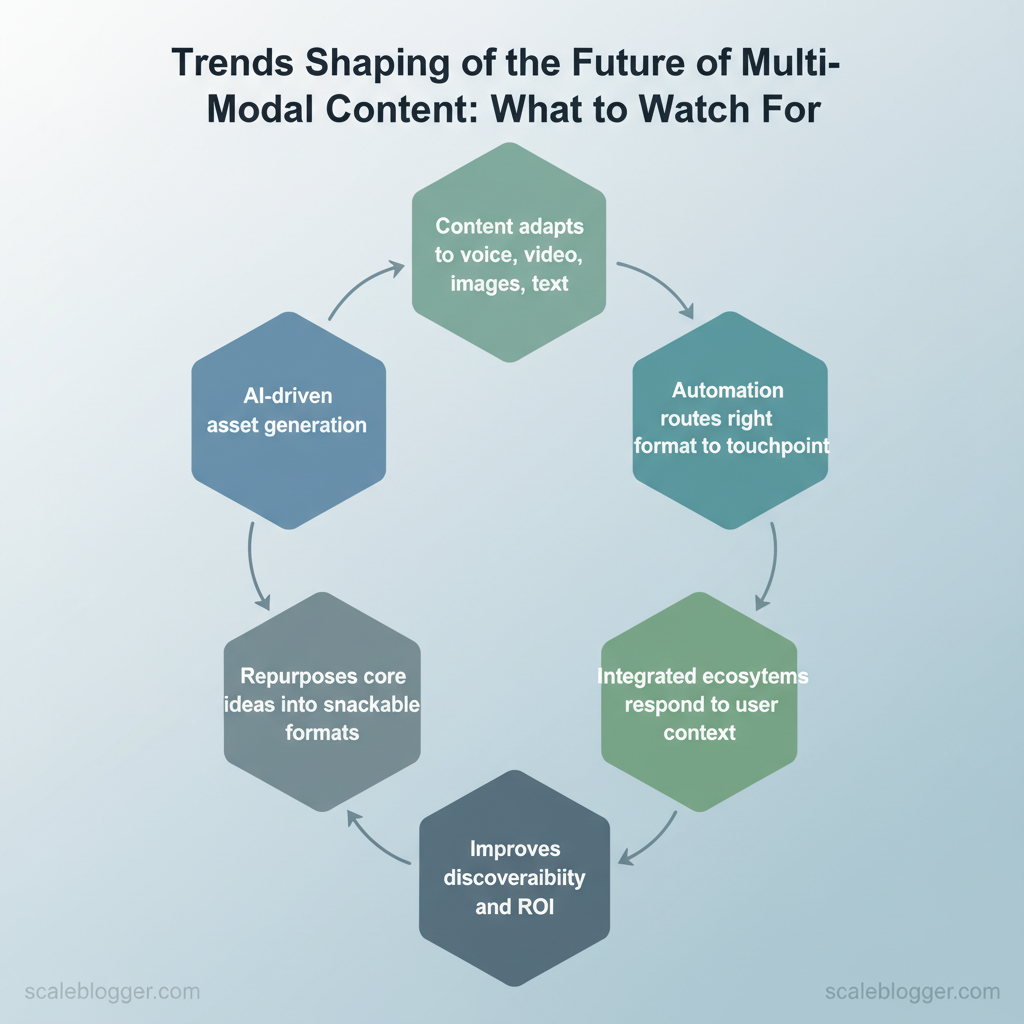
What if your content transformed from isolated assets into a dynamic experience that adapts to voice, video, images, and text? More brands are seeing multi-modal content as essential for engaging audiences. They are moving budgets from single-format campaigns to integrated systems that adjust in real time to user context.
This change rewires workflows and measurement. Modern production pipelines pair AI-driven asset generation with automation to route the right format to the right touchpoint, reducing time-to-publish and improving relevance. The shift matters for discoverability and ROI because search and social platforms prioritize rich, interactive signals over plain text alone.
Picture a brand that uses short-form video, interactive transcripts, and adaptive images to lift conversion across channels while the content engine automatically repurposes core ideas into snackable formats. That practical approach to the future content strategies landscape turns experimentation into repeatable advantage.
- How automation integrates with creative workflows to speed production
- Ways emerging content formats improve discoverability and engagement
- Metrics that reveal cross-format performance, not just vanity counts
- Practical steps to convert text-first assets into multi-modal experiences
Explore Scaleblogger’s AI-driven content strategy and automation: https://scaleblogger.com
> Key Takeaway: ## Trend 1 — AI-Generated Multi-Modal Creative
Generative models can now connect different formats. They turn one idea into coordinated text, images, audio, and video assets with little human intervention.
Trend 1 — AI-Generated Multi-Modal Creative
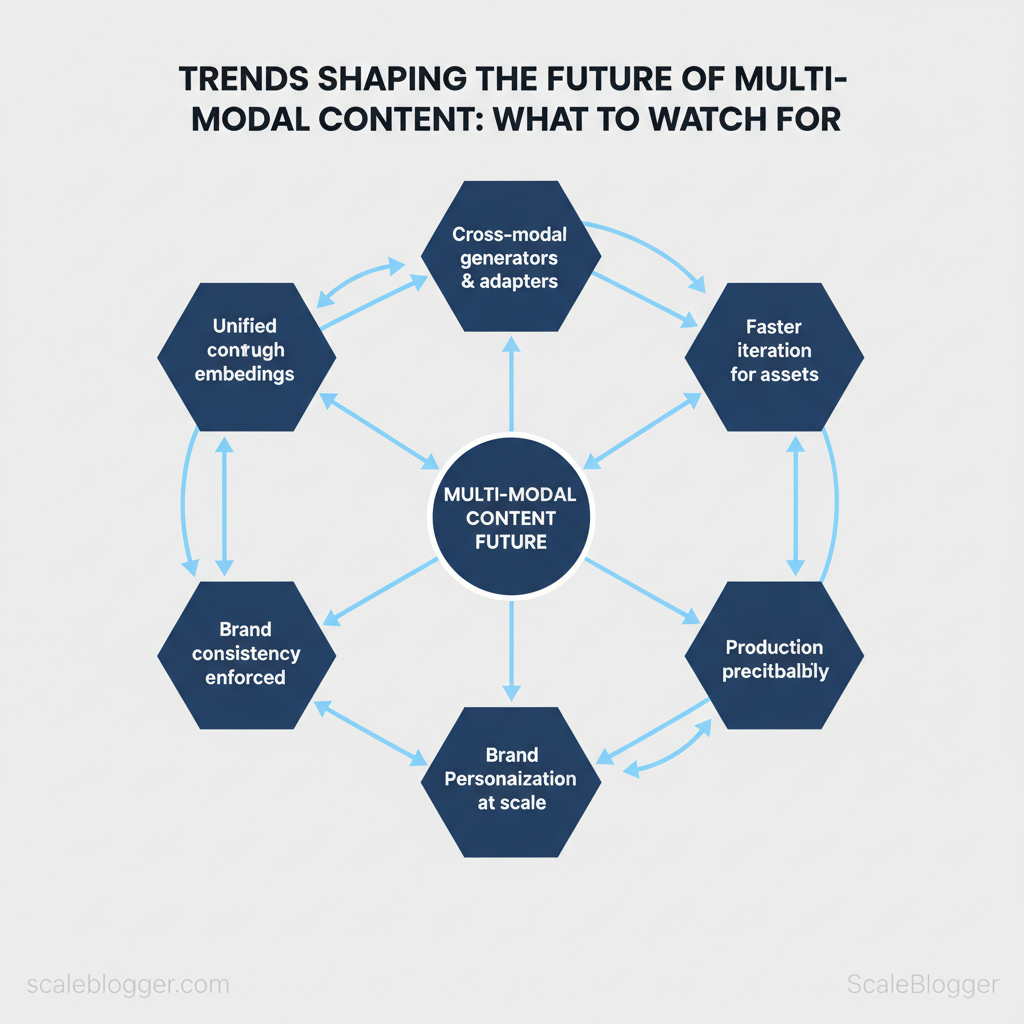
Generative models can now connect different formats. They turn one idea into coordinated text, images, audio, and video assets with little human intervention. Instead of seeing visuals, audio, and text as separate items, modern processes use cross-modal transformations and unified embeddings to maintain context and intent across outputs. This lets content teams scale campaigns, A/B test formats quickly, and keep brand voice consistent while producing more personalized creative.
How modalities get tied together
Unified context through embeddings
Multimodal embedding spaces map text, images, and sometimes audio into a shared vector space so similarity and intent are preserved. That means a headline, an accompanying hero image, and the voiceover for a short video can all derive from a single semantic representation.Cross-modal generators and adapters
Large text-to-image models,text-to-speech engines, and early text-to-video systems act as adapters—transforming one modality into another while retaining the originating prompt’s nuance. Teams combine these into pipelines that automatically produce localized variants and format-specific cuts.
> “Multimodal models let creators repurpose a single brief across formats, cutting production time and inconsistencies.”
Practical benefits for content teams
- Faster iteration: create dozens of asset variants from one prompt.
- Brand consistency: shared
embeddingsenforce tone and visual cues. - Personalization at scale: programmatic swaps for names, locations, or imagery.
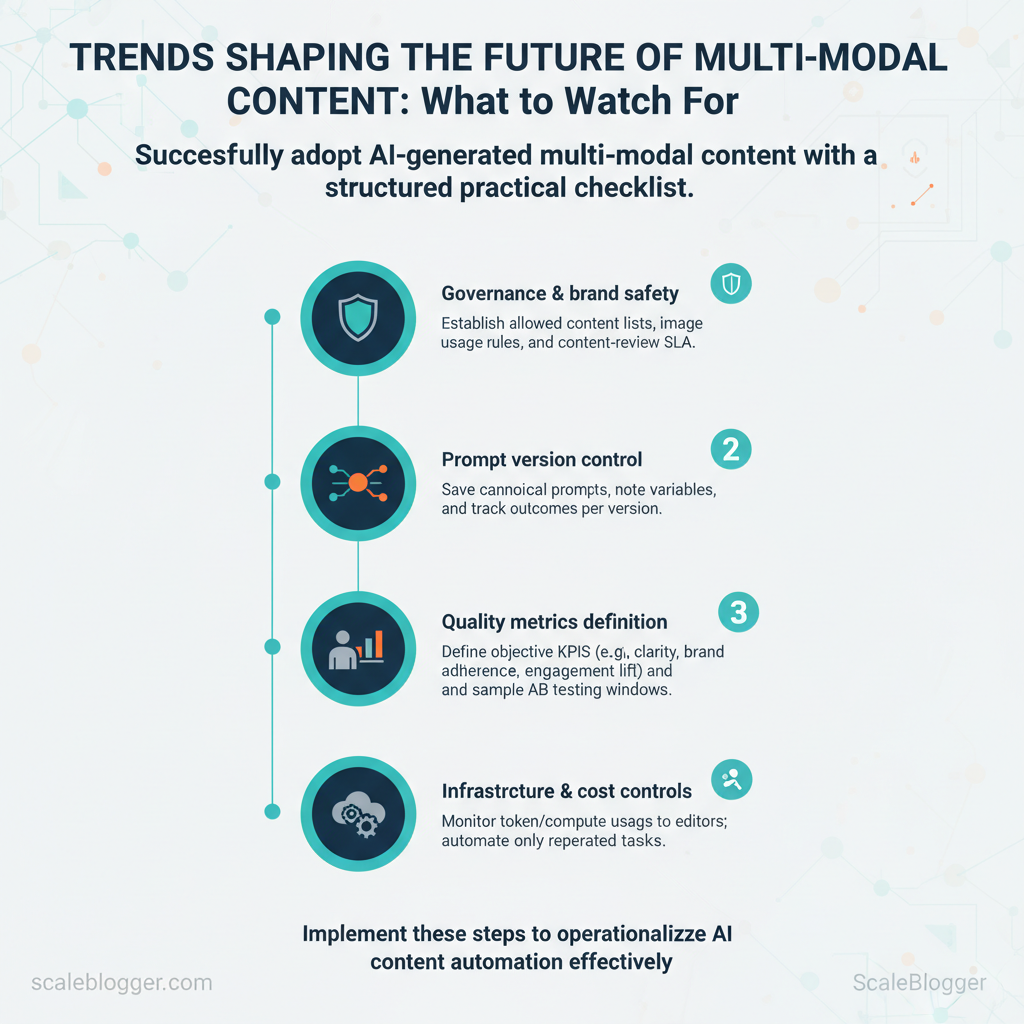
Practical adoption checklist
- Governance & brand safety: establish allowed content lists, image usage rules, and content-review SLA. 2.
Prompt version control: save canonical prompts, note variables, and track outcomes per version. 3. , clarity, brand adherence, engagement lift) and sample A/B testing windows.
- Human-in-the-loop review: route borderline outputs to editors; automate only repeatable tasks. 5.
Infrastructure & cost controls: monitor token/compute usage and cache generated assets.
Popular generative approaches and what modality pairs they support (e.g., text→image, image→text, text→audio, text→video)
| Approach / Tool | Supported Modality Pairs | Strengths | Typical Use Cases |
|---|---|---|---|
| Stable Diffusion | text→image, image→image | Open models, fine-tuning | Concept art, social visuals |
| DALL·E (OpenAI) | text→image | High-quality compositing, coherent scenes | Marketing hero images |
| Midjourney | text→image | Artistic stylization, fast iterations | Brand moodboards |
| GPT-4 with Vision | image→text, text→image (via prompts) | Strong context, reasoning across modalities | Captioning, brief-to-asset |
| CLIP / Embedding platforms | image↔text (similarity) | semantic matching | Asset search, tagging |
| ElevenLabs | text→audio (TTS) | Natural prosody, voice cloning | Podcasts, ads |
| Descript / Overdub | audio→audio, text→audio | Editing-first workflow, multitrack | Voice edits, tutorials |
| Runway | text→video, image→video | Rapid prototyping, toolchain integrations | Short form video ads |
| Synthesia | text→video (avatar) | Script-to-video, multilingual | Training videos, spokespeople |
| Custom multimodal pipelines | any via orchestrators | Tailored controls, data privacy | Enterprise-grade campaigns |
Understanding these principles helps teams move faster without sacrificing quality.
> Key Takeaway: ## Trend 2 — Personalization at Modality-Level
Personalization now focuses on how we mix content types, rather than just audience segments. Different users have varied preferences for text, audio, images, and video based on their context, device,…
Trend 2 — Personalization at Modality-Level
Personalization now focuses on how we mix content types, rather than just audience segments. Different users have varied preferences for text, audio, images, and video based on their context, device, and intent. Modality-level personalization means mapping behavioral and contextual signals to content formats (for example, short audio summaries for commuters, long-form interactive guides for desktop researchers) and continually testing which mixes drive engagement and conversions. This approach reduces wasted content effort and increases relevance by delivering the right format at the right moment.
Modality profiling and audience signals
Modality profiling turns raw analytics into format decisions. Important signals include session length, device type, time of day, and explicit accessibility needs. These signals infer preferences and suggest modality priorities.- Session length: short sessions → concise formats (summaries, bullets)
- Device type: mobile → vertical video, snackable audio; desktop → interactive longreads, dashboards
- Time of day: commute hours → audio-first; late-night browsing → long-form reading
- Accessibility needs: screen readers → semantic HTML, transcripts, captions
- Behavioral patterns: repeat readers → deeper, progressive disclosure content; first-time visitors → clear, fast paths
> Industry analysis shows that users exposed to preferred modalities spend more time and show higher conversion intent, especially when accessibility and context are respected.
Practical profiling uses analytics platforms and simple heuristics (e.g., avg_session_duration < 90s → prefer audio-summary or infographic). Privacy and consent are non-negotiable: collect only necessary signals, honor do-not-track, and provide clear opt-outs.
Implementing modality-level tests
Design tests that compare modality mixes, pick outcomes, iterate quickly, and scale winners.- Define hypothesis and mixes. Example: "Combining article + 90s audio increases newsletter signups vs. article + static image."
- Choose metrics. Primary: engagement rate, time on content, conversion rate; Secondary: scroll depth, repeat visits.
- Run A/B or multivariate tests. Randomize modality exposure by session and control for device/time.
- Analyze and iterate. Use cohort analysis to see which mixes win for which segments; roll out winners as default for that cohort.
- Scale programmatically. Feed winning rules into your CMS or automation layer to deliver modality variants at runtime.
yaml
Example test config
test_name: audio_vs_image_signup cohorts:
- mobile_commuters
variants:
- article + audio_90s
- article + hero_image
primary_kpi: newsletter_signup_rate duration: 14_daysPractical tips: prioritize low-friction modalities first (transcripts, short audio), measure both immediate and downstream conversion, and respect privacy signals when personalizing.
Map audience signals to recommended content modalities and delivery formats
| Audience Signal | Inferred Preference | Recommended Modalities | Measurement KPI |
|---|---|---|---|
| Mobile, short sessions | Quick answers, skim-friendly | Snackable text, vertical video, 60–90s audio | CTR, bounce rate, micro-conversions |
| Desktop, long sessions | Deep research, multi-step tasks | Interactive longreads, data visualizations, downloadable PDFs | Time on page, task completion, lead form fills |
| Commuting behavior | Hands-free consumption | Podcast episodes, audio summaries, chapterized content | Audio completion rate, subscribe rate |
| Accessibility needs | Non-visual access, clear structure | Semantic HTML, captions, full transcripts, alt text | Screen reader usage, accessibility compliance checks |
| Repeat readers/subscribers | Deeper content, personalization | Progressive series, personalized recs, gated deep dives | Repeat visit rate, subscription upgrades |
When implemented correctly, modality-level personalization shifts work from one-size-fits-all publishing to delivering format-first experiences that respect context and accessibility—letting creators focus on substance while automation handles format delivery. For teams ready to operationalize this, AI content automation like Scaleblogger's AI-powered content pipeline can accelerate mapping signals to format rules and scale winning mixes across the blog estate. This approach speeds decision-making and reduces wasted content production effort.
> Key Takeaway: ## Trend 3 — Immersive and Spatial Formats (AR/VR/3D)
Immersive formats are changing from novelty to useful business tools. Augmented reality and 3D viewers allow customers to try and customize products before purchasing.
Trend 3 — Immersive and Spatial Formats (AR/VR/3D)
Immersive formats are changing from novelty to useful business tools. Augmented reality and 3D viewers allow customers to try and customize products before purchasing. VR and mixed reality provide environments for training, storytelling, and experiential marketing. These formats change the content relationship from passive consumption to active interaction — content becomes a product utility as much as messaging.
Business use cases and how they map to outcomes
- Product try-ons & configurators: Virtual try-ons, furniture placement, and color/configuration selectors increase conversion intent and reduce returns. Interactive storytelling: Branded micro-worlds and location-based AR campaigns boost dwell time and social sharing. Training & simulations: VR flight decks, industrial maintenance sims, and safety drills lower training costs and accelerate skill transfer.
- Sales enablement: 3D demos and AR overlays help reps explain complex products during remote pitches. Event & retail experiences: Mixed reality installs create memorable, shareable moments that drive earned media.
Budgeting and tooling roadmap — practical sequence
- Pilot (low cost): Use
WebARplatforms (8th Wall, Zappar), 3D marketplaces (Sketchfab, TurboSquid) and mobile-friendly viewers; time and cost: weeks to a couple months, low monthly fees or one-off asset costs. 2.
Prototype (medium cost): Build interactive demos in Unity or Unreal with lightweight SDKs (AR Foundation, ARCore) and simple analytics; expect 2–4 months and contractor or in-house developer hours. 3. Scale (higher cost): Invest in hosting (CDN for 3D assets), performance engineering (LOD, glTF optimization), cross-platform SDK maintenance, and analytics that track spatial interactions; timelines move to quarters, budgets scale with concurrency and asset complexity.
Practical tooling notes
- Pilot tools: WebAR platforms for no-app experiences, 3D marketplaces for reusable assets.
- Prototype tools: Unity/Unreal for interactivity, glTF* +
dracocompression for performance. - Scale considerations: CDN hosting, device performance testing, custom analytics for interaction metrics.
Immersive format types (AR, WebAR, VR, 3D) against business fit and technical complexity
| Format | Best Use Cases | Technical Complexity | Typical Time-to-Launch |
|---|---|---|---|
| Mobile AR (WebAR) | Quick try-ons, location AR | Low; WebXR friendly |
2–8 weeks |
| App-based AR | High-fidelity product demos | Medium; SDK integration | 2–4 months |
| VR experiences | Training, deep storytelling | High; hardware & UX design | 3–6 months |
| 3D product viewers | E-commerce product pages | Low–Medium; optimization | 2–6 weeks |
| Mixed reality installations | Events, retail flagship | Very high; custom hardware | 3–9 months |
Understanding execution costs and tooling options streamlines decision-making and keeps projects focused on outcomes rather than tech for tech’s sake.
Trend 4 — Contextual Distribution and Device Fragmentation
Content is no longer confined to one platform; it must work across different contexts and devices. This means creating short vertical clips for quick discovery, long episodes for in-depth engagement, voice responses for transactions, and in-app microcontent for active users. Matching length, format, metadata, and progressive enhancement strategies to each context reduces friction and preserves the same underlying message across channels.
Start with content design that accepts fragmentation as the norm. Build a canonical asset (long-form article, episode, or report) and produce derived variants tuned for each distribution context. Technical enablers include content_id conventions, consistent metadata schemas, and progressive enhancement so experiences degrade gracefully on older devices or lower-bandwidth networks.
Key distribution contexts to:
- Short-form social: prioritize vertical, under-60s clips with on-screen captions and a clear hook. Long-form platforms: chapters, timestamps, and structured show notes boost discoverability and session time. Voice assistants: surface concise answers with schema markup and conversational snippets.
- Email/newsletters: modular blocks and linked microsummaries increase click-throughs. In-app content: lean on personalization signals and lightweight HTML/CSS for fast rendering.
Cross-context measurement requires a unified framework. Define core metrics that translate across channels — for example engaged minutes, assisted conversions, and recurring reach — then instrument consistently.
- Implement
content_idacross CMS exports and all distribution URLs. - Append structured UTMs and a canonical
campaign_idto derived assets. - Consolidate events in a centralized analytics layer and normalize session definitions.
Table: Section Content — Distribution Context, Recommended Length/Format, Primary Modalities & more
| Distribution Context | Recommended Length/Format | Primary Modalities | Indexing / Discovery Tip |
|---|---|---|---|
| Short-form social (TikTok/Reels) | 15–60s vertical clips, 1–3 hooks | Video, captions, stickers | Use clear captions, trending sounds, short captions |
| Long-form platforms (YouTube/Podcast) | 10–60+ minutes, chapters | Video, audio, transcripts | Add timestamps, full transcripts, structured show notes |
| Voice assistants (Alexa/Google) | 1–30s response snippets | Spoken answer, SSML | Provide concise answers + FAQ schema, SSML for prosody |
| Email/newsletters | 50–250 words modular blocks | Text, images, links | Use preheader text, content IDs, linked microsummaries |
| In-app content | 5–90s micro-interactions | HTML, AMP-like pages | Use lightweight markup, local caching, personalization tags |
Operationalizing this—consistent IDs, UTMs, and a centralized analytics layer—lets teams attribute multi-touch journeys and where each variant produces the best return. When implemented correctly, this approach reduces wasted effort and makes decisions about format and channel measurable. This is why modern content strategies invest in automation and standardized metadata: they let creators focus on narrative quality while systems handle distribution complexity.
Trend 5 — Accessibility and Inclusive Design as Competitive Advantage
Accessibility and inclusive design are now essential; they help reach more people, improve SEO, and lower legal and reputational risks. Making content usable for people with disabilities—via readable text, meaningful alt text, accurate captions, and navigable immersive experiences—also improves machine readability. Search engines index transcripts, captions, and semantic headings, which increases discoverability.
Brands that prioritize accessibility tap underserved audiences, avoid compliance costs, and gain long-term trust.
Why accessibility moves the needle
- Improved discoverability: Transcripts and captions create indexable text that drives long-tail search traffic. Better user engagement: Clear headings and readable copy reduce bounce rates and increase time-on-page. Risk mitigation: Meeting accessibility standards lowers the chance of compliance penalties and class-action suits.
- Brand differentiation: Inclusive experiences signal reliability and broaden market reach. * Operational efficiency: Accessibility-first content is easier to localize, repurpose, and automate.
Practical steps to embed accessibility into content workflows
- Start with structure: Use semantic headings, short paragraphs, and clear link text before visual polish. 2.
Add machine-readable layers: Publish captions, transcripts, and alt attributes alongside media. 3. Validate and iterate: Run automated checks and manual testing with assistive tech at key milestones.
Modality-specific accessibility checklist
Actionable checklist mapping modality to accessibility action and quick implementation time estimate
| Modality | Accessibility Action | Implementation Time (estimate) | Priority (High/Medium/Low) |
|---|---|---|---|
| Text / Articles | Use semantic headings, readable fonts, 90+ contrast, aria landmarks |
1–3 hours per article | High |
| Images / Graphics | Add descriptive alt text, provide detailed captions, include data tables as text |
15–30 minutes per image | High |
| Video | Add captions, provide verbatim transcripts, include audio descriptions for visuals | 1–4 hours per video | High |
| Audio / Podcasts | Publish episode transcripts, chapter markers, show notes with links | 30–90 minutes per episode | Medium |
| AR/VR experiences | Ensure keyboard/navigation alternatives, adjustable speed and text size, spatial audio cues | 1–2 weeks per experience | Medium |
Integration tip: Automate repetitive steps—caption generation, alt-text suggestions, and contrast checking—so creators focus on quality. Scale your content workflow with AI-powered tools that handle the mundane parts of accessibility while teams refine voice and context. Understanding and applying these practices accelerates production without sacrificing usability or SEO gains.
📥 Download: Multi-Modal Content Strategy Checklist (PDF)
Trend 6 — Measurement and Monetization of Multi-Modal Experiences
To measure multi-modal experiences, treat each modality as both a cost and a source of revenue. Track costs of production and distribution, then link engagement results to revenue or increased lifetime value (LTV). Start by quantifying engaged minutes, leads attributed to each format, and incremental conversion rate change; then attribute a dollar value to those increases. That lets teams compare the marginal return of a podcast episode versus a short-form video or an interactive infographic and choose where to scale.
This matters because brands that connect engagement to revenue can focus on modalities that yield higher value for their investment.
Core framework: measuring multi-modal ROI
- Define cost buckets: production, post-production, distribution, and platform fees. Measure engagement-weighted outcomes: engaged minutes, repeat visits, shares, lead quality. Calculate incremental conversion uplift: A/B test variants with and without the modality to isolate effect.
- Translate to revenue/LTV: assign
average order value (AOV)andLTVto incremental conversions. * Track net ROI and payback period: include depreciation of content (evergreen value).
Monetization strategies to explore
- Match model to modality: advertising for high-reach videos, subscriptions or memberships for deep audio series, lead-gen gated content for long-form research, and microtransactions for interactive tools. 2.
Pilot low-friction offers: launch freemium gated assets or a paid companion video to validate demand before full rollout. 3. Measure incremental revenue per modality: calculate delta revenue / delta cost to decide scale.
> Industry analysis shows Research from industry analysis shows that engagement-quality beats raw reach for monetization—deep engagement converts at materially higher rates than passive impressions.
Illustrate a worked ROI example with sample numbers for production, distribution, engagement, and revenue uplift
Table: Section Content — Line Item, Assumed Value, Notes & more
| Line Item | Assumed Value | Notes | Impact on ROI |
|---|---|---|---|
| Content production (multi-modal) | $12,000 | 4 videos + 2 podcasts + interactive asset | Largest upfront cost; enables repurposing |
| Distribution & hosting | $1,500 | CDN, hosting, platform promotion | Ongoing monthly + paid placements |
| Engagement uplift (value) | $18,000 | +40% engaged minutes → higher ad / sponsorship CPM | Converted to ad/sponsorship revenue |
| Conversion uplift (value) | $6,000 | +1.2% conversions from gated leads | Based on AOV and lead-to-sale rates |
| Net ROI | $10,500 (78%) | (Revenue uplift $24,000 − Costs $13,500) / Costs | Positive payback, justifies scale |
engaged minutes and tying them to AOV/LTV makes ROI comparisons actionable. Use experiments to validate assumptions, then automate attribution and scheduling with tools that integrate content performance and financial metrics—this is where AI-powered content automation, such as Scale your content workflow at Scaleblogger.com, accelerates repeatable wins. Understanding these principles helps teams invest in the formats that actually move the business forward.
Conclusion
Transforming isolated assets into a dynamic, context-aware content system changes how audiences find and interact with your work. Integrating structured content, automated distribution, and multimodal adaptation reduces production friction, improves relevance, and shortens time-to-value. Teams that standardized their content pipeline saw faster iteration loops and clearer performance signals; editorial groups that layered AI-driven tagging onto legacy archives unlocked renewed traffic from evergreen pieces.
Keep attention on three practical moves: map the content lifecycle, automate repetitive distribution tasks, and measure outcomes by audience journeys rather than page counts.
For immediate next steps, audit one high-value workflow and replace manual touchpoints with automation, then run a two-week pilot to compare engagement and efficiency. For teams looking to scale that pilot into an operational system, platforms that unify AI, orchestration, and analytics can cut implementation time. com).
This site provides resources and examples to help translate the strategies above into concrete processes, so teams can move from experimentation to predictable content ROI.
