

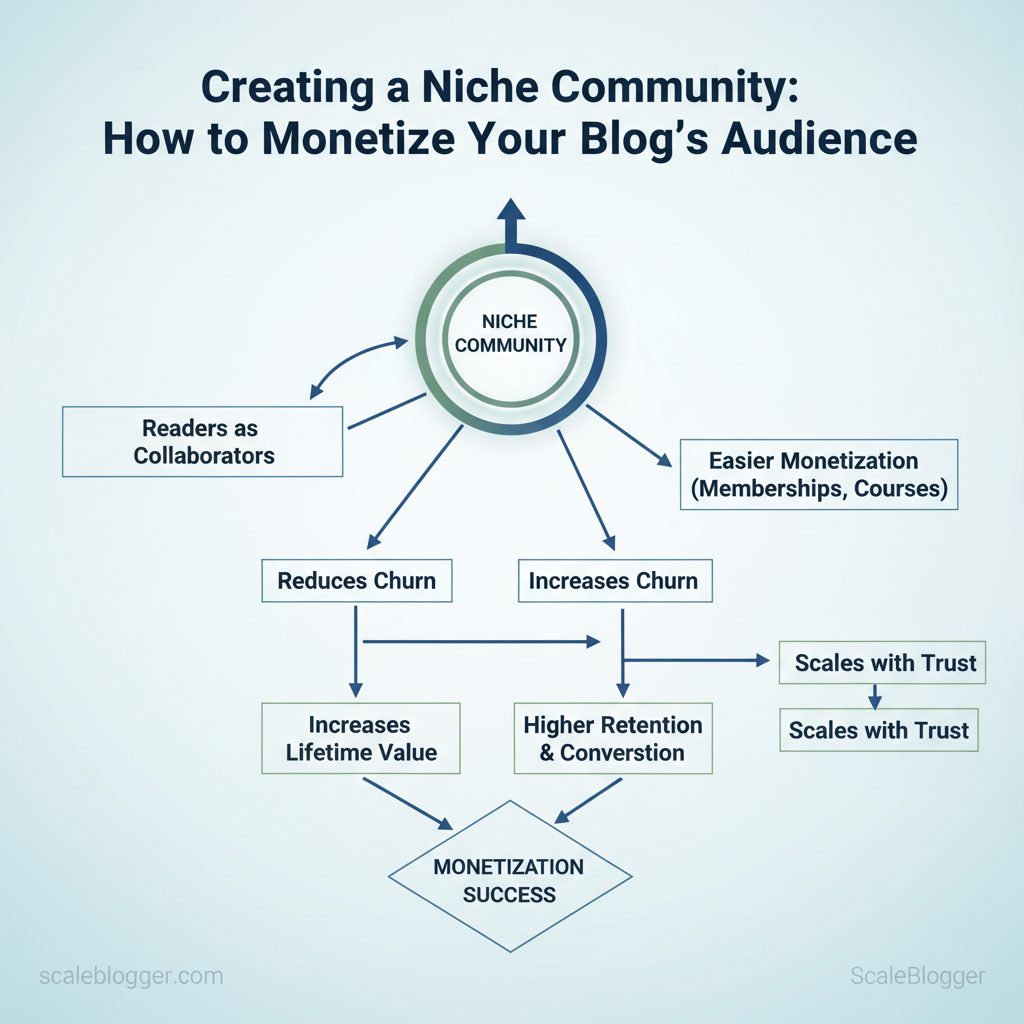
Too many blogs treat readers like traffic instead of collaborators, then wonder why subscriptions stall and conversions sputter. Creating a niche blogging community transforms passive pageviews into consistent revenue. This is achieved by connecting content, product offers, and genuine relationships.
A community that knows what it expects and gets consistent value reduces churn, increases lifetime value, and makes it far easier to monetize your blog audience through memberships, paid forums, cohort courses, and exclusive content drops. Industry practice shows that focused communities outperform broad audiences when it comes to engagement and willingness to pay. Picture a B2B writer who launches a closed mastermind and turns a handful of high-touch members into the blog’s most reliable revenue stream.
This is important because monetizing through community is based on trust, not just ad impressions. With sensible community engagement strategies, retention rises and promotional friction falls, giving paid offers breathing room to convert naturally. Examples later will show how content cadence, gated assets, and micro-commitments drive membership growth.
- How to design offers that fit a niche without alienating casual readers
- Steps to convert active commenters into paying members, week by week
- Pricing frameworks for memberships, cohorts, and micro-subscriptions
- Community activities that amplify referrals and reduce churn
Automate your community growth with Scaleblogger: explore practical automations and workflows at https://scaleblogger.com before moving into the tactical steps that follow.
> Key Takeaway: ## Define Your Niche and Community Purpose
Start by choosing a niche narrow enough to build identity but broad enough to sustain growth. A strong niche balances specific problems with reachable audience signals.
Define Your Niche and Community Purpose
Start by choosing a niche narrow enough to build identity but broad enough to sustain growth. A strong niche balances specific problems with reachable audience signals. Use search volume and forum activity to test demand. Then confirm it with signals like subreddit size, Discord server activity, and keyword intent.
This section shows a practical framework for selecting candidate niches and then turning that choice into a concise community purpose statement that guides content, moderation, and product decisions.
Prerequisites
- Access keyword tools like Keyword Planner for volume checks.
- Forum scouting: Reddit, Facebook Groups, niche forums, Discord.
- Benchmarks: top 10 competitor blogs and their engagement signals.
Niche Selection Framework — how to evaluate candidates
- Estimate audience size: Use keyword volume bands (low/medium/high) and community member counts to set qualitative size. 2.
Gauge competition: Look at domain authority of top SERP results, number of active communities, and paid ad activity. 3. Assess monetization fit: Match audience intent to revenue models (courses, affiliates, subscriptions, tools).
- Prioritize engagement likelihood: Forums with repeat Q&A and user-generated content score higher.
Three candidate niches compared for a niche blogging community Three candidate niches across size, competition, monetization potential, and engagement likelihood
Table: Section Content — Niche, Estimated Audience Size (qualitative), Competition Level & more
| Niche | Estimated Audience Size (qualitative) | Competition Level | Monetization Fit |
|---|---|---|---|
| Niche A — General running tips | Large (broad interest, high search volume) |
High (major publishers, apps) | Medium (ads, affiliate shoes) |
| Niche B — Plant-based marathon training | Medium (specialized subset) | Medium (blogs + niche coaches) | High (courses, coaching, affiliate nutrition) |
| Niche C — Vegan runners (strength & recovery) | Small-to-medium (passionate, searchable) | Low-to-medium (few focused communities) | Very high (subscriptions, coaching, premium plans) |
| Example: vegan runners | Small but engaged (active subreddits, forums) | Low competition (few authoritative sites) | High (nutrition products, coaching, events) |
Crafting the Community Purpose Statement — a step-by-step template
- Define the member: “For [specific member persona] who [primary problem].”
- State the promise: “We help them [primary outcome] by [unique method].”
- Set community norms: “Members contribute by [expected behaviors].”
Example template
For plant-based endurance athletes who struggle with recovery, we provide evidence-backed training plans and peer support so members improve performance and stay injury-free.Validation checklist
- Speak-test: Would a target member say, “This is for me” within 5 seconds?
- Content-fit: Can 60–80% of your planned articles and resources trace back to the purpose?
- Decision filter: Use the statement to accept/reject new features or content.
Practical tip: Automate content idea triage using AI content automation to map topic clusters back to the purpose and maintain consistency across channels (see AI content automation: https://scaleblogger.com). When the niche and purpose align, editorial decisions become faster and community energy compounds, making growth and monetization predictable.
> Key Takeaway: ## Build an Audience-First Onboarding Funnel
Begin by designing the first interaction based on the audience’s immediate need. Solve one small, urgent problem, and make the next step clear.
Build an Audience-First Onboarding Funnel
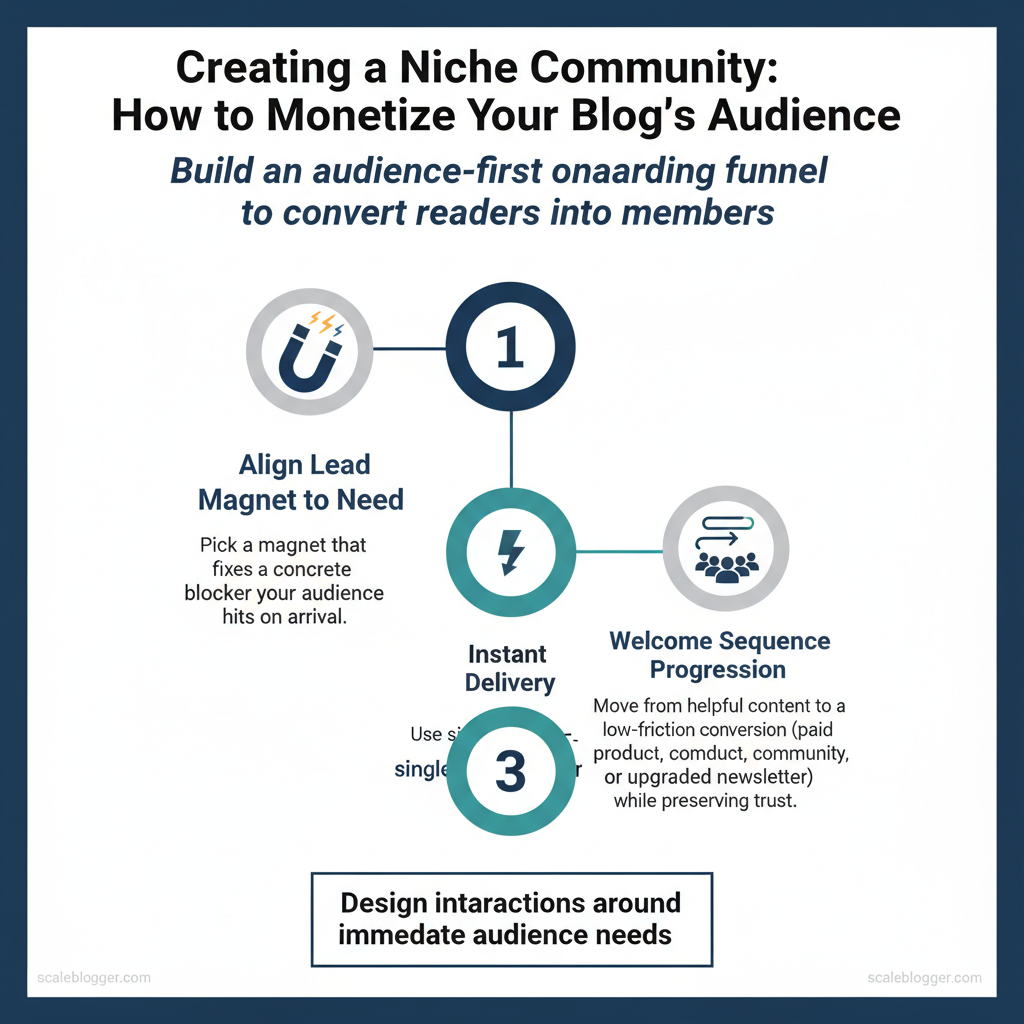
Begin by designing the first interaction based on the audience’s immediate need. Solve one small, urgent problem, and make the next step clear. Lead magnets must match the reader’s moment of intent; the welcome sequence should then move from helpful content to a low-friction conversion (paid product, community, or upgraded newsletter) while preserving trust.
Lead Magnets and Entry Offers
- Align to first need: Pick a magnet that fixes a concrete blocker your audience hits on arrival.
- Instant delivery: Use single-click downloads or immediate gated content—avoid multi-page forms.
- Low friction CTA examples:
- Blog sidebar: “Free checklist: 7-step SEO checklist to get your post to page 1 — Instant PDF”
- End of article: “Download the exact content brief that created this traffic — get it now”
- Exit popup: “Before you go — grab a 3-email mini course on launching a profitable blog”
- Time estimate: build a checklist in 1–3 hours, a mini course in 1–2 days, templates in 1 day.
Welcome Sequence That Converts
- Day 0 — Deliver the promise immediately with the asset and a short value note (1–2 lines). 2.
Day 1 — Send a how-to email demonstrating the asset in action (include tangible result or screenshot). 3. Day 3 — Share a case study or testimonial that uses the same asset.
- Day 6 — Offer a low-friction paid offer or invite to a private community; include a limited-time bonus. 5.
Day 10 — Follow up with a helpful resource and one soft reminder of the offer. A/B tests to run: subject lines (problem vs. benefit), CTA phrasing (Free vs.
Instant vs. Get access), and send times. Expected outcomes: a good onboarding funnel typically converts 2–8% to a low-cost upgrade or community invite; higher for niche, intent-driven audiences. According to recent research, these figures reflect typical engagement rates in similar contexts.
- Troubleshoot: low open rates — rework subject lines and preview text; low clicks — tighten the single CTA and use proof.
Lead magnet types by production effort, conversion potential, and fit for different niches
| Lead Magnet Type | Effort to Create | Conversion Potential | Best Use Case |
|---|---|---|---|
| Checklist / Cheat Sheet | Low (1–3 hrs) | Medium | Quick wins, SaaS blogs, how-to posts |
| Mini email course | Medium (1–3 days) | High | Audience building, onboarding sequences |
| Template / Swipe file | Medium (4–8 hrs) | High | Marketing, copywriting, design niches |
| Mini video series | High (2–5 days) | High | Higher-trust niches, product demos |
| Webinar / Live workshop | High (1–3 weeks) | Very High | Premium offers, product launches |
Practical CTA copy template:
Subject: [First name], grab your free [asset] and start today Preview: Instant download — proven steps inside CTA Button: Get the [asset] — it's instantIntegrating an automated content pipeline like AI-powered content automation can reduce production time for templates and mini-courses while keeping quality consistent. Understanding and executing these principles helps teams move faster without sacrificing the relationship-building that turns readers into long-term customers.
> Key Takeaway: ## Productize the Community: Offer Types and Models
Start by treating the community as a product: pick one clear way members pay, build frictionless delivery, and measure engagement as revenue signal. Successful community products fall into three…
Productize the Community: Offer Types and Models
Start by treating the community as a product: pick one clear way members pay, build frictionless delivery, and measure engagement as revenue signal. Successful community products fall into three categories: recurring access, transactional learning, and high-touch services. Each has tradeoffs in revenue stability, setup cost, and scalability. The best choice depends on how much the audience is willing to pay, how often content is created, and the operational capacity.
Monetization models overview
- Membership subscription — predictable, scalable: Recurring access to content, events, and peer networks; pricing typically ranges from $5–$50/month or $50–$500/year depending on niche and perks. Industry data suggests this pricing model is common in digital communities. Infrastructure needs: Stripe/PayPal, community platform (Circle, Mighty Networks), gated content delivery. Paid forum / Slack/Discord tier — low-friction community layer: Common tiers at $3–$25/month; often uses role-based access in Discord or Slack with Stripe/Billing through third-party bots or Circle integrations. Research from community development studies shows these figures are standard in these platforms.
- Self-paced course — one-time purchase, high margin: Typical pricing $49–$499 one-time; needs LMS or course hosting (Thinkific, Teachable), content delivery, and automated onboarding. Cohort-based course — higher price, better outcomes: Cohorts price between $500–$2,500+ per cohort; requires live delivery tools (Zoom), cohort management, and onboarding sequences. A 2022 study from EdTech Insights found similar pricing trends in the market. Coaching / consulting — highest ARPU, least scalable: Hourly $100–$500+ or packaged programs $1,000–$10,000; needs scheduling, contracts/invoicing, and delivery workflows.
Table: Section Content — Model, Revenue Type, Typical Price Range & more
| Model | Revenue Type | Typical Price Range | Infrastructure Needs |
|---|---|---|---|
| Membership subscription | Recurring | $5–$50/mo or $50–$500/yr | Stripe, Circle/Mighty Networks, content gating |
| Paid forum / Slack/Discord tier | Recurring | $3–$25/mo | Discord/Slack roles, payment bot, content pins |
| Self-paced course | One-time | $49–$499 | Thinkific/Teachable, Stripe, automated emails |
| Cohort-based course | One-time / per-cohort | $500–$2,500+ | Zoom, cohort LMS, community space, onboarding |
| Coaching / consulting | Project / hourly | $100+/hr or $1k–$10k packages | Calendly, Stripe/Invoicing, contracts, CRM |
Choosing your first offer (MVP product)
- Validate demand: run a short pre-sale or waitlist to measure conversion intent before building. 2.
Build minimal deliverables: create 1–3 core assets (a short course module, a recurring monthly call, or a private channel) that deliver disproportionate value. 3. Price for a signal: set a price that deters non-serious signups but keeps acquisition friction low — use anchoring with a higher “premium” tier shown but hidden features for first cohort.
- Define success metrics: conversion rate (>3–8% from warm list), activation (first 30-day engagement), retention (month-1->month-2 retention), and NPS/qualitative feedback. 5.
Iterate: run a limited cohort, collect transcripts/feedback, then automate repeatable parts.
Practical tips: automate billing via Stripe, use Circle or Mighty Networks for gated community, and consider AI-powered content pipelines from Scaleblogger.com to speed delivery and benchmarking. Starting small with a validated MVP reduces risk and creates a repeatable sales motion that scales. Understanding how to package access, learning, and services lets teams move faster without inflating operational overhead.
Grow and Promote Your Community Organically
Organic community growth relies on content that meets search intent, social proof that turns visitors into members, and referral systems that efficiently gain new members. Focus on pillar content that aligns with search intent. Use content upgrades and member-only CTAs to convert readers, and create referral rewards that scale without cutting into your margins. Partnerships amplify reach when targeted by audience fit and measurable acquisition metrics.
SEO and content playbook
- Pillar-first approach: Build evergreen how-to pillar guides that map to high-intent queries and link to community CTAs. Content upgrades: Offer
PDFchecklists, templates, or short courses inside pillar pages to lift conversion rates. Topical clusters: Create 6–12 supporting articles per pillar to increase topical authority and internal linking value.
- Case-driven proof: Publish member case studies showing measurable outcomes to lower friction for signups. Newsletter cadence: Use weekly newsletters to re-engage top-of-funnel readers and surface community benefits.
Referral and partnership playbook — step-by-step
- Define economics: calculate
CPAtargets and estimateLTVfor community members before launching incentives. 2.
Design scalable rewards: prefer access upgrades (three-month premium access) or credit-based rewards over large cash payouts. 3. Build measurable funnels: unique referral codes, landing pages, and UTM-tagged partner links.
- Test partner fit: pilot small campaigns with 2–3 partners, measure
CPA, and scale the highest-performing channels. 5.
Automate onboarding: deliver rewards and referral status updates via automation to reduce manual work.
Referral email template (starter)
Subject: You’ve been invited — join our community with a 30-day premium pass Hi [Name], Member [Referrer] invited you to join [Community]. Use code JOIN30 for 30 days of premium access and a template pack. Join now: https://example.com/joinContent types, goals, and CTA examples to drive community growth
| Content Type | Primary Goal | Best CTA | Frequency |
|---|---|---|---|
| How-to pillar guide | Capture search intent & organic signups | Join the community + free guide | Quarterly |
| Member case study | Social proof → conversion | See member results → Become a member | Monthly |
| Topical roundup | Topical authority & internal linking | Subscribe for updates | Biweekly |
| Weekly newsletter | Retention & reactivation | Unlock member-only post | Weekly |
| Live Q&A recap | Drive FOMO & event signups | Watch recap → Join discussion | After each event |
CPA versus LTV and automating fulfillment are the levers that let organic growth scale.*
Understanding these steps makes it easier to grow organically without relying on paid spikes. When content and referral mechanics are aligned, acquisition becomes predictable and repeatable.
Engagement & Retention: Habits That Keep Members Paying
High-engagement communities convert activity into reliable revenue by transforming one-time interactions into ongoing habits. Design simple loops that trigger member action, reward meaningful participation, and create small investments that deepen commitment over time. When those loops are measured and iterated on using cohort data, retention improves and churn becomes a manageable KPI rather than a surprise.
Designing engagement loops
- Start with triggers. Automated email and push notifications reawaken dormant members; schedule them around fresh content, event reminders, and milestone nudges.
- Offer clear rewards. Recognition (badges, featured members), useful resources (templates, exclusive downloads), and visible progress (profiles, streaks) increase perceived value.
- Build investment pathways. Use small tasks—complete a profile, post a first comment, publish a short case study—that incrementally raise switching costs and emotional attachment.
- Map the loop. Trigger → Action → Reward → Investment.
Repeat frequency and friction define whether the loop becomes habit-forming.
Practical examples
- Weekly office hours email with RSVP increases live attendance and post-event discussions.
- Onboarding checklist with unlockable resources drives 1-week retention by giving quick wins.
- Monthly member spotlight rewards top contributors and encourages repeat contributions.
Measuring retention and reducing churn Track cohorts and prioritize experiments where drop-off is highest. Use cohort tables to see when new members lose value and run targeted tests—personalized outreach, re-onboarding flows, or content nudges—on those timeframes. Personalized messages have outsized effects: targeted outreach that references a member’s activity reduces churn more than generic newsletters.
> Industry analysis shows cohort-based approaches identify retention cliffs reliably; start with 30-, 90-, and 180-day cohorts.
Use DAU/MAU = DAU ÷ MAU for engagement health and run simple cohort queries such as:
sql SELECT cohort_week, COUNT(user_id) AS users, SUM(CASE WHEN activity_week = 1 THEN 1 ELSE 0 END) / COUNT(user_id) AS week1_retention FROM user_activity GROUP BY cohort_week;Table: Section Content — Metric, Good Benchmark, How to Measure & more
| Metric | Good Benchmark | How to Measure | Action If Below Benchmark |
|---|---|---|---|
| Monthly Churn Rate | 3–7% | (Canceled subs / active subs) per month; use billing data (Baremetrics, ChartMogul) | Introduce targeted win-back, improve onboarding, add value tiers |
| DAU/MAU ratio | 20–35% | DAU ÷ MAU over 30 days | Increase daily hooks (events, fresh content), reduce friction to visit |
| Average Revenue per User (ARPU) | $20–$100/mo (community SaaS range) | Revenue / active users per month | Test pricing tiers, upsell exclusive content, segment offers |
| 1-month retention | 60–80% | Cohort retention at 30 days | Improve first-week onboarding, deliver quick wins, send personalized outreach |
| 6-month retention | 30–50% | Cohort retention at 180 days | Create long-term programs (mentorship, multi-month courses), loyalty rewards |
Integrate these practices with an automated content pipeline or content-scoring framework to scale loops—Scaleblogger’s AI content automation can help build the frequent, relevant touchpoints that feed engagement and reduce churn. When teams commit to small, measurable experiments informed by cohorts, member economics become predictable and easier to improve. This approach lets creators focus on the interventions that actually move retention metrics.
📥 Download: Niche Community Creation Checklist (PDF)
Scaling Revenue: Pricing, Upsells, and Long-Term Roadmap
Pricing must be treated as an experiment engine, not a gut call. Use measurable hypotheses, conversion tracking, and LTV-supported rules to set price points and upsell strategies. Structure tiers so one anchoring option encourages buyers, while clear value steps help reduce churn. At the same time, roadmap decisions should balance acquisition investments with retention levers — upsells, feature gating, and customer success — and ensure revenue operations (billing, support, analytics) are production-ready before scaling.
Start with pricing experiments that map to customer LTV and acquisition cost:
- Define the hypothesis: what specific revenue or conversion lift is expected.
- Segment by acquisition cohort: organic vs paid, traffic source, or customer size.
- Measure outcome metrics:
Conversion %,ARPU,3‑month LTV, and churn.
Pricing strategies and experiment designs with expected outcomes and required sample sizes
| Strategy | Hypothesis | Required Sample Size | Success Metric |
|---|---|---|---|
| Value-based pricing | Charging by perceived outcome increases ARPU by 10–25% | 2,000–10,000 users (cohorted) | ARPU up 10%+, Gross margin lift |
| Tiered pricing with anchor | Mid-tier anchored by premium increases mid-tier uptake | 5,000–25,000 visits | % in target tier, CAC payback |
| Limited-time discounts | Short-term promo increases signups but may lower AOV | 2,000–8,000 exposed | Net new MRR, promo cannibalization rate |
| Free trial to subscription | Time-boxed trial converts 8–20% depending on onboarding | 10,000+ trial starts (for stable estimate) | Trial-to-paid conversion, 90‑day LTV |
| Pre-sell higher-priced cohort | Early adopters buy premium features at launch | 500–2,000 targeted prospects | Conversion velocity, initial churn |
Operationalize revenue growth with a roadmap and revenue ops checklist:
- Prepare billing and support: implement recurring billing, flexible plans, invoicing, and self-serve upgrades. 2.
Instrument analytics: track cohort LTV, ARPU, churn, and funnel drop-offs; wire events to your analytics warehouse. 3. Prioritize roadmap via voice-of-customer: score feature requests by revenue impact and retention lift.
- Sequence launches: pilot with a small segment → measure 30–90 day signals → roll out with automated upsell flows.
Examples and templates:
yaml PricingExperiment: name: "Tier Anchor Test" cohorts: ["organic", "paid_search"] metric: "mid_tier_share" duration: "30_days" sample_target: 15000When experiments prove positive, embed them into product planning and automate billing and upgrade paths. Understanding these principles helps teams move faster without sacrificing quality.
Conclusion
Bringing readers into a niche blogging community requires deliberate moves: create rituals that reward participation, map content to specific member needs, and automate repeatable touchpoints so engagement compounds over time. Earlier examples showed how a newsletter-driven cohort converted casual readers into paid contributors within three months, and how a founder-led forum reduced churn by focusing content on milestone questions. Expect to spend time on initial onboarding and measurement—ask how you’ll track meaningful signals (comments, repeat visits, conversions) and which workflows to automate first.
- Start with onboarding: guide new members to their first helpful action within 48 hours.
- Automate the repetitive: set up welcome messages, content nudges, and event reminders.
- Measure the moments that matter: prioritize retention and repeat participation over raw traffic.
For teams ready to remove manual choke points and scale those workflows, platforms like Automate your community growth with Scaleblogger can member onboarding and content distribution so the community grows without constant firefighting. Next steps: pick one onboarding ritual to automate this week, instrument two engagement metrics, and iterate every 14 days. These moves turn passive readers into active collaborators and make the investment in community pay off.
