

Most bloggers hit a ceiling: steady traffic isn’t translating into reliable revenue. This gap exists because income relies too much on one channel. This makes creators vulnerable to changes in algorithms, cuts in advertiser budgets, or shifts in platform policies. Building multiple income streams turns sporadic earnings into predictable cash flow, and it’s the practical route to financial independence for bloggers.
Start by thinking beyond banner ads. Affiliate programs can create consistent commissions, info products capture audience value directly, and subscriptions turn occasional readers into recurring supporters. Diversifying blog income reduces risks and increases potential benefits. It also allows for smarter reinvestment in content and growth.
Picture a niche blog that pairs a small paid newsletter with targeted affiliate deals and a compact online course; together those three streams out-earn display ads alone and stabilize monthly revenue. Some industry experts suggest that portfolios of complementary monetization tactics may outperform single-channel approaches over time. That reality shifts decision-making from chasing viral hits to designing reliable systems.
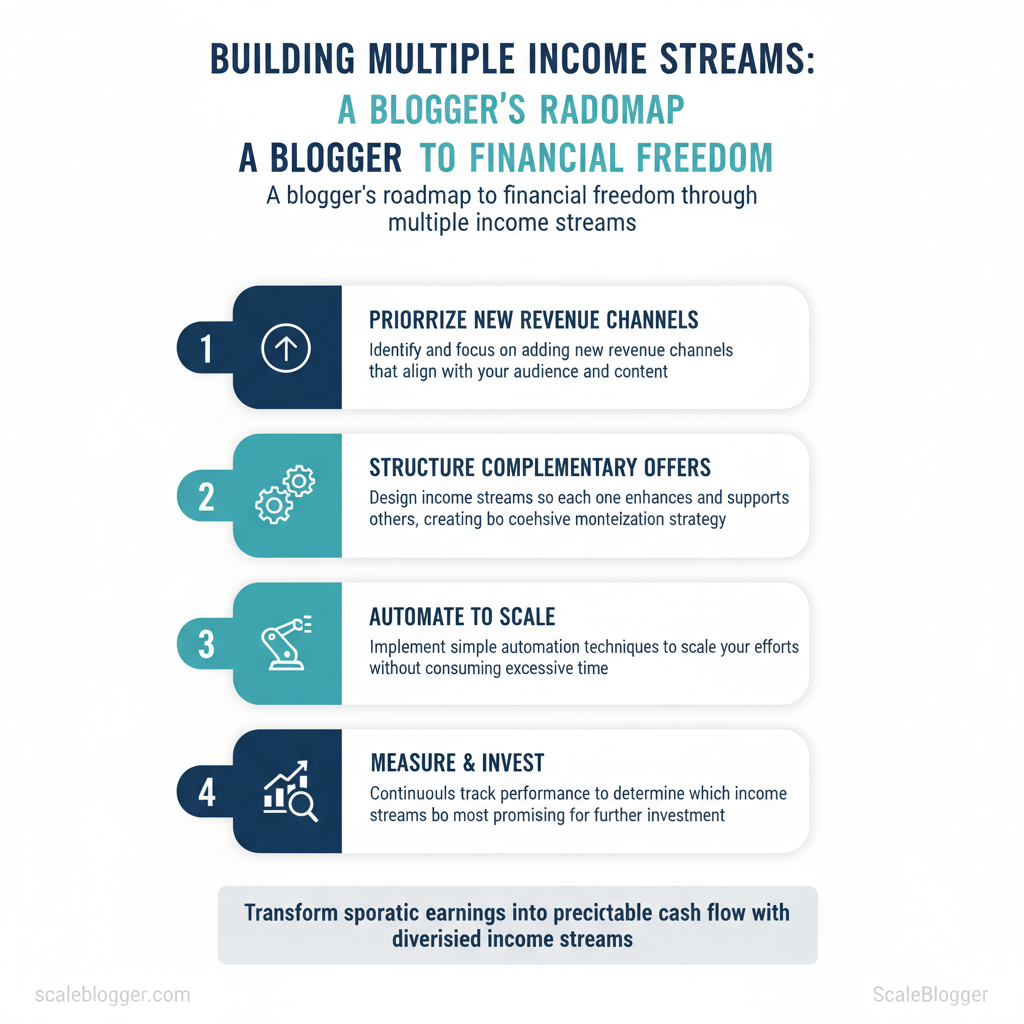
- What to prioritize first when adding new revenue channels
- How to structure offers so each stream complements the others
- Simple automation techniques to scale without burning time
- Ways to measure which income streams deserve more investment
Try Scaleblogger to automate and scale your blog monetization — the next sections map a step-by-step roadmap for turning diversified income into long-term financial freedom.
> Key Takeaway: ## Assess Your Starting Point — Content, Audience, and Monetization Readiness
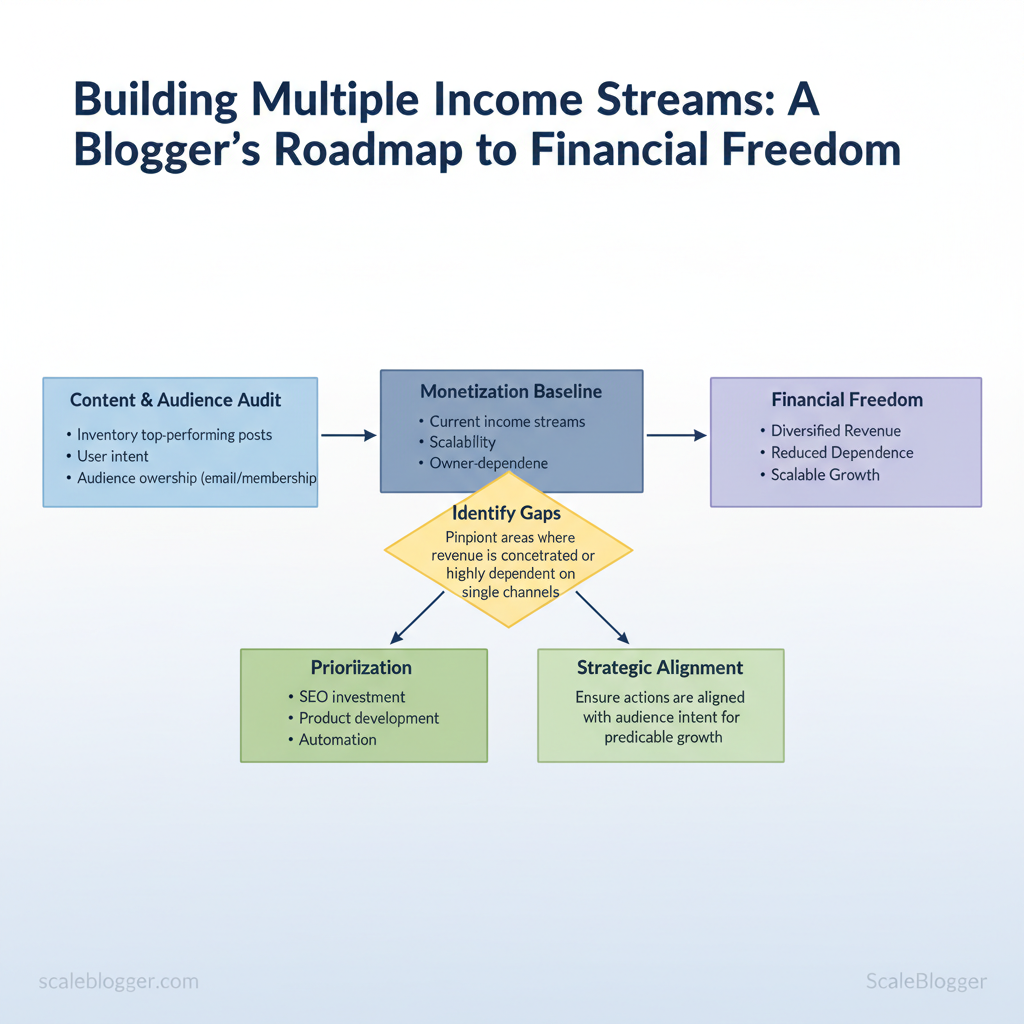
Start by treating the blog as a business line: inventory the content, map the audience intent, and quantify how monetizable the existing assets are. Fast and repeatable…
Assess Your Starting Point — Content, Audience, and Monetization Readiness
Start by treating the blog as a business line: inventory the content, map the audience intent, and quantify how monetizable the existing assets are. Fast and repeatable audits show if you need better content, more audience growth, or new ways to make money. The most practical first move is a targeted audit that identifies the top-performing posts, the dominant user intent (informational vs.
transactional), and how much of your audience you actually own via email or membership. —this creates clarity about whether to invest in SEO, product development, or automation.
Content & Audience Audit — What You Already Have
- Export the last 12 months of page-level traffic from Google Analytics and revenue from your payment/affiliate dashboards.
- Identify the top 10 posts by combined traffic and attributable revenue; tag each as informational, commercial, or transactional.
- Measure audience ownership:
email list size,open rate,CTR, and repeat traffic percentage. - Score readiness to monetize using simple thresholds: traffic concentration, intent match, email reach, and niche monetization density.
Quick audit scorecard to help bloggers rate content, traffic, email, and niche monetization potential
| Dimension | Metric to check | How to measure | Score (Low/Med/High) |
|---|---|---|---|
| Top posts (traffic & revenue) | Top 10 combined visits/revenue | GA4 pageviews + affiliate/ads revenue | High |
| Email list size & open rate | Subscribers / open rate |
According to industry data, email provider dashboard; >20% open = High | Med |
| Social following & engagement | Followers / engagement rate | Recent research indicates native analytics; ER >1% = Med | Low |
| Search traffic & keyword intent | % organic visits from queries | Search Console impressions & CTR | High |
| Niche monetization potential | Existing commercial intent keywords | Keyword lists; CPC estimates | Med |
Monetization Baseline — Current Revenue Streams and Gaps
Catalog each income stream, average the last 6 months, and tag scalability and owner-dependence. This exposes whether revenue is repeatable or tied to one-off deals.
Revenue source matrix showing earnings, scalability, time intensity, and control level
| Income Stream | Avg Monthly Revenue | Scalability (Low/Med/High) | Time Intensity | Control/Dependency |
|---|---|---|---|---|
| Display Ads | $200–$1,500 | Med | Low | Platform dependent |
| Affiliate Marketing | $300–$4,000 | High | Med | Merchant-dependent |
| Sponsored Posts | $500–$3,000 | Low | High | Client relationships |
| Digital Products (courses/eBooks) | $0–$5,000 | High | Med | Self-controlled |
| Services / Consulting | $1,000–$8,000 | Low | High | Owner-dependent |
Understanding the current state lets teams prioritize: top posts for conversion, strengthen email capture, or build one scalable product. When those moves are aligned with audience intent, growth becomes predictable and less time-intensive.
> Key Takeaway: ## Choose High- Income Streams — Mapping Options to Your Blog
Begin by aligning income streams with audience behavior and traffic level. High-traffic, low-engagement sites earn money differently than small, loyal audiences.
Choose High- Income Streams — Mapping Options to Your Blog
Begin by aligning income streams with audience behavior and traffic level. High-traffic, low-engagement sites earn money differently than small, loyal audiences. Choose streams that minimize friction for your readers and maximize for you — systems that scale without a linear time-for-money exchange. Below are concrete comparisons and niche mappings to make selection and first tests immediate.
Passive vs. Active Streams — Pros, Cons, and Suitability
Passive income earns with lower ongoing time per dollar but usually needs more upfront work or traffic; active income trades time or expertise for higher per-sale returns and faster conversion on smaller audiences. Typical time-to-earnings may vary by model and niche.
Table: Section Content — Income Stream, Best for (traffic/audience), Time to profit & more
| Income Stream | Best for (traffic/audience) | Time to profit | Upfront work | Scalability |
|---|---|---|---|---|
| Display Ads | High traffic, broad audience | Research from industry sources shows that 1–12 months (with traffic growth) | Medium (ad placement, layout tests) | High (revenue grows with traffic) |
| Affiliate Marketing | Niche-focused, commercial intent | 1–6 months (with targeted content) | High (content + conversion optimization) | High (content scales) |
| Digital Products | Loyal audience, expert content | 3–12 months (product dev + launches) | Very high (product creation, setup) | Very high (low marginal cost) |
| Sponsored Content | Established brand, stable traffic | 1–3 months (networking/PR) | Medium (pitching, content briefs) | Medium (depends on brand deals) |
| Services / Consulting | Small audience, high trust | Immediate–3 months (leads convert fast) | Low–Medium (proposals, onboarding) | Low–Medium (time-limited unless packaged) |
- Audit first. Identify pages with high intent and conversion potential.
- Prioritize the stream with fastest realistic path to positive ROI for your current traffic stage.
- Measure time-to-first-dollar and CAC (content acquisition cost) per stream.
Niche-Specific Opportunities — Tailoring Streams to Your Topic
Match each niche to the highest-converting channels, realistic CPMs/affiliate rates, and a lightweight first test to validate assumptions without heavy engineering.
Niche-to-income mapping to help readers see practical fits for their blog
| Niche | Top Income Streams | Typical CPM/Affiliate Rates | Recommended First Test |
|---|---|---|---|
| Personal Finance | Affiliate (loans, brokers), Courses, Consulting | CPM $8–$25; Affiliate 20–50% for products, $50–$200 CPA for leads | Publish a high-intent product review + apply to affiliate program |
| Tech / Productivity | Affiliate software, SaaS trials, Digital templates | CPM $4–$12; Affiliate 10–40% recurring | Create a comparison post with trial links and track conversions |
| Lifestyle / Parenting | Sponsored content, Affiliate physical products | CPM $3–$10; Affiliate 3–10% | Run a product roundup and pitch to 3 relevant brands |
| Health & Wellness | Courses, Affiliate supplements, Sponsored posts | CPM $6–$18; Affiliate 5–30% | Publish an evidence-backed guide and test supplement affiliate links |
| Niche Hobbies | Digital guides, Merch, Affiliate gear | CPM $2–$8; Affiliate 5–12% | Offer a paid mini-guide and measure sales from email list |
For workflow efficiency and predictable scaling, automate repeatable tasks — topic research, publication scheduling, and performance benchmarking — using AI content automation like the systems at Scaleblogger.com to free the team for higher- product and partnership work. Understanding these mappings makes it fast to pick the right experiment and iterate until a reliable revenue pipeline emerges.
> Key Takeaway: ## Build & Launch — Step-by-Step for Your First Additional Income Stream
Start by validating a narrow, search-intent driven offer fast, then execute a tight launch loop that converts visitors into paying users or leads. The quickest successes come…
Build & Launch — Step-by-Step for Your First Additional Income Stream
Start by validating a narrow, search-intent driven offer fast, then execute a tight launch loop that converts visitors into paying users or leads. The quickest successes come from creating a simple minimum viable product that matches clear intent signals. Then, run a short traffic test and adjust based on measurable results. This section walks through a 2–4 week validation sprint, the MVP checklist, and a practical launch playbook you can execute with common tools.
Planning & Validation — MVP Approach
Validate with focused search intent tests and small experiments before building a full product. Use keyword intent to define an offer that answers a transactional or high-value informational query. Run paid or email traffic tests to a single landing page with a lead magnet or pre-sale.Define success thresholds before you start so decisions are objective.
- MVP checklist: clear value proposition, 1-2 conversion actions, lead magnet or pre-sale, simple payment or sign-up flow, analytics tracking.
- Small tests to run: keyword CTR, landing page conversion, lead magnet downloads, paid ad cost-per-lead.
- Metrics to track: organic impressions & clicks (Google Search Console), landing page CTR, conversion rate (page → signup), cost-per-lead (Google Ads), email open/click rates (ESP).
> Market data shows short validation sprints reduce wasted development spend and speed decision cycles.
Validation sprint timeline showing activities and expected outcomes over 2-4 weeks
| Week | Activity | Tools Needed | Success Metric |
|---|---|---|---|
| Week 1 – Research & Keyword Intent | Map 10 target keywords, intent grouping | Google Keyword Planner, Google Search Console, Ahrefs/SEMrush |
Top 3 keywords with CPC ≤ $2, high intent phrases identified |
| Week 2 – Landing Page & Lead Magnet | Build single page + lead magnet PDF | Unbounce/WordPress + Mailchimp/ConvertKit | Landing CTR ≥ 5%, lead magnet download rate ≥ 20% of visitors |
| Week 3 – Traffic Test (ads/email) | Run small ad campaign + email blast | Google Ads ($100–$300 test), ESP analytics | Cost-per-lead ≤ $10, ≥ 50 leads or 5% CR from email |
| Week 4 – Data Review & Go/No-Go | Analyze results, decide launch or iterate | Google Analytics (GA4), Ads dashboard, ESP reports | Clear decision: scale if metrics met; iterate copy/offers if not |
Execution Checklist — Launch Steps & Templates
Launch with materials that remove friction and measure every touchpoint. Follow this ordered checklist and reuse the templates.- Build landing page: headline, subhead, 3 benefits, social proof, CTA,
one-clickpayment or lead capture. - Publish email welcome sequence (3 emails): welcome + deliver lead magnet, value-add content, offer/pitch on email 3.
- Set up tracking: GA4 events, UTM parameters for all links, conversion goals, Ads pixel, ESP conversion tags.
- Launch traffic: paid test, organic promotion, and targeted newsletters.
- first 90 days: run A/B tests for headlines, CTA text, pricing, and email subject lines; monitor cohort retention.
- Landing page copy template: bold headline that matches search intent, subhead clarifies outcome, bullet benefits, single CTA.
- Email sequence outline: 1) Deliver + expectation, 2) deeper value + social proof, 3) limited offer/next step.
- 90-day optimization checklist: monitor conversion trends weekly, reduce friction in checkout, increase sample size before changing major elements.
For faster execution, integrate AI content automation tools to generate copy variants and a content calendar. When done correctly, this sequence turns a validated idea into a repeatable revenue stream. Understanding these steps helps teams move faster without sacrificing quality.
Scale & Automate — Systems to Turn Income Streams into Reliable Revenue
Start by automating the repeatable, high-friction tasks that either consume owner time or directly influence conversion rates. Focus on systems that deliver measurable time savings or lift revenue per visitor; those automations pay back fastest and create predictable cash flow. The approach below prioritizes low-risk, high-ROI automations, explains how to measure impact, and shows when to bring humans back into the loop.
Automation & Tools — What to Automate First
Automate the routine that blocks growth and the conversion levers that move revenue.
- Prioritization checklist (do this first)
- Track time drains: Audit weekly tasks that consume owner/editor hours.
- Map conversion touchpoints: Identify pages, emails, or ads that drive revenue.
- Score by ROI: Estimate hours saved or conversion lift × value per conversion.
Common tool categories and what to look for:
- Content scheduling: bulk upload, editorial calendar, CMS integrations. Email automation: segmentation, behavior triggers, A/B testing. Affiliate link management: link cloaking, auto-updates, commission tracking.
- Ad/bid optimization: autobidding, budget pacing, ROAS rules. * Reporting & dashboards: real-time metrics, multi-source joins, alerts.
Table: Section Content — Task to Automate, Tool Type, Example Features & more
| Task to Automate | Tool Type | Example Features | Estimated Monthly Cost |
|---|---|---|---|
| Content Scheduling | Social/CMS scheduler (Buffer, CoSchedule) | bulk scheduling, calendar, WordPress integration | $12–$80 |
| Email Automation | ESP (Mailchimp, ConvertKit, Klaviyo) | segmentation, behavior triggers, templates | $9–$300+ |
| Affiliate Link Management | Link manager (Pretty Links, ThirstyAffiliates) | cloaking, redirects, auto-updates | $0–$79 |
| Ad/Bid Optimization | Ad automation (Google Ads automated bidding, Optmyzr) | rule-based bidding, scripts, budget pacing | $0–$299+ |
| Reporting & Dashboards | BI/dashboard (Looker Studio, Databox) | multi-source joins, scheduled reports | $0–$150 |
How to measure automation impact
- Baseline first: record manual time and conversion rates for 2–4 weeks.
- Run A/B or phased rollouts: compare traffic segments with/without automation.
- Calculate ROI: (hours saved × hourly rate) + incremental revenue — monthly cost = net gain.
When relevant, integrate an AI content automation layer — for example to auto-generate topic briefs or repurpose posts — as part of the scheduling pipeline to increase throughput without hiring more staff. Scaleblogger’s AI content automation framework fits naturally here for teams that need pipeline-level orchestration.
Outsourcing & Teaming — When to Hire and What to Delegate
Delegate execution, keep strategy close. Hire when specialization improves throughput or quality faster than internal training.
- Tasks to delegate first: content production (research + draft), technical SEO fixes, ad creative design, routine reporting.
- SOP essentials: clear inputs/outputs, acceptance criteria, file naming, review cadence, and
rollbacksteps. - Hiring channels & cost expectations: freelance marketplaces for $25–$80/hr writers; agencies for $2,000–$8,000/month retainers; offshore ops for $8–$20/hr.
- KPIs to measure: quality (editor pass rate), throughput (pieces/week), conversion lift (CTR, revenue per visitor), cost per acquisition.
Practical delegation steps
- Create a 1-page SOP per task. 2.
Run a paid pilot (2–4 weeks) with clear KPIs. 3. Use weekly reporting templates and a 30/60/90 review.
Understanding these systems lets teams scale predictable revenue while keeping decision-making and creative control where it matters. When automation and outsourcing are applied together, the routine stops being a bottleneck and becomes a growth engine.
Revenue Mix — Testing, Measurement, and Iteration
Think of your revenue mix as a portfolio. Each income stream requires specific metrics, a tracking method suited to its customer journey, and a schedule of experiments to confirm scale decisions. Build a dashboard that surfaces leading indicators (engagement, conversion rate changes) and lagging financials (ARPU, RPM) so teams can decide quickly whether to double down, tweak, or pause.
KPIs & Attribution — What to Track for Each Stream
Table: Section Content — Income Stream, Primary KPI, Secondary KPI & more
| Income Stream | Primary KPI | Secondary KPI | Attribution Notes |
|---|---|---|---|
| Display Ads | RPM (revenue per 1,000 pageviews) | Pageviews, Viewability rate | Use last-touch for quick reporting; consider view-based attribution for programmatic buys |
| Affiliate Sales | Conversion rate (click→sale) | Average order value (AOV) | Use click-through attribution with 30-day lookback; track assisted conversions to capture multi-touch paths |
| Digital Products | Revenue per visitor (RPV) | Trial-to-paid conversion | Use first-purchase attribution for product launches; track cohort LTV for pricing tests |
| Sponsored Content | Sponsor CPM / campaign ROI | Engagement time, Social shares | Use campaign-level attribution; blend direct traffic uplift with referral tracking to measure activation |
| Services | Lead-to-sale conversion rate | Sales cycle length, ARPA | Use multi-touch attribution (marketing-assisted pipeline) to capture top-of-funnel impact |
Experimentation Calendar — Quarterly Tests to Grow Revenue
- Define hypothesis, metric, and minimum detectable effect before any test.
- Prioritize tests by estimated impact × confidence ÷ effort (ICE score).
- Run one major revenue experiment and two rapid A/B tests per quarter.
Sample 90-day calendar:
- Month 1 — Productize: launch a small paid guide; test pricing tiers (A/B).
- Month 2 — Monetize: implement sticky ad placements on high-engagement pages; measure RPM lift.
- Month 3 — Convert: add targeted CTAs for services; run a landing-page variant for lead conversion.
Prioritization framework:
- Impact: Estimated monthly revenue upside
- Confidence: Data or precedent supporting the hypothesis
- Effort: Dev/content/time cost
Iterate faster by using time-boxed experiments, shared dashboards, and decision rules: if a test produces a statistically and commercially meaningful lift within the calendar quarter, scale; if not, archive the learning and move to the next prioritized item. Use automation and systems—such as AI content pipelines or scheduling tools—to reduce execution cost and accelerate the learning loop; tools like Scaleblogger.com can help automate publishing and performance benchmarking. Understanding these processes lets teams make repeatable, low-risk bets that progressively improve margin and predictability.
📥 Download: Multiple Income Streams Checklist for Bloggers (PDF)
Protect & Sustain — Legal, Tax, and Risk Management for Multiple Streams
To safeguard your multi-stream content business, establish clear rules to prevent legal issues and protect your profit margins. Start by treating each revenue source—ads, affiliates, sponsors, products—as a separate line item for compliance and tax purposes, then apply straightforward processes for disclosures, bookkeeping, and insurance so decisions stay operational rather than reactive.
Compliance & Disclosures — Stay Honest and Legal
Be explicit and consistent about what’s sponsored or affiliate-linked. The FTC requires clear, conspicuous disclosures that an average reader will notice. Place disclosures where the audience encounters the content (above the fold for social posts, at the top of long-form posts, and inline near affiliate links).
- FTC basics: Disclose material connections clearly and unambiguously; avoid buried language.
- Placement best practice: Top-of-post disclosure + inline near each affiliate link; use bold or a short sentence.
- Common pitfalls: Vague language, disclosure only in a terms page, or buried in a footer.
Example disclosure copy (use and adapt):
Sponsored post: This article is sponsored by [Brand]. I received compensation for this review, but opinions are my own. Affiliate links: Some links are affiliate links — if you buy through them I may earn a commission at no extra cost to you.- Label sponsored social posts with
#ador#sponsoredat the start of the caption. - For affiliate links, add an inline note: “This is an affiliate link — I may earn a commission.”
- Keep a compliance log: date, content ID, revenue type, disclosure used.
Practical examples: Publishers often use a short banner at the top of sponsored posts plus the affiliate line next to each CTA. That redundancy reduces risk and keeps reader trust.
Taxes, Accounting & Insurance — Financial Hygiene
Track revenue by source from day one and reconcile monthly so tax planning is predictable. Separate business and personal accounts, set a bookkeeping cadence, and know when to bring in professionals.
Estimated cost ranges for essential financial/professional services bloggers may need
| Service | Typical Cost Range | When to Hire | Expected Benefit |
|---|---|---|---|
| Bookkeeper | $200–$800/month or $30–$75/hr | When monthly transactions >30 or you want clean P&L | Accurate cash flow, monthly reconciliations |
| Accountant / Tax Prep | $300–$2,500/year | Before first tax filing as a business or for complex returns | Tax optimization, compliance, audit support |
| Legal contract review | $200–$1,500 per contract | Before signing sponsorships or partnerships | Reduces liability, clarifies IP and payment terms |
| Business insurance (liability) | $300–$1,500/year | When monetization exceeds hobby threshold or hiring contractors | Protects against third-party claims and E&O risks |
Recommended cadence and triggers:
- Monthly: Reconcile accounts, tag income by stream, review P&L.
- Quarterly: Run tax estimates, update cash reserves.
- Annually: Consult accountant for tax strategy, review insurance limits, and get legal review of new contract templates.
When income from any stream becomes material (e.g., consistent monthly revenue above local hobby thresholds) move to a business bank account and hire an accountant. Proper setup reduces surprises and lets the team focus on growth rather than firefighting. Understanding these practices keeps the business resilient and decision-ready as revenue scales.
Conclusion
The strategies outlined here move beyond chasing traffic and toward building predictable revenue: diversify income streams, systematize content-to-conversion paths, and treat experimentation as a repeatable process. You saw how niche blogs that introduced bundled digital products and simple affiliate funnels recovered lost ad revenue within months, and how a consistent editorial cadence paired with automated distribution lifted engagement without extra headcount. Expect an initial setup phase where measurement and small A/B tests matter most; the pattern shows durable gains once workflows and monetization hooks are automated.
If the next question is where to begin, start by mapping current revenue by channel, pick one underperforming but scalable lever, and run a 90-day sprint to test pricing or a lead magnet. If you’re unsure how long it will take to see results, expect measurable signs in 6 to 12 weeks and growth that builds up over the months. Prioritize diversifying revenue and automating repeatable content tasks so effort turns into predictable output.
com) is one practical next step to accelerate the process.
