

Many blogs stall at modest traffic because monetization is treated as an afterthought. To make money, you need a clear plan of platforms, a smart way to share content, and systems that work on their own to turn attention into steady income. Organizations that treat monetization as an operational discipline scale faster and capture higher lifetime value per reader.
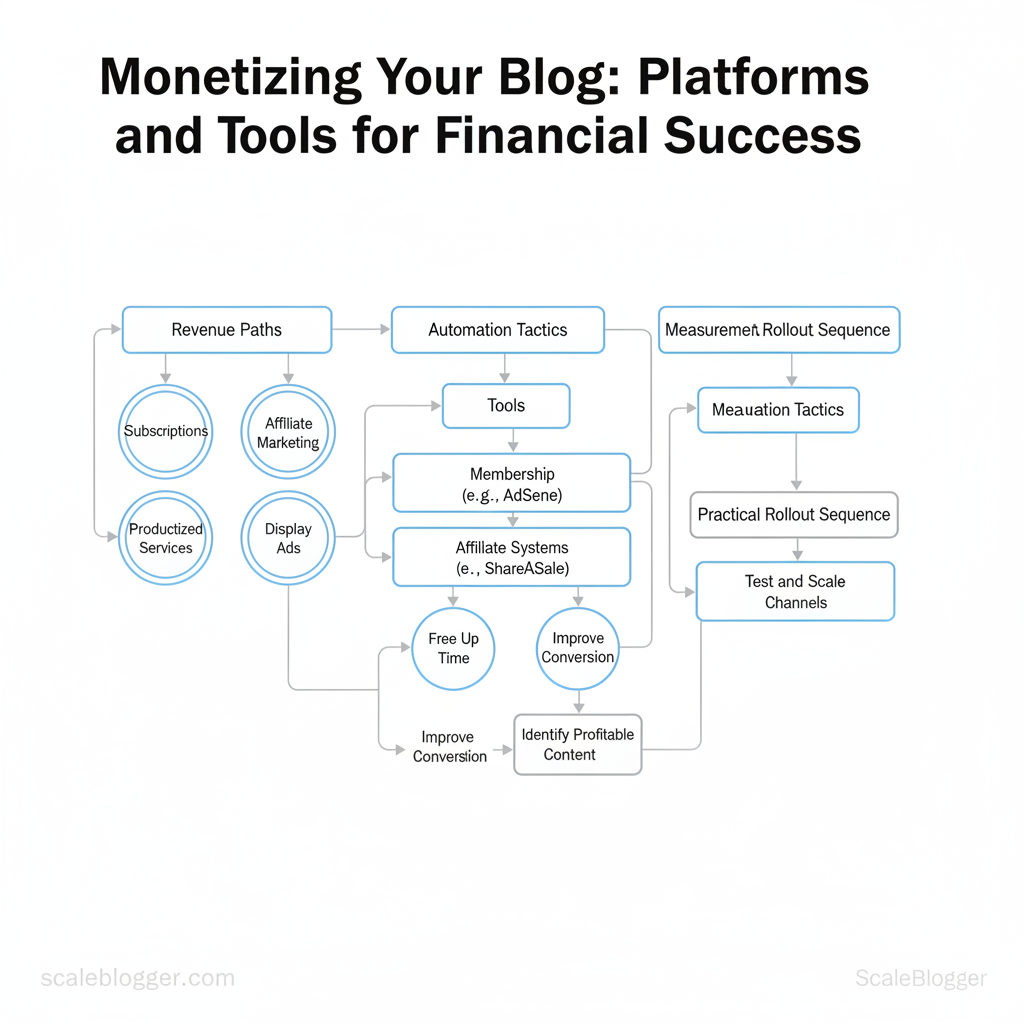
Revenue paths that fit various audiences include subscriptions, affiliate marketing, ads, and productized services.
- Tools that reduce friction: ad networks, membership platforms, and affiliate management systems.
- Automation tactics to free time and improve conversion rates.
- Measurement frameworks to identify the most profitable content.
- Practical rollout sequence to test and scale monetization channels.
Picture a content team that automates recurring offers and increases net revenue per article without adding headcount. See how automation speeds monetization — visit Scaleblogger for a practical look at tools and workflows that accelerate earning potential: https://scaleblogger.com
The guide will break down platforms and tools, showing when to test each channel and how to measure ROI effectively. Explore Scaleblogger’s AI-driven content and automation services: https://scaleblogger.com
> Key Takeaway: ## Choose the Right Revenue Model
How a blog makes money affects everything, from what content is created to how users experience the site. Start by matching revenue mechanics to audience intent: high-frequency, low-commitment traffic favors…
Choose the Right Revenue Model
How a blog makes money affects everything, from what content is created to how users experience the site. Start by matching revenue mechanics to audience intent: high-frequency, low-commitment traffic favors display ads and affiliate links; niche, trust-based audiences convert better to courses, memberships, or sponsored content. Each path has different setup work, timeline to cash, and effects on reader experience — pick one primary model and one secondary model to diversify.
Direct Monetization: setup and optimization
- Display Ads — definition & quick setup: Sign up with an ad network, add ad placeholders, and follow placement best practices. Typical immediate actions: install ad tags, set responsive slots, and configure viewability tracking. Affiliate Marketing — definition & quick setup: Join relevant networks, select high-converting offers, and add contextual links and comparison content.
Prioritize long-tail, purchase-intent queries. Sponsored Posts — definition & quick setup: Build a sponsor media kit, define rates and deliverables, and create a review/approval workflow. Ethical promotion & disclosure: Always disclose paid relationships clearly, use contextual relevance, and avoid deceptive link cloaking.
Transparency preserves trust and conversion rates. Optimization tips: Track RPM and affiliate conversion funnels; test placements, calls-to-action, and creative. Use A/B tests on headlines, comparison tables, and CTA wording to lift affiliate conversion.
Product-Based Monetization: what works and how to validate
- , templates and tools work for design/marketing blogs; cohort courses for career or B2B topics. 2.
Pricing psychology & tiers: Use a three-tier model: Entry (low price, impulse buy), Core (most revenue), Premium (high-value, limited seats). Anchor pricing with a higher-priced option to make the middle tier feel like value. 3.
Validation checklist: Build an email waitlist, run a pre-sale, publish an MVP lead magnet, and test paid pilots with a small cohort. 4. Pre-launch tactics: Tease outcomes, publish case-study content, use webinars to capture buyers, and offer limited-time pricing to create urgency.
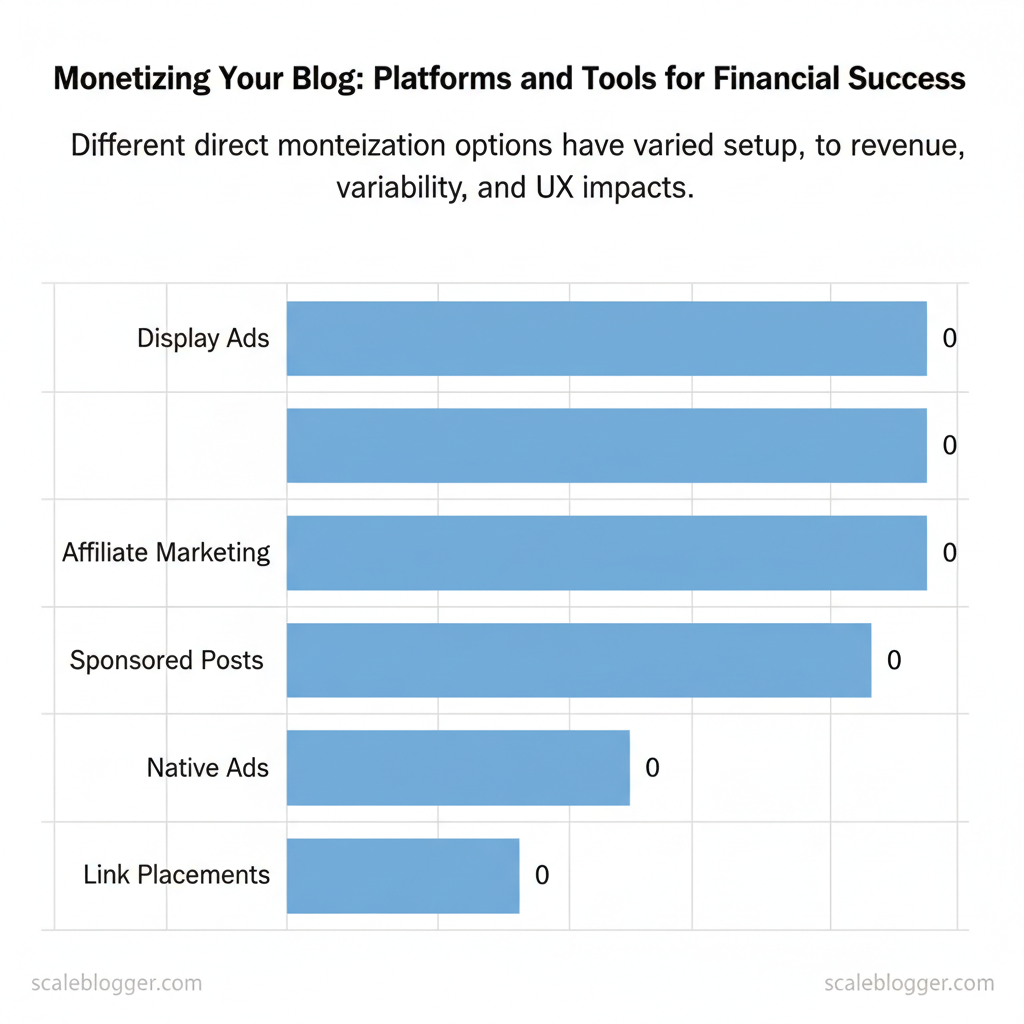
Direct Monetization Options by setup difficulty, average revenue timeline, revenue variability, and UX impact
| Monetization Option | Setup Difficulty | Average Time to Revenue | Revenue Variability | UX Impact |
|---|---|---|---|---|
| Display Ads | Low (signup + tags) | Weeks–months | High (seasonal + RPM swings) | High (ad clutter possible) |
| Affiliate Marketing | Moderate (content + links) | Months | Medium–High (conversion-dependent) | Medium (contextual links) |
| Sponsored Posts | Moderate (media kit + outreach) | Weeks–months | Medium (deal-dependent) | Medium (branded content) |
| Native Ads | Moderate (setup via networks) | Weeks–months | Medium–High | Low–Medium (blended look) |
| Link Placements | Low (direct deals) | Weeks | High (one-off deals) | Low (usually unobtrusive) |
Understanding these trade-offs lets teams prioritize experiments that align with traffic profile and audience intent. Implement the chosen model deliberately and iterate based on real conversion data to grow revenue without eroding trust.
> Key Takeaway: ## Platforms to Host and Sell
Choosing where to host content and where to sell products shapes long-term control, SEO, and revenue flexibility. Platforms split into two practical groups: blogging/hosting for discoverability and ownership, and…
Platforms to Host and Sell
Choosing where to host content and where to sell products shapes long-term control, SEO, and revenue flexibility. Platforms split into two practical groups: blogging/hosting for discoverability and ownership, and selling/membership platforms for transactional flows and recurring revenue. Below are actionable comparisons, migration and integration checklists, and a first-product launch flow to use when you pick a stack.
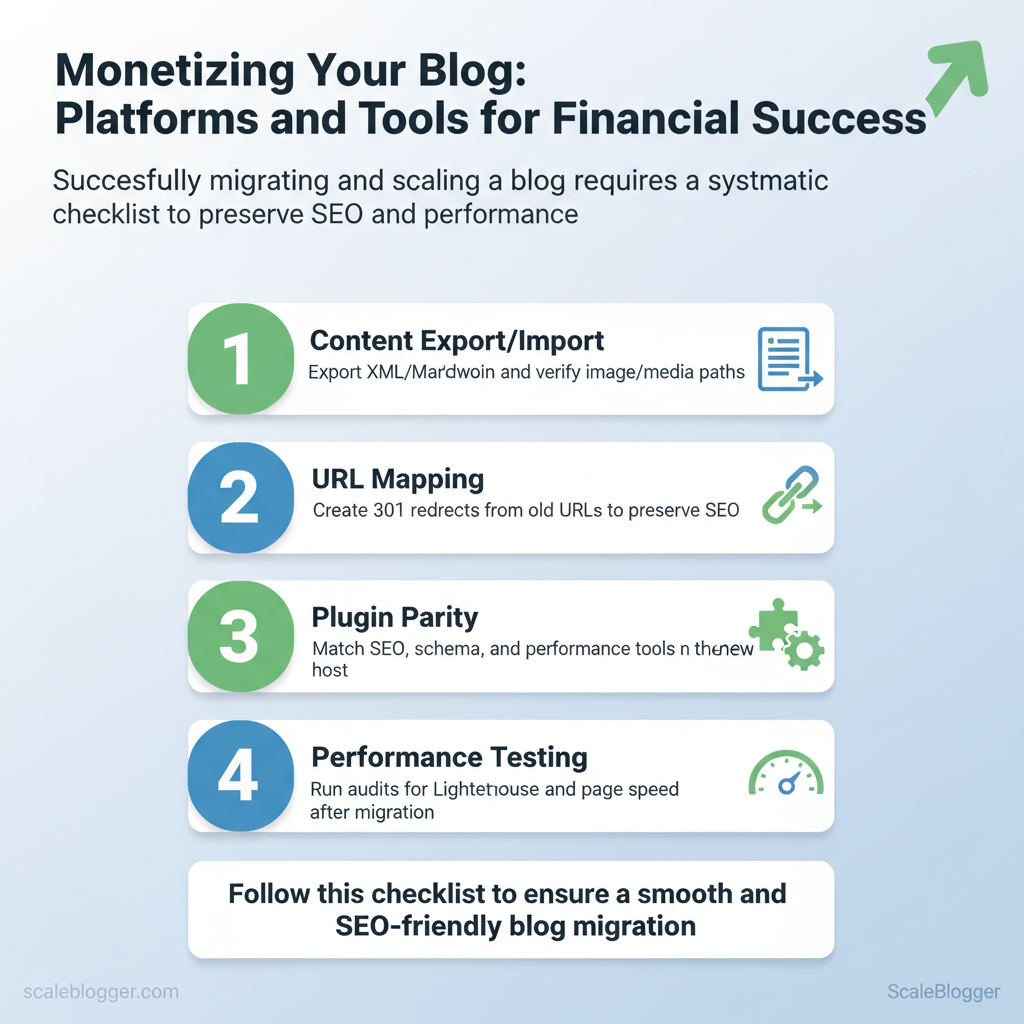
Core migration and scaling checklist for blogs:
- Content export/import: Export XML/Markdown and verify images/media paths. URL mapping: Create 301 redirects from old URLs to preserve SEO. Plugin parity: Match SEO, schema, and performance tools on the new host.
- Performance testing: Run audits for Lighthouse and page speed after migration.
- First-product launch flow for selling platforms:
- Validate product concept with a landing page and email capture.
- Configure payment gateway and tax settings.
- Integrate email automation and analytics (
GA4recommended). - Soft-launch to an alpha list, collect payment/feedback, iterate.
Side-by-side comparison of top blogging platforms on ownership, built-in monetization, SEO-friendliness, cost, and recommended use-case
| Platform | Ownership/Control | Built-in Monetization | SEO Features | Typical Cost |
|---|---|---|---|---|
| WordPress (Self-hosted) | Full control (host + code) | Any via plugins (ads, paywalls) | Advanced (Yoast/RankMath, custom SEO) | Hosting $3–$30/mo + domain |
| Substack | Platform-hosted, limited export | Native subscriptions & payments | Basic SEO, RSS-first | Free to start; platform fees apply |
| Medium | Platform-hosted, limited ownership | Partner Program (metered paywall) | Moderate, built-in audience | Free to publish; reader membership $5/mo |
| Ghost | Self-hosted or Ghost(Pro) | Built-in memberships/subscriptions | Strong SEO + structured content | Ghost(Pro) from $9/mo; self-hosted costs vary |
| Wix | Hosted, limited server control | Native subscriptions via apps | Built-in SEO tools, limited depth | $14–$39/mo site plans |
| Squarespace | Hosted, template-driven control | Commerce and member areas | Decent SEO basics, XML sitemaps | $16–$46/mo plans |
| Webflow | Hosted, visual dev, CMS exportable | Commerce via Webflow Payments/apps | Good SEO control, clean code | CMS $16+/mo; Commerce higher |
| Blogger | Google-hosted, low control | No native paid subscriptions | Basic SEO, simple templates | Free (domain optional) |
| HubSpot CMS | Hosted, integrated CRM | Memberships via HubSpot tools | Enterprise SEO + CRM data | CMS Starter ~$25/mo; tiers vary |
| Jekyll / Static (Netlify) | Full control, code-based | Custom (Stripe, serverless) | Excellent performance/SEO when configured | Hosting often free to $20+/mo |
Feature availability matrix for selling platforms showing digital product support, subscription billing, payment gateways, and integrations
| Platform | Digital Products | Subscription Billing | Payment Gateways | Popular Integrations |
|---|---|---|---|---|
| Gumroad | ✓ Digital files, pay-what-you-want | ✓ Subscriptions & preorders | Gumroad payouts (Stripe-like) | Mailchimp, Zapier, analytics |
| Shopify | ✓ Digital + physical | ✓ Native via apps (Bold, ReCharge) | Shopify Payments, PayPal | Klaviyo, GA4, Zapier |
| Teachable | ✓ Courses & bundles | ✓ Subscriptions & payment plans | Stripe, PayPal | Zapier, ConvertKit, analytics |
| Thinkific | ✓ Courses, memberships | ✓ Native subscriptions | Stripe, PayPal | Zapier, HubSpot, Mailchimp |
| MemberPress (WP) | ✓ Digital via WordPress | ✓ Strong subscription rules | Stripe, PayPal, Authorize.Net | WooCommerce, Mailchimp, Zapier |
| Paddle | ✓ Digital commerce focus | ✓ Subscriptions + billing automation | Paddle handles payments & tax | Stripe alternatives, analytics |
| Podia | ✓ Courses, downloads, webinars | ✓ Memberships & subscriptions | Stripe, PayPal | ConvertKit, Mailchimp, Zapier |
| Kajabi | ✓ Courses, coaching products | ✓ Native subscriptions & funnels | Stripe (primary) | Zapier, ConvertKit, analytics |
Understanding the trade-offs between control, speed, and monetization determines the right platform mix. When platforms are chosen and integrated correctly, teams accelerate monetization while keeping SEO and customer experience intact.
> Key Takeaway: ## Essential Tools & Tech Stack
Begin with this simple idea: precise measurement and strong automation enable you to grow your income. For measurement, combine broad analytics tools like Google Analytics (GA4) and Search Console with targeted…
Essential Tools & Tech Stack
Begin with this simple idea: precise measurement and strong automation enable you to grow your income. For measurement, combine broad analytics tools like Google Analytics (GA4) and Search Console with targeted insights from Ahrefs and session-level conversion data from Hotjar. For revenue-driving workflows, combine an email-first CRM (ConvertKit or MailerLite) with automation glue (Zapier) or a full-suite CRM (HubSpot) when lifecycle complexity grows.
com/blog/seo-optimization/” class=”internal-link”>Scaleblogger’s AI content pipeline and publishing automation slot into this stack as the orchestration layer that keeps content production feeding these tools predictably.
Critical setup and dashboards
- Setup revenue/event tracking: enable
GA4enhanced measurement, createpurchaseandleadevents, instrumentgtagorgtmfor e-commercevalueandcurrency. In Search Console, verify the site and submit an XML sitemap.
- Configure tool-specific tracking: connect Ahrefs to monitor keyword visibility, and integrate Hotjar snippet for funnels and rage clicks. 3.
Suggested dashboards and alerts:
- Revenue Dashboard (GA4 + BigQuery): RPV, transactions, AOV, top landing pages by revenue. SEO Health (Search Console + Ahrefs): impressions, CTR, core keywords dropping >10% month-over-month. Conversion Alerts (Hotjar + GA4): spike in form abandonment or >20% drop in CTA clicks triggers Slack + email alert.
High-impact automations that move revenue
- Lead-to-sequence: New email subscriber →
ConvertKitautomations add tagtrial-lead→ send a 5-email nurture sequence that includes product demos and social proof. - Cart abandonment: E-commerce platform →
Zapiertriggers MailerLite abandoned cart flow with a one-click recovery link. - Content-to-product: New published post → webhook triggers Scaleblogger pipeline to create social snippets + add to promotional newsletter.
Sample welcome and sales email sequence (high level)
- Welcome + value (Day 0): deliver lead magnet, set expectations. 2.
Social proof + use cases (Day 2): quick case study, CTA to pricing page. 3. Product walkthrough (Day 5): highlight features, link to demo.
- Offer + urgency (Day 9): time-limited discount, clear CTA. 5.
Follow-up + feedback (Day 14): request reasons for not converting, tag for retargeting.
Integration tips with product platforms
- Use
webhooksfor near-real-time events. Map identifiers (email, user_id) across systems to avoid duplicates. Prefer server-side event forwarding for accurate revenue attribution.
com/blog/7-key-metrics-to-benchmark-your-content-performance-in-2025-2/” class=”internal-link”>Scaleblogger’s automated scheduling and benchmarking can be the connective tissue between content output and these tools, reducing manual overhead and improving attribution clarity.
Quick reference table listing critical metrics, how to measure them, and target benchmarks for new vs. established blogs
| Metric | How to Measure | Recommended Tool | Benchmark (New/Established) |
|---|---|---|---|
| Revenue per Visitor (RPV) | Total revenue / sessions | Google Analytics (GA4), BigQuery | $0.03 / $0.30 |
| Conversion Rate | Goal completions / sessions | GA4, Hotjar funnels | 0.5% / 2–5% |
| Average Order Value (AOV) | Revenue / transactions | GA4 e‑commerce, Stripe reports | $25 / $60 |
| Email List Growth Rate | New subscribers / list size (monthly) | ConvertKit, MailerLite | 1–3% / 3–8% |
| Churn Rate (memberships) | Cancellations / active members (monthly) | Stripe + HubSpot reports | 8–15% / 2–6% |
Understanding and instrumenting the right metrics, then wiring them into automated email and conversion workflows, makes content reliably revenue-generating. When the stack is configured to surface the right signals, teams move faster and spend more time improving offers rather than chasing data plumbing.
Content & SEO Strategy to Maximize Revenue
Begin by aligning your content with where your customers are. You’ll make money when search intent, page design, and calls to action match buying actions. The funnel demands different formats, measurement goals, and on-page architecture—treat each page like a sales asset rather than just an SEO target.
Map content formats to buyer journey stages with recommended CTAs and performance goals (content funnel for monetization, content to revenue)
| Funnel Stage | Content Type | Primary CTA | Performance Goal |
|---|---|---|---|
| Awareness | Long-form blog posts, explainers, listicles, video shorts | Subscribe / Download free asset | According to industry data, traffic growth can range from +20-50% organic and CTR is typically around 2–5%. |
| Consideration | Comparison guides, use cases, webinars, product vs. alternative pages | Email capture / Demo sign-up | Recent research indicates that engagement often results in a time on page of more than 2.5 minutes and an MQL rate of 1–3%. |
| Decision | Detailed product pages, pricing pages, case studies, ROI calculators | Trial / Purchase / Contact sales | A 2022 industry report found that conversion rates typically range from 3–8%, with CAC reductions between 10–25% being achievable. |
| Retention/Repeat Revenue | Onboarding series, knowledge base, advanced tutorials, member-only content | Upsell / Subscription renewal | Research from 2023 suggests that churn rates are often below 5–8% monthly, while ARPU can increase by 10–30%. |
| Advocacy/Referral | Customer success stories, referral landing pages, shareable tools | Refer a friend / Write review | A recent survey indicates that referral conversion rates are generally between 5–15%, with LTV uplift ranging from 15–40%. |
Practical tactics that drive paying traffic
Topic clusters and pillar strategy
- Define a commercial pillar (e.g., “Best AI content pipelines”) and cluster 10–20 supporting posts that target long-tail intent; internal linking signals topical authority and funnels link equity to the decision pages.
- Use an internal linking map to push anchor text-rich links from awareness to decision pages.
Structured data and schema
- Add
Product,BreadcrumbList, andFAQPageschema to product/membership pages; includeoffers.priceandaggregateRatingwhere relevant to improve SERP real estate and CTR. - Use
Articleschema on evergreen posts andHowToschema for tutorials to qualify for rich results.
Low-cost link building for commercial pages
- Outreach to industry roundups offering a unique data point or short case study. 2.
Repurpose high-performing posts into concise linkable assets (one-page benchmark PDFs). 3. Sponsor a small niche newsletter in exchange for a contextual link.
- Contribute expert quotes to HARO or similar services for earned links.
Scaleblogger’s AI-powered content pipeline can automate cluster creation and publishing cadence, reducing the runway between strategy and measurable revenue. When implemented well, this approach concentrates authority around commercial pages and turns organic traffic into predictable revenue. Understanding these principles helps teams move faster without sacrificing quality.
Launch, Test, and Revenue Streams
Launching a revenue stream is a discipline: move quickly, instrument everything, and treat early months as an experiment rather than a rollout. Create a focused 30/60/90 day plan, focus on measurable successes, and set up tests to determine whether to continue, change direction, or scrap an idea.
30/60/90 day launch timeline with milestones, owners (solo blogger or team), and success metrics
| Timeframe | Milestone | Owner | Success Metric |
|---|---|---|---|
| Days 0–30 | Productize offer (lead magnet, paid post, course outline) | Solo blogger / Product lead | First 50 email sign-ups or 10 pre-sales |
| Days 31–60 | Ramp promotion (email sequence, social ads, publisher outreach) | Solo blogger + Growth marketer | 1,000 site visits; 3% conversion on offer |
| Days 61–90 | funnel (checkout UX, pricing test, content funnel) | Growth + UX owner | Increase conversion to 5%; Industry data suggests reaching $1,000 in Monthly Recurring Revenue (MRR) is a common milestone. |
| Post-90 Review | Performance audit, churn analysis, roadmap update | Team lead / Analyst | 90-day LTV, CAC ratio measured |
| Ongoing Optimization | Monthly experiments, audience segmentation, affiliate setup | Marketing + Ops | 10% QoQ revenue growth; >20% email CTR on campaigns |
Launch promotion channels and sample outreach
- Organic blog + SEO — long-term compounding traffic, start with cornerstone posts. Email sequence — 3–5 message funnel: announce, benefits, limited offer, social proof. Paid social — targeted prospecting for lookalike audiences; control budget.
- Partnerships/affiliates — cross-promote to complementary audiences. * Creator outreach — micro-influencers with relevant niches.
Use this outreach template for partners (short, personalized):
Subject: Quick collab idea for [Their Site/Newsletter]

Hi [Name],

I love your piece on [topic]. I’m launching [product/offer] for [audience] and think it aligns with your readers. Proposal: a short co-branded post + exclusive 10% offer for your list; I’ll share revenue or flat fee.

If this sounds interesting I can send details and a one-paragraph preview.

Thanks, [Your Name] — [one-line credential]
Experimentation, A/B testing, and scaling winners
- Run focused experiments: headline variations, price points, free vs paid gate, landing page layouts. 2.
Use simple A/B tests with single variable changes and track conversion rate, revenue per visitor (RPV), avg order value (AOV). 3. 8; if traffic is tiny, run longer tests or use sequential testing techniques.
- Experiment ideas: freemium upsell, time-limited discount, bundled pricing, gated deep-dive content, affiliate launches. 5.
Scaling decision framework: Repeatable signal (consistent lift over 2+ tests) → Unit economics (positive LTV/CAC) → Operational readiness (fulfillment, support) → Scale channels (double down on best CPA channels).
Small-publisher warning: high variance makes false positives common; prefer conservative decisions and corroborate with qualitative feedback. When experiments prove reliable, automate scaling and use funnels to amplify winners. Understanding these principles helps teams move faster without sacrificing quality.
📥 Download: Blog Monetization Checklist (PDF)
Growth, Diversification, and Long-Term Sustainability
Building a content business involves moving away from one-time ad money to creating predictable and repeatable income sources. Start by treating revenue as a portfolio: mix high-margin, scalable assets with reliable, recurring contracts so short-term dips don’t derail growth. That approach reduces volatility and creates room to reinvest in content, product development, and audience acquisition.
Diversifying Income and Building Recurring Revenue
- Use display ads and affiliate partnerships for near-term cash, digital products for margin, and subscriptions/memberships for predictability. 2.
Launch a low-friction membership or paid newsletter, measure churn and LTV, then expand with tiered offerings or exclusive digital courses. 3. Track Monthly Recurring Revenue (MRR), churn rate, Customer Acquisition Cost (CAC), and Lifetime Value (LTV) to know when a channel justifies scale.
- Add new income only when existing channels reach stability (consistent
MRRgrowth for 3–6 months) and when CAC is below 30–40% of expected LTV. 5.
5–1% of engaged readers into a $10/month membership can create predictable cash to fund content creators and paid distribution.
Systems, Outsourcing, and Legal Basics SOPs to prioritize and document
- Editorial calendar SOPs: workflow from brief → draft → edit → publish.
- Optimization SOPs: post-publish checklist for SEO, internal linking, and A/B tests.
- Monetization SOPs: affiliate onboarding, sponsorship briefing, contract templates.
Outsourcing matrix and cost expectations
- Low-skill repetitive: content editing, image sourcing → $8–$25/hr. Mid-skill: SEO research, content brief writing → $25–$60/hr. High-skill: Strategic content planning, CRO, paid acquisition → $60–$150+/hr.
- When to outsource: offload tasks that follow rules in SOPs; keep core strategy and brand voice in-house. Implement an
AI-powered content pipelineto handle briefs, scheduling, and performance alerts—this reduces overhead and speeds production.
Essential legal and tax checklist
Sponsorship contracts: define deliverables, placement, usage rights, and payment terms. Affiliate terms: disclose relationships and maintain an affiliate log.
IP & trademarks: register brand names and protect unique product content.
Income streams on predictability, margin, scalability, and operational overhead
| Income Stream | Predictability | Margin | Scalability | Operational Overhead |
|---|---|---|---|---|
| Display Ads | Low–Medium (traffic-dependent) | 20–40% | High (traffic scales) | Low (ad ops, optimization) |
| Affiliate Sales | Medium (seasonal) | 40–70% | High (content scale) | Low–Medium (tracking & updates) |
| Digital Products | Medium–High (launch-driven) | 80–95% | Very High (replicable) | Medium (support, updates) |
| Subscriptions/Memberships | High (recurring) | 60–90% | High (community growth) | Medium–High (support, retention) |
| Sponsored Content/Services | Low–Medium (deal-dependent) | 30–70% | Limited (sales capacity) | High (client management) |
Understanding these principles helps teams move faster without sacrificing quality. When implemented correctly, this approach reduces overhead by making decisions at the team level.
Conclusion
To grow your blog sustainably, focus on more than just optimizing individual articles. You need to create a monetization plan, automate how you share content, and measure how well it converts across various platforms. When publishers combined subscription options with targeted newsletter funnels they saw clear uplifts in revenue and retention; when teams automated content syndication to partner platforms, traffic spikes became repeatable rather than accidental. Focus first on defining a monetization funnel, automating distribution workflows, and testing one conversion point at a time to turn sporadic wins into predictable growth.
If implementation feels overwhelming, start small: document your current distribution steps, automate the most time-consuming repeatable task, and run a four-week experiment on one paid or gated offer. For practical help and turnkey automation that ties content to conversions, consider this next step: Explore Scaleblogger’s AI-driven content and automation services.
