

Audience attention is scattered, and paid advertising gets more expensive each quarter. Encourage user-generated content and audience involvement to boost real engagement, reduce acquisition costs, and speed up content creation. In short, focus on community-driven content, set up a system for capturing UGC, and use automation to channel effective content into owned platforms for measurable reach and improved conversions.
This is important because social proof works better than brand messages. Regular audience contributions also build a continuous content stream. Imagine a product team turning customer photos and short reviews into weekly highlight posts that double views while cutting creative costs in half. Research shows that marketers using UGC workflows experience higher engagement and more efficient creative processes.
Credibility comes from repeated patterns across mature content programs: incentives, simple submission paths, and automated moderation multiply contributions without manual overhead. The rest of this guide explains practical tactics, governance rules, and tools to operationalize UGC at scale, with concrete steps for attribution and measurement.
- What makes UGC perform better than brand content on social and email
- Simple workflows to collect, moderate, and republish audience content
- Incentives and governance that protect brand voice while boosting volume
- Measurement metrics to track engagement lifts and cost savings
- How automation platforms like Scaleblogger UGC pipelines
Explore Scaleblogger and start automating your UGC strategy: https://scaleblogger.com

> Key Takeaway: ## Why User-Generated Content Matters
User-generated content shifts the focus from brand messages to customer stories. This change positively affects trust, reach, and cost-efficiency.
Why User-Generated Content Matters
User-generated content shifts the focus from brand messages to customer stories. This change positively affects trust, reach, and cost-efficiency. When potential customers see reviews, photos, or detailed testimonials from others, their skepticism decreases and engagement increases. This is because genuine signals come from outside the brand.
UGC is a powerful tool for building social proof, enhancing organic discoverability, and maximizing the value of your marketing budget.
How UGC drives value
- Trust and social proof: Consumers treat peer reviews and real photos as unbiased evidence; this often outperforms polished marketing in conversion lift. Brand authenticity: Real stories expose brand personality and product use-cases that official creative rarely captures. Reach amplification: Each contributor shares with their networks, producing secondary distribution without incremental ad spend.
Research from recent studies indicates that reviews and comments create long-tail content and semantic relevance for product + problem queries. According to industry data, incentives or community management typically do not cost a fraction of producing studio-level content.
Measuring authenticity signals
- Engagement quality: Ratio of comments to likes indicates conversational depth. Reviewer credibility: Percent of reviews from repeat purchasers or verified buyers. * Content diversity: Mix of media types (video, photos, text) and use-case descriptions.
- Sentiment consistency: Distribution of sentiment over time, not just average score.
Simple ROI estimation (practical steps)
- Estimate production cost: tally creative, editing, distribution for a brand post (
$). 2.
Measure earned engagement: aggregate likes/comments/shares for a UGC post. 3. Translate to visits: use historical conversion rates to convert engagement into site visits.
- Calculate incremental value: multiply visits by average revenue-per-visit, subtract cost, divide by cost.
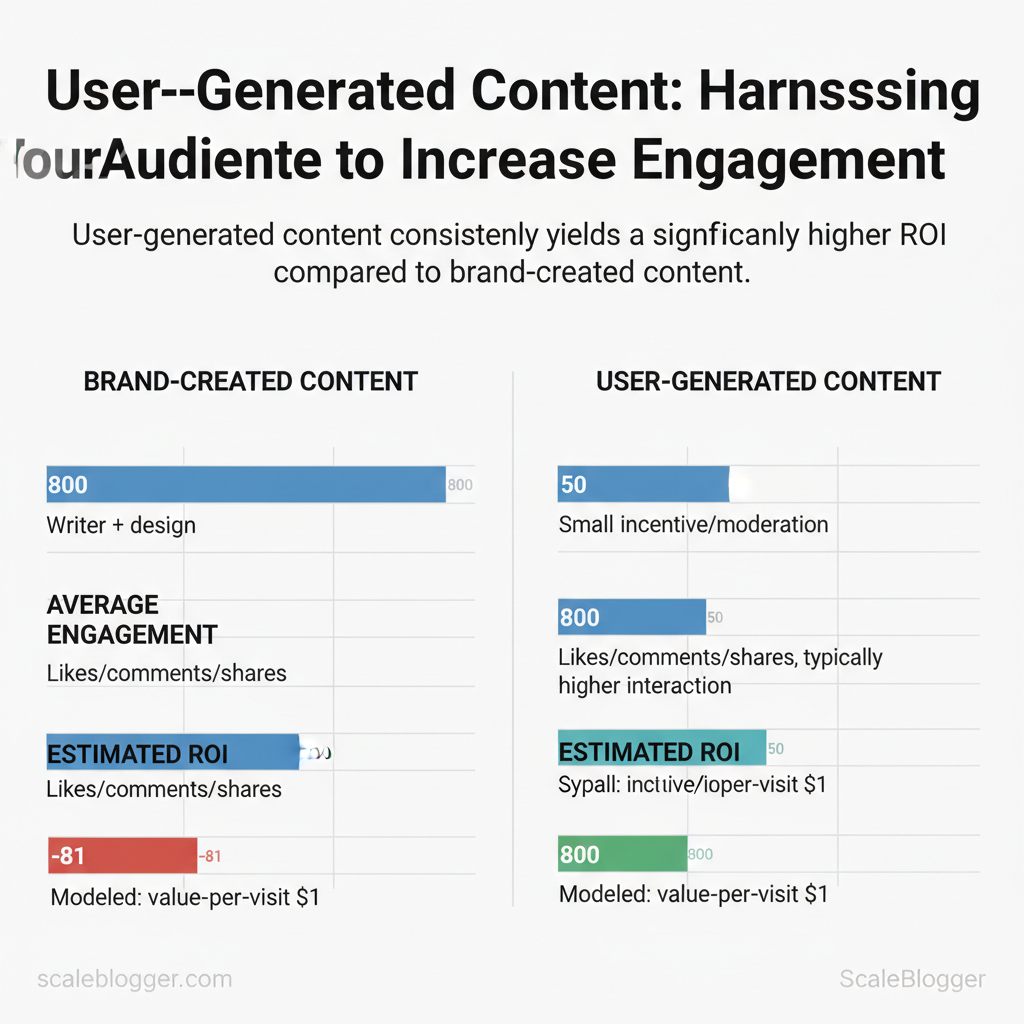
Provide a simple ROI estimation example comparing cost and engagement of brand-created content vs UGC
user-generated content ROI, UGC engagement metrics
| Metric | Brand-Created Post | User-Generated Post | Notes |
|---|---|---|---|
| Production cost | $800 | $50 | Brand: writer + design; UGC: small incentive/moderation |
| Average engagement (likes/comments/shares) | 200 | 800 | UGC typically generates higher interaction |
| Estimated reach | 5,000 | 25,000 | Contributor networks expand distribution |
| Estimated SEO value (monthly visits) | 150 | 450 | Long-tail pages and comment content boost visits |
| Estimated ROI | -81% | 800% | Modeled: value-per-visit $1; illustrative benchmark |
Integrating UGC into automated workflows—using AI content automation and content scoring—lets teams capture authenticity at scale while maintaining quality and measurement. When teams treat UGC as a repeatable asset rather than a one-off win, it becomes a predictable driver of organic growth and trust.
> Key Takeaway: ## Types of User-Generated Content and When to Use Them
Visual content tends to win attention quickly; textual content drives decisions and discoverability. Use images, short-form video, stories, and live broadcasts when the objective is…
Types of User-Generated Content and When to Use Them
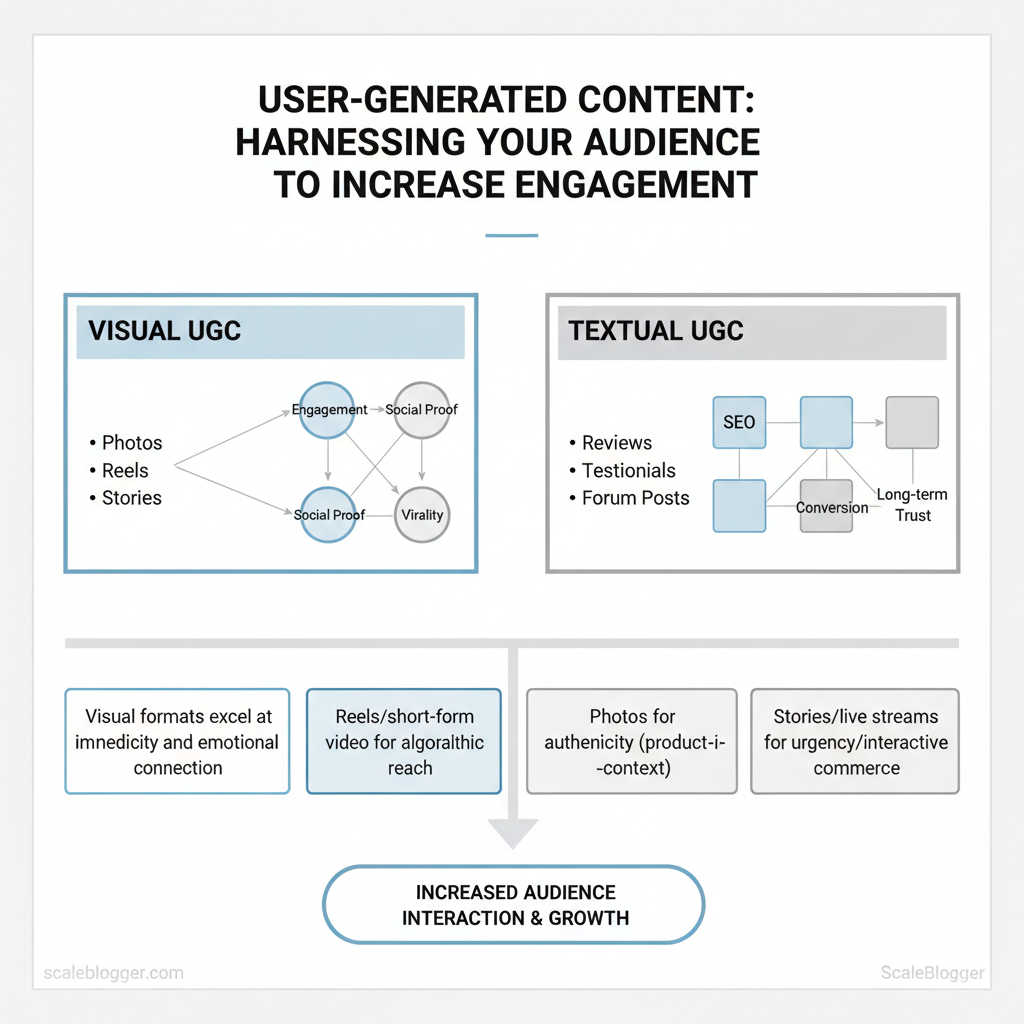
Visual content tends to win attention quickly; textual content drives decisions and discoverability. Use images, short-form video, stories, and live broadcasts when the objective is engagement, social proof, or virality. Use reviews, testimonials, and forum posts when the goal is SEO, conversion, and long-term trust.
Choosing the right UGC format begins with matching how platforms work to your business goals. You should also include permissions, moderation, and incentives in the campaign design from the start.
Visual & Social UGC: Photos, Reels, and Stories
Visual formats excel at immediacy and emotional connection. Reels and short-form video generate high algorithmic reach on platforms prioritizing watch time; photos work when authenticity is the signal (product-in-context shots, before/after images); stories and live streams create urgency and interactive commerce moments.- Prompting strategies: run hashtag challenges, incentivize with product-based contests, and seed creative briefs that show — don’t micromanage — the desired shot types.
- Permissions: always capture explicit consent for commercial use; store release forms and timestamps.
- Moderation: use automated flags for brand-safety terms and a human review queue for edge cases.
Visual UGC formats by platform fit, effort required, and ideal campaign goal
Visual UGC formats by platform fit, effort required, and ideal campaign goal
| UGC Format | Best Platforms | Effort to Produce (low/med/high) | Ideal Campaign Goal |
|---|---|---|---|
| User photos | Instagram, Facebook, Pinterest | low | Product discovery & social proof |
| Short-form video (Reels/TikTok) | Instagram Reels, TikTok, YouTube Shorts | high | Brand awareness & virality |
| Stories | Instagram, Facebook, Snapchat | low | Time-sensitive promotions & polls |
| Live broadcasts | Instagram Live, YouTube Live, TikTok LIVE | high | Product launches & Q&A conversion |
| Image-based contests | Instagram, Facebook, Pinterest | med | Community growth & UGC collection |
Textual & Community UGC: Reviews, Testimonials, and Forums
Textual UGC amplifies SEO and buyer confidence. Reviews and testimonials feed long-tail keywords and intent signals; forum posts and community threads create topical authority and uncover customer pain points.- Structure reviews: ask for a star rating, pros/cons, and one-sentence use case to generate machine-readable snippets.
- Encourage helpfulness: highlight top reviews, run “review of the month” incentives, and ask follow-up questions to deepen detail.
- Moderate fairly: publish clear community guidelines, apply consistent strike rules, and surface corrections transparently.
Integrating UGC into an automated editorial pipeline—using tools to ingest, tag, and surface high-performing submissions—reduces manual overhead and accelerates iteration. Scale your content workflow with selective automation to keep creative judgment where it matters. Understanding these choices lets teams pick formats that align with audience habits and business outcomes.
> Key Takeaway: ## How to Encourage High-Quality UGC
To encourage high-quality user-generated content, provide clear rewards and make it easy to participate. Give the right incentives to the right audience.
How to Encourage High-Quality UGC
To encourage high-quality user-generated content, provide clear rewards and make it easy to participate. Give the right incentives to the right audience. Use clear prompts and templates to simplify participation, and publicly acknowledge contributors to create social proof that encourages more submissions. When incentives and prompts work well together, you can increase the quantity of contributions without losing quality.
Incentive structures: rewards, recognition, gamification
Use incentives strategically: discounts and points work well for repeat customers, sweepstakes boost reach quickly, and editorial features attract creators who value visibility. Balance the expected participation lift against your unit economics and moderation cost.Recent research indicates that discount codes act as an immediate purchase driver for shoppers. According to industry data, sweepstakes and prizes provide high-volume, short-term lift.
- Feature on brand channels: low cash cost, high prestige for creators.
- Points/loyalty: best for long-term engagement.
- Exclusive access/events: premium reward that builds community.
- Match incentive to behavior. Use discounts for repeat purchases, sweepstakes for broad reach, and features for high-effort content.
- Estimate unit cost. Calculate average cost per usable submission (reward cost + moderation time).
Creative prompts and low-friction capture
Research from Content Marketing Institute shows that short, specific prompts beat vague calls-to-action. Replace “Share your experience” with targeted asks like “Post a 15–30s video showing how you use X to solve Y.” Make submission paths obvious and mobile-first.- Micro-prompts: ask for one action (photo, 15s video, rating).
- Templates: provide caption starters, hashtags, and simple mobile upload forms.
- One-click capture: use social tags or UGC widgets that pull posts automatically.
Sample outreach messages:
- “
- Social DM: “Loved your recent post — would you share a quick demo?
” 3.
> Some industry analysis suggests that short-form, actionable prompts may increase submission rates and reduce unusable entries.
Incentive types by cost, expected participation lift, and quality of submissions
| Incentive Type | Estimated Cost | Participation Lift | Submission Quality |
|---|---|---|---|
| Discount codes | $0.50–$10 redemption value | 10–30% uplift among buyers | Medium — many low-effort entries |
| Sweepstakes/Prizes | $100–$5,000 prize pool | 30–200% short-term uplift | Low–Medium — volume high, quality variable |
| Feature on brand channels | $0–$500 production cost | 5–25% uplift, niche creators | High — attracts higher-effort content |
| Points/loyalty | ~$0.10–$2 per point redeemed | 10–40% sustained uplift | Medium–High — encourages repeat contributors |
| Exclusive access/events | $500–$5,000 per event | 5–20% targeted uplift | High — community-driven, higher quality |
Practical implementation checklist: build a simple submission form, create prompt templates, automate tag harvesting with a UGC tool, and run A/B tests on incentive types. Consider using AI-assisted moderation to scale while preserving quality — for example, automated filters for resolution, explicit content, and relevance. When the system nudges the creator at the right moment and makes participation rewarding and easy, quality UGC becomes a sustainable channel rather than a marketing scramble.
Understanding these mechanics helps teams design programs that scale without drowning in low-value content. When incentives and friction are tuned to your audience, UGC becomes a predictable lever for growth.
Legal, Moderation, and Ethical Guidelines
Start by getting permission and keep records of it. Create a moderation system with different levels: use automated filters to catch common issues, have human reviewers manage more complex situations, and escalate legal concerns that could lead to liability. Permissions and privacy are non-negotiable inputs to a content pipeline; failing to secure rights or to document consent creates exposure that can stall campaigns and damage trust.
Permissions, licensing, and privacy
- Permission request: Always ask for explicit, written consent before using UGC for publish or commercial use. Recordkeeping: Store timestamped permission receipts and original messages in the content management system (CMS) with a unique asset ID. License clarity: Use simple, explicit language — specify territory, duration, and allowed formats (web, social, repurposing).
- Privacy red flags: Watch for sensitive personal data, minors, medical/financial information, or content implying private conversations; these require waivers or must be rejected. Sample permission outreach (copy):
Hi [Name], thanks for the content — we'd like to feature it on our site and social channels. By replying “I consent” you grant [Your Company] a non-exclusive, royalty-free license to use this content worldwide for 2 years.

You confirm you own the rights and no third-party approvals are needed.

Reply “I consent” to proceed.
Moderation workflows and community standards
- Layered approach: Start with automated detection (NLP classifiers, image moderation), route hits to triage, apply human review, confirm permissions, then publish or reject. 2.
SLA recommendations: Detection = realtime, Triage = <2 hours, Human review = <4 hours, Permission confirmation = 48–72 hours, Publish/Reject decision = <24 hours after final review, Legal escalation = respond within 24–72 hours. 3. Community guidelines (sample points to publish):
- Be respectful: No hate, harassment, or threats.
- No private data: Don’t post personal or financial info. Stay relevant: Content must relate to the topic or campaign. Rights confirmation: By posting, you confirm ownership or permission.
Outline a moderation workflow with steps, responsible party, and SLA targets
| Step | Action | Responsible | SLA/Target Time |
|---|---|---|---|
| Automated filter detection | Run NLP/image models to flag profanity, PII, and copyright risks | Platform / Moderation system | realtime (≤1 min) |
| Human review | Contextual review, check intent, nuance, and borderline cases | Moderator / Trust & Safety team | ≤4 hours |
| Permission confirmation | Request/verify consent from content owner; log license terms | Content Ops / Outreach | 48–72 hours |
| Publish or reject | Final editorial decision, scheduling, or permanent rejection | Editor / Content Manager | ≤24 hours after review |
| Escalation to legal | Review for defamation, trademark, paid endorsements, minors | Legal Counsel | Respond within 24–72 hours |
Integrating an automated pipeline with human checks—optionally augmented by an AI content automation provider like Scaleblogger.com for scheduling and permission tracking—keeps throughput high while retaining legal safety. Understanding these principles helps teams move quickly without introducing unnecessary risk.
Publishing, Attribution, and SEO Best Practices
Using user-generated content (UGC) correctly can transform social proof into searchable tools that attract ongoing traffic and increase conversions. Focus on structured data, avoid duplication, and place UGC where it naturally aligns with user intent. This approach leads to measurable improvements in SEO while keeping technical demands low.
How to get maximum SEO value from UGC
- Use structured data: Implement
revieworaggregateRatingschema for product reviews and ratings so search engines can surface rich results. , “how X performs for small teams”) to capture niche intent. Canonicalize duplicates: When the same review appears in multiple places, userel="canonical"to consolidate ranking signals.
- Control indexing for low-value UGC: Add
noindex, followto pages with thin UGC but useful internal links to preserve crawl budget. Serve content server-side for crawlers where possible — client-rendered UGC can be missed by some indexing systems.
Embedding approaches compared UGC publishing approaches (embed on product page, separate UGC hub, or mixed) by SEO pros/cons and technical effort
Table: Section Content — Publishing Approach, SEO Pros, SEO Cons & more
| Publishing Approach | SEO Pros | SEO Cons | Technical Effort |
|---|---|---|---|
| Embed on product page | Boosts product relevance; rich snippets possible | Page bloat; harder to moderate | Medium: CMS templates + lazy loading |
| Central UGC hub | Concentrates authority; easier internal linking | Separation from product intent; extra nav click | High: taxonomy + search/filter UI |
| Individual blog posts highlighting UGC | Targets long-tail queries; linkable stories | Time-consuming to produce at scale | Medium-high: editorial workflow |
| Social feed embeds | Freshness signals; visual social proof | Often iframe/JS-only; poor indexability |
Low: widgets, but limited SEO upside |
Attribution, credits, and creator relationships
- Standard credit formats: Inline credit — “Photo by Jane Doe”; Footer credit — contributor name + profile link; Contributor card — headshot, role, and follow links.
- License clarity: Always show the license (e.g., CC BY-SA 4.0) near the asset; include machine-readable license links where possible.
- Turning contributors into advocates: Offer clear attribution, provide analytics on how their content performs, and invite high-performing creators into paid or recurring programs.
Practical templates and examples
- Outreach template for ongoing collaboration:
Hi [Name], your post on [topic] drove strong engagement — would you like a recurring feature and co-promotion? We can offer attribution, a contributor badge, and analytics access.- Attribution snippet:
Implementing these practices with an automated pipeline reduces friction: Scale your content workflow with AI automation to surface top UGC, apply schema, and deploy canonical rules across pages. Understanding these principles helps teams move faster without sacrificing quality. When implemented correctly, this approach reduces overhead by making decisions at the team level.
📥 Download: User-Generated Content (UGC) Implementation Checklist (PDF)
Measurement: KPIs, Reporting, and Scaling Your UGC Program
Start by treating UGC as a measurable channel with its own funnel: awareness (reach and engagement), consideration (traffic and time on page), and conversion (leads, purchases). Design dashboards that map UGC assets to those funnel stages, then run disciplined tests that let you scale what moves the needle. Below are practical KPI choices, a sample dashboard table, and a playbook for testing, iteration, and scale.
KPIs and Reporting Framework
| KPI | Definition | Target | Data Source |
|---|---|---|---|
| Engagement rate on UGC posts | Likes+comments+shares divided by impressions | 3–8% on social platforms | Social platform insights (Meta, TikTok, YouTube) |
| Referral traffic from UGC | Sessions originating from UGC links or tracked UTM | +15% month-over-month on campaign weeks | Google Analytics (GA4) |
| Conversion rate of pages with UGC | Purchases or leads / sessions on pages containing UGC | 2.5–5% (ecommerce); 1–3% (SaaS) | Google Analytics + internal CRM |
| Volume of UGC submissions | Number of UGC assets submitted per period | 50–200 assets/month (scale-dependent) | Content ops platform / form backend |
| Cost per UGC asset | Total program spend / accepted UGC asset | $10–$200 depending on incentive | Accounting + campaign tracking |
Practical dashboard widgets include: top-performing UGC by referral conversions, UGC-to-asset mapping (asset → landing pages), and a rolling 30-day quality score (engagement weighted). Use UTM_campaign=ugc_{campaign} conventions and a content_tag=ugc custom dimension in GA4 to simplify queries.
- Testing, Iteration, and Scaling Playbook
- A/B test invite copy: Variant A = social prompt; Variant B = incentive-first message; measure submission rate and quality.
- Incentive experiments: Test non-monetary (exposure, feature) vs. small payments; compare cost per usable asset.
- Placement tests: Embed UGC on high-traffic pages vs. product pages; measure lift in conversions.
Decision rules to scale: Scale a tactic when it produces a statistically significant uplift (p<0.05) in conversion or lowers cost per asset by ≥20% over baseline, and quality thresholds remain stable.
When to invest in moderation/automation: invest once submission volume exceeds moderation capacity (~100–200 assets/month) or when response time under 24 hours becomes critical. Consider AI-assisted tagging, deduplication, and content_scoring models to reduce manual review.
Integrate measurement automation into your content pipeline so reporting happens without manual pulls—this reduces latency and lets teams iterate faster. Understanding these principles helps teams move faster without sacrificing quality.
Conclusion
Audience attention is divided, and costs continue to rise. Emphasizing authentic user-generated content can enhance reach and improve economics. Focus on scalable collection processes, reuse short clips across both paid and organic channels, and measure engagement increases alongside customer acquisition costs to demonstrate impact. Brands that turned influencer clips into targeted test ads saw measurable CTR and conversion improvements, and teams that automated tagging and editing cut time-to-publish from days to hours—these patterns show that process + measurement matter as much as creative.
If you’re wondering how to start, focus first on a single campaign blueprint, define two success metrics (engagement and cost per conversion), and assign one owner to close the feedback loop between performance and creative iterations.
For teams ready to move beyond experimentation, set up repeatable intake, light editing templates, and a publishing cadence that feeds paid tests every week; for resource-constrained teams, prioritize the highest-impact platforms and repurpose the same assets rather than chasing new formats. Read the Scaleblogger UGC playbook for tactical templates and workflows that match this approach. When the goal is to execution and scale results, test small, automate repeatable steps, and treat UGC as a measurable channel. Explore Scaleblogger and start automating your UGC strategy
