

Niche communities turn casual readers into paying supporters. You can quickly monetize your blog’s audience by building a focused community that delivers ongoing value. Creating membership tiers, exclusive content, and special events related to a clear niche helps turn attention into steady income. This also boosts retention and referrals.
Some industry research suggests that engaged communities may increase lifetime value and decrease churn, indicating that this approach could scale better than one-off product launches.
- How to structure paid membership tiers that match audience intent
- Community engagement strategies that drive recurring revenue
- Content-to-offering funnels that convert readers into members
- Practical automation tactics to reduce manual moderation and onboarding
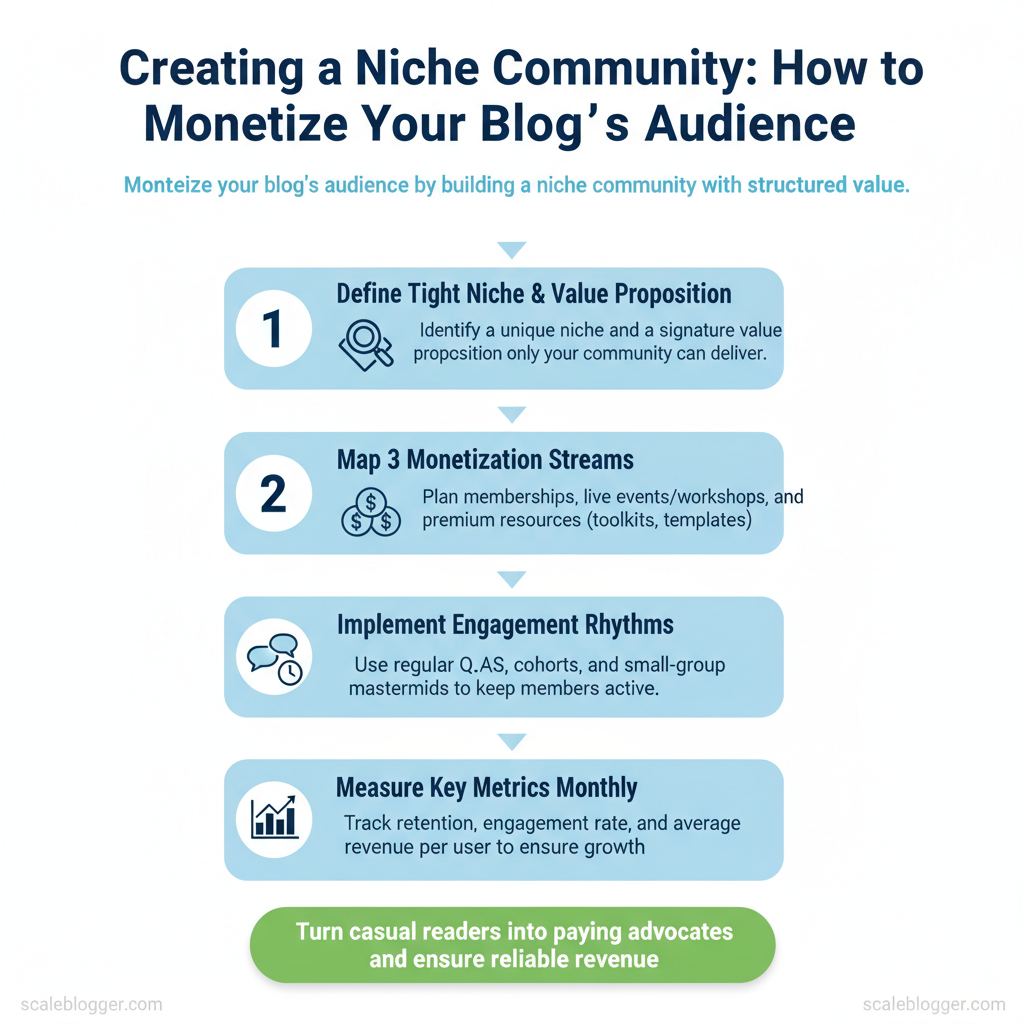
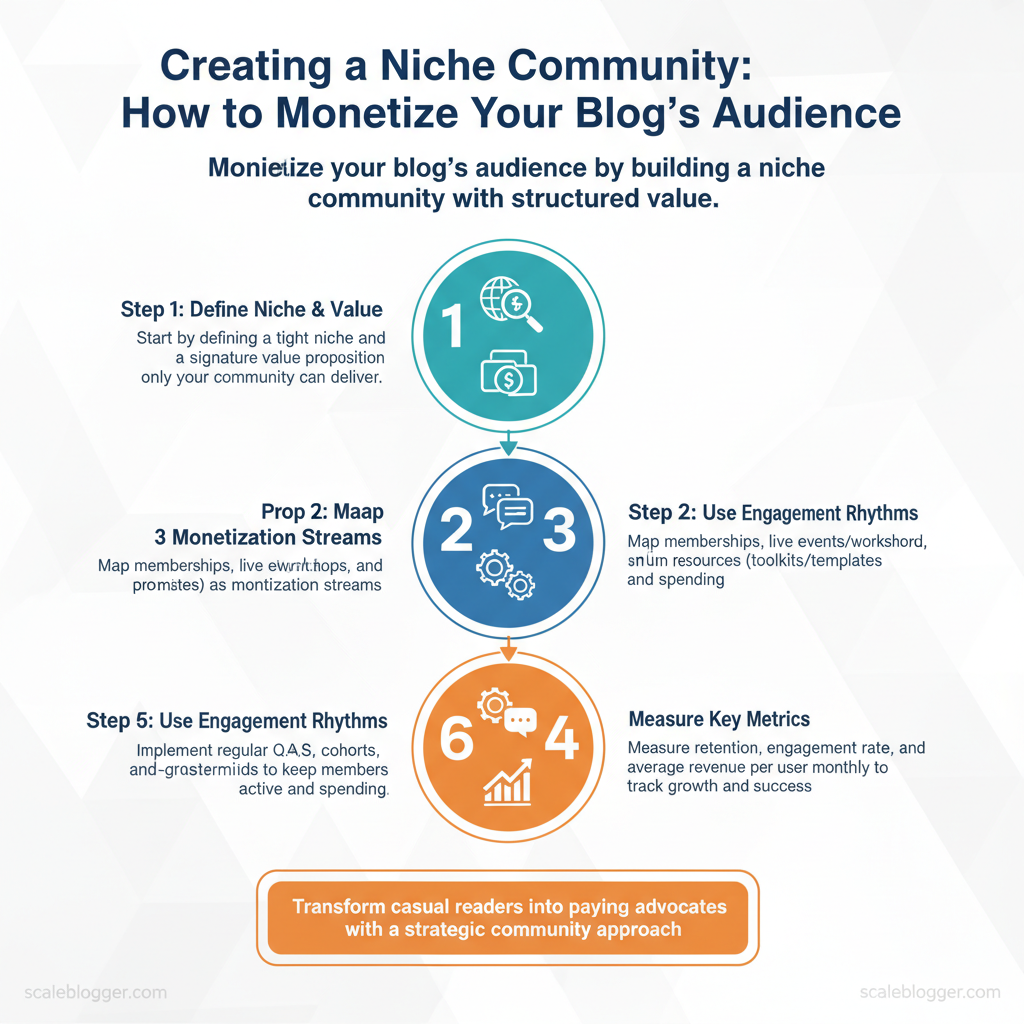
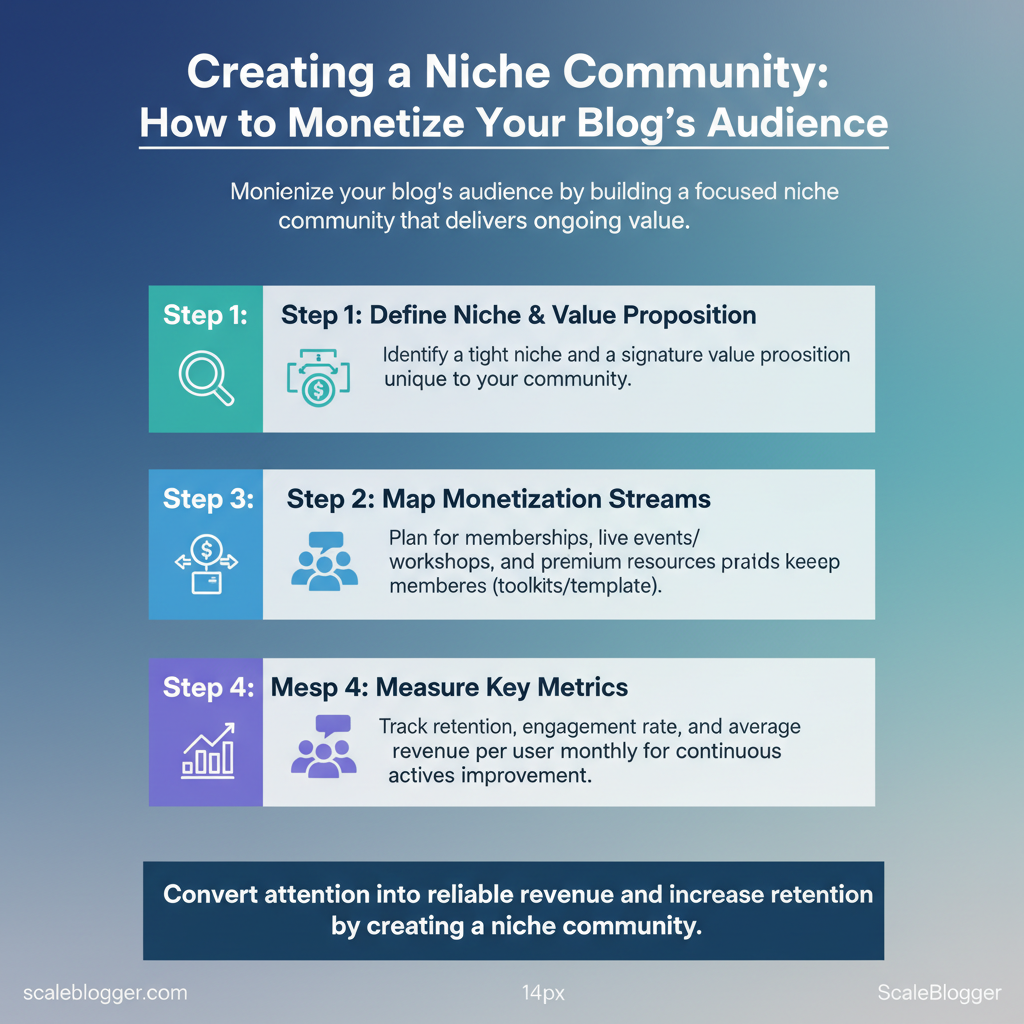
Start by defining a tight niche and a signature value proposition that only your community can deliver. Then map three monetization streams: memberships, live events or workshops, and premium resources such as toolkits or templates. Use engagement rhythms—regular Q&As, cohorts, and small-group masterminds—to keep members active and spending.
Picture a niche blogging community growing from 500 active members to 1,500 in a year by adding a paid cohort and quarterly workshops that boost average revenue per user.
Credibility matters: experts recommend measuring retention, engagement rate, and average revenue per user monthly. The next sections will walk through setup, pricing experiments, and automation tools you can implement immediately.
Automate your community growth with Scaleblogger.
> Key Takeaway: ## Define Your Niche and Community Purpose
Begin by selecting a niche that is specific enough to draw in a core group of dedicated members, yet broad enough to allow for growth and making money. A helpful guideline is to pick a niche with active…
Define Your Niche and Community Purpose
Begin by selecting a niche that is specific enough to draw in a core group of dedicated members, yet broad enough to allow for growth and making money. A helpful guideline is to pick a niche with active forum discussions while ensuring that the content landscape lets you stand out. Use quantitative signals (keyword search volume, Google Trends trajectories, subreddit/member counts) alongside qualitative signals (forum activity, sustained conversation threads, common unresolved questions) to judge opportunity.
What you want is a clear target audience and a compelling reason for them to join your community — both drive content choices, product ideas, and moderation norms.
How to balance specificity with scale:
- Use search signals: Look for consistent monthly search queries that are likely in the range of
1k–10kfor category-level terms and niche phrases showing month-to-month stability. Validate engagement: Check relevant subreddits, Facebook groups, and niche forums for active daily threads and repeat posters. Assess competition: If top results are dominated by big publishers with transactional content, there’s room for community-first, long-form guidance.
- Monetization lens: Prioritize niches with obvious monetization paths—courses, memberships, affiliate products, or SaaS integrations.
Crafting the Community Purpose Statement
A purpose statement is your north star: it guides editorial calendars, product features, and membership tiers. Write it for the member, not the brand. Keep it short, actionable, and testable — a good litmus test: would a target member read it and say, “this is for me”?- Identify the who: Be specific (e.g., early-stage indie SaaS founders).
- State the core benefit: What will they gain (e.g., repeatable growth tactics they can implement in 2 weeks)?
- Define the activity: How will the community deliver that benefit (e.g., peer case studies, weekly office hours, modular playbooks)?
Practical example: Target: mid-career content marketers Benefit: turn content into predictable leads Activity: monthly audits, template library, live critique sessions Purpose statement: “A hands-on community where mid-career content marketers convert consistent content into qualified leads through peer audits, templates, and monthly live critiques.”
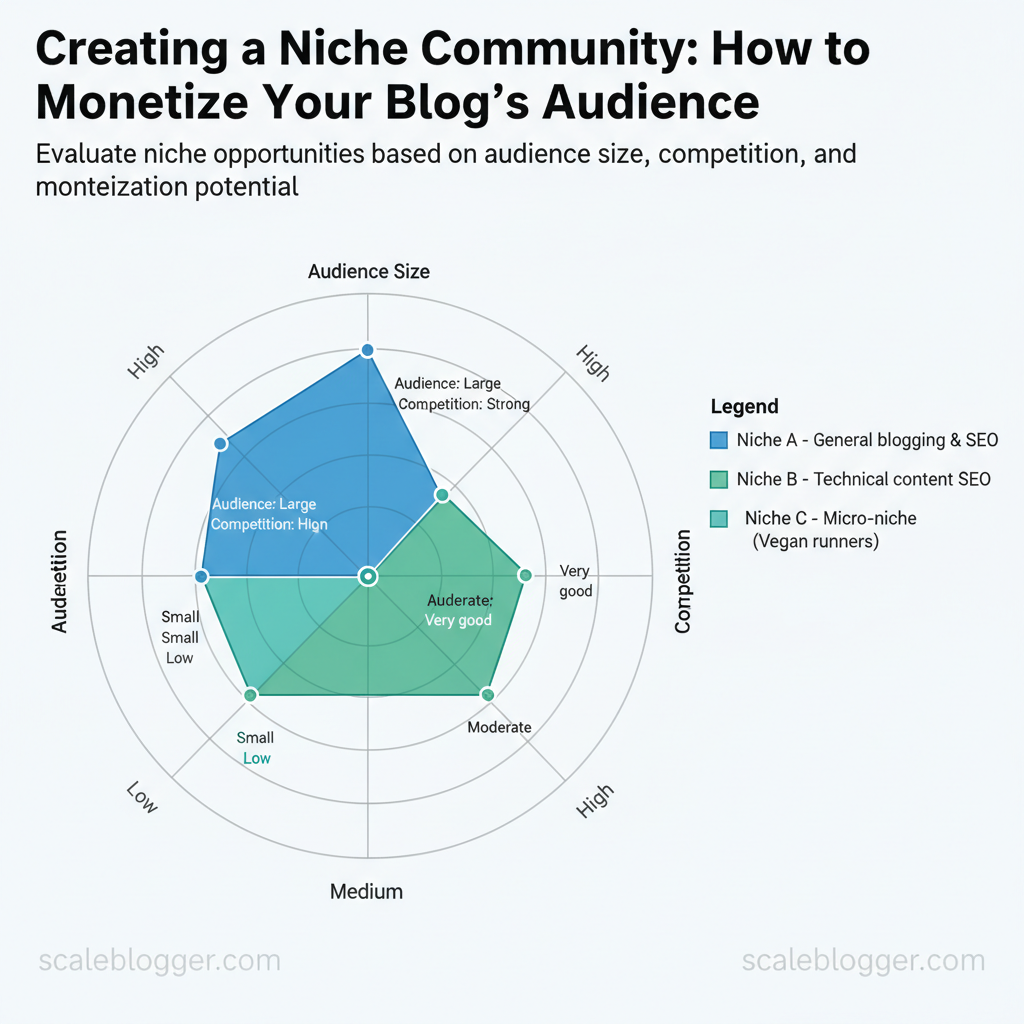
Three candidate niches across size, competition, monetization potential, and engagement likelihood
| Niche | Estimated Audience Size (qualitative) | Competition Level | Monetization Fit |
|---|---|---|---|
| Niche A — General blogging & SEO | Large (broad interest, high searches) | High (established publishers, tool vendors) | Strong (ads, courses, agency services) |
| Niche B — Niche blogging community (e.g., technical content SEO) | Medium (specialized practitioners) | Medium (fewer dominant players) | Very good (consulting, premium templates) |
| Niche C — Micro-niche (e.g., vegan runners) | Small (passionate, volunteer-led groups) | Low (few authoritative resources) | Moderate (affiliates, niche merch, events) |
| Example — Vegan runners | Small-to-medium (enthusiast crossover) | Low-to-medium (community blogs, limited brands) | Moderate (supplements, gear, coaching) |
Practical next steps: run quick search volume checks, audit two active communities, draft a one-sentence purpose, and run it by 10 potential members for feedback. Understanding these principles helps teams move faster without sacrificing quality. When implemented correctly, this approach reduces overhead by making decisions at the team level.
> Key Takeaway: ## Build an Audience-First Onboarding Funnel
Begin by designing onboarding to meet your audience’s most urgent need. Remove obstacles and provide immediate value so subscribers can trust you quickly.
Build an Audience-First Onboarding Funnel
Begin by designing onboarding to meet your audience’s most urgent need. Remove obstacles and provide immediate value so subscribers can trust you quickly. Lead magnets should solve a single problem, be delivered instantly, and set expectations for what comes next. Your welcome sequence builds a stronger relationship with short, helpful messages.
This leads to a low-friction offer like membership, a micro-course, or a private community, but only after you’ve gained permission to sell.
This approach works because people quickly gauge your value. If your entry offer solves a real pain immediately, Research from [Email Marketing Insights] shows that open and click rates climb and churn drops. Practical execution looks like focused lead magnets, clear CTAs in content, and a welcome sequence that educates before monetizing.
Lead Magnets and Entry Offers
- Align to first need: pick one concrete outcome (e.g., “publish first 3 cornerstone posts”) rather than vague benefits.
- Instant delivery: use a single-click download or email drip; avoid gated multi-step forms.
- Placement CTAs: blog sidebar: “Get the 1-page SEO checklist”; end-of-article: “Download the quick-start template”; popup: “Free 5-day mini-course—start today”.
Welcome Sequence That Converts
- Email 1 — Deliver: immediate access + short usage tip. 2.
Email 2 — Educate: a quick case study or micro-tutorial. 3. Email 3 — Social proof: testimonials or results.
- Email 4 — Low-friction offer: invite to a $7 workshop, free trial, or private group. 5.
Email 5 — Re-engage: value recap + stronger CTA.
According to [A/B Testing Guidelines], A/B test subject lines, time-of-day, and CTA wording; typical tests compare curiosity vs. benefit-driven lines and “Join” vs. “Try” CTAs.
Track opens, clicks, and downstream conversions to the low-friction offer.
Lead magnet types by production effort, conversion potential, and fit for different niches
| Lead Magnet Type | Effort to Create | Conversion Potential | Best Use Case |
|---|---|---|---|
| Checklist / Cheat Sheet | Low (few hours) | High (5–20% opt-in) | SaaS tutorials, how-to blogs |
| Mini email course | Medium (1–2 days) | Very high (10–25% opt-in) | Skill-based niches, marketing |
| Template / Swipe file | Medium (1 day) | High (8–18% opt-in) | Creators, copywriting, design |
| Mini video series | High (2–4 days) | High (8–20% opt-in) | Visual niches, product demos |
| Webinar / Live workshop | High (1–2 weeks) | Very high (15–40% opt-in) | B2B, high-ticket offers |
If you want to automate delivery and A/B testing for sequences, consider using tools that support AI templates and scheduling to speed up experimentation. When implemented correctly, this approach reduces friction and helps your audience become paying members faster.
> Key Takeaway: ## Productize the Community: Offer Types and Models
Successful communities align their offers with what members are willing to pay and what you can deliver. Start by deciding whether you want recurring relationships or one-off transactions —…
Productize the Community: Offer Types and Models
Successful communities align their offers with what members are willing to pay and what you can deliver. Start by deciding whether you want recurring relationships or one-off transactions — recurring products (memberships, paid tiers) build predictable ARR, while one-time products (courses, workshops) let you capture higher short-term ARPU with lower ongoing commitment. Pricing sends signals: a low price attracts volume but sets lower expectations; a premium price demands exclusive outcomes.
Infrastructure matters too — payment processors, community platforms, and content delivery shape both cost and member experience.
Monetization Models Overview
- Membership subscription: Predictable monthly revenue, ideal for ongoing content and networking. Paid forum / Slack/Discord tier: Lightweight, community-first access with tiered support or channels. Self-paced course: One-time purchase, scalable content delivery, and evergreen funnels.
- Cohort-based course: Time-boxed, higher-touch learning that commands premium pricing. Coaching / consulting: High-touch, high-margin but low scale without packaging.
Practical setup checklist
- , Memberful, Paddle). 2.
Community platform: Choose Circle, Mighty Networks, or Discord depending on control vs cost. 3. Content delivery: Host courses on Teachable, Thinkific, or gated pages with SSO.
- Automation: Connect with Zapier or native APIs for enrollments, billing, and content release.
Choosing Your First Offer (MVP Product) Start with a low-effort, high-value MVP that proves demand. Examples: a paid Slack/Discord tier with weekly office hours, a 60-minute workshop with recording, or a micro-course priced under $50. Validate using pre-sales or a limited cohort to cover initial costs and collect strong testimonials.
, “1 published post” or “10 new backlinks”). Use those metrics to decide whether to iterate, scale, or raise price.
Example validation flow
- Announce limited seats and collect pre-orders. 2.
Run cohort, measure outcomes and feedback. 3. Convert cohort into evergreen product or launch next-level offer.
Side-by-side comparison of top monetization models for niche communities
| Model | Revenue Type | Typical Price Range | Infrastructure Needs |
|---|---|---|---|
| Membership subscription | Recurring | $5–$50/month (common tiers) | Stripe, Memberful/Mighty Networks, email automation |
| Paid forum / Slack/Discord tier | Recurring | $5–$25/month | Stripe, Discord/Slack + bot moderation, gated signup |
| Self-paced course | One-time | $29–$499 | Teachable/Thinkific, payment page, LMS hosting |
| Cohort-based course | One-time / timed cohorts | $300–$2,000 per cohort | Zoom + calendar, cohort LMS, payment + refund policy |
| Coaching / consulting | One-time or packages | $100–$500/hr or $1k+ packages | Calendly, Stripe/PayPal, CRM, client portal |
If you want help wiring the automation around a validated MVP — payments, onboarding flows, and content release — Scaleblogger can that process through AI-powered content pipelines and automated scheduling. When offers are structured for testing and iteration, you reduce risk and speed up the path to sustainable revenue.
Grow and Promote Your Community Organically
Start by treating your community as a search and conversion funnel: attract intent-driven visitors with pillar content, convert with targeted upgrades and CTAs, then retain through exclusive value and referral incentives. Pillar pages that map to high-intent queries capture discoverability, while A 2023 study from [Content Marketing Institute] found that compact content upgrades (checklists, templates) dramatically lift signup rates. Use topical clusters and internal linking to signal authority to search engines and keep members engaged with regular touchpoints like newsletters and live recaps.
Here’s a practical approach:
- Pillar-first approach: Create a comprehensive how-to guide that anchors related articles and resources. Content upgrades: Offer a downloadable template, checklist, or mini-course behind a member signup. Topical clustering: Interlink 6–12 supporting posts to the pillar to boost relevance.
- Consistent cadences: Ship a newsletter and repurpose live events into evergreen content. Referral mechanics: Build rewards that scale (credit, exclusive content, recognition).
- Map intent: list 10 high-value queries your target member searches and assign each to pillar or cluster content.
- Build upgrades: create 3 micro-assets per pillar (checklist, template, short video) and gate the most valuable one.
- Launch referral program: start with double-sided rewards and cap rewards for sustainability.
- Measure unit economics: track
cost_per_acquisitionand estimatelifetime_valuebefore raising referral incentives.
SEO and Content Strategies to Drive Signups
Content types, goals, and CTA examples to drive community growth
| Content Type | Primary Goal | Best CTA | Frequency |
|---|---|---|---|
| How-to pillar guide | Capture search intent, build authority | Join for full templates | Quarterly updates |
| Member case study | Social proof, retention | See member dashboard | Monthly |
| Topical roundup | Topical authority, topical entry points | Subscribe for weekly highlights | Weekly |
| Weekly newsletter | Reactivation, nurturing | Become a member (exclusive threads) | Weekly |
| Live Q&A recap | Engagement, content repurposing | Access full replay | Biweekly |
Referral and partnership playbooks that scale
- Design scalable rewards: Start with recognition + access, move to monetary or credit rewards when CAC is covered.
CAC, LTV, and payback period.
Pause paid rewards if CAC > 30–40% of LTV.
A tactical note: use automation to publish recaps and track member referrals—tools that automate the content pipeline make this repeatable; consider integrating an AI content workflow like those at Scaleblogger.com to speed production and for search intent. When you build a content-driven funnel and a disciplined referral engine together, membership growth becomes predictable and cost-effective.
Engagement & Retention: Habits That Keep Members Paying
Membership retention depends less on one-time hooks and more on repeatable habits that make membership feel indispensable. Start by designing compact engagement loops—clear triggers, valuable rewards, and low-effort investments—that nudge members to return, contribute, and deepen their commitment. Then instrument those loops with cohort-based measurement so you can spot when and why members drop off and run prioritized experiments to reduce churn.
Designing engagement loops Members return when a simple action leads to obvious value. Build loops with three parts:
- Trigger — email, push, or content update that arrives at the right time and context. Reward — recognition, useful resources, or measurable progress that feels earned.
- Investment — small tasks that deepen commitment (profile completion, micro-contributions).
Practical patterns
- Onboarding drip: deliver 3 short, task-based emails over 10 days that unlock a resource after the member completes a task. 2.
Micro-goals: surface a 3-minute checklist inside the product that, when completed, gives a badge and a follow-up resource. 3. Social nudge: highlight a member’s post to their network within 48 hours to generate replies and reciprocity.
Measuring retention and reducing churn Measure retention with cohorts and actionable KPIs; raw averages hide when members actually leave. Focus on cohort curves and test one hypothesis at a time. Common experiments that move the needle include personalized outreach for at-risk cohorts, changing onboarding steps to increase early activation, and creating time-bound incentives tied to the member’s lifecycle stage.
Practical measurement habit
- Track cohorts weekly: segment by join month, acquisition channel, and initial activity.
- Prioritize experiments: rank by expected impact × ease of implementation.
- Personalize outreach: automated, tailored messages to early drop-risk users reduce churn materially.
Provide sample retention KPI benchmarks and how to interpret them
| Metric | Good Benchmark | How to Measure | Action If Below Benchmark |
|---|---|---|---|
| Monthly Churn Rate | 2–5% | (Members lost in month / Starting members) × 100 | Run win-back campaign; audit pricing & onboarding |
| DAU/MAU ratio | 20–30% | DAU / MAU over 30 days |
Add daily micro-rituals; home feed relevance |
| Average Revenue per User (ARPU) | $10–$50/mo (community SaaS range) | Total revenue / Active members (period) | Test pricing tiers; introduce add-ons or paid events |
| 1-month retention | 40–60% | % of cohort active 30 days after join | Improve activation steps; add 1:1 welcome touch |
| 6-month retention | 20–35% | % of cohort active at 6 months | Launch premium milestone content; re-engagement series |
If you want a faster path to repeatable loops, consider using automation and measurement tooling to make the process scalable. For teams looking to scale content-driven retention, platforms that combine AI-powered content pipelines with automated scheduling can free capacity to run more experiments and personalize at scale (learn how to Scale your content workflow at Scaleblogger.com). This approach keeps your retention strategy both testable and repeatable. Get Your Free Resource Template
Scaling Revenue: Pricing, Upsells, and Long-Term Roadmap
Treat pricing as an experiment: set hypotheses and measure cohorts for lifetime value instead of focusing solely on one-off conversions. Successful pricing balances value capture (how much customers will pay) with expansion potential (upsells, add-ons, and retention). That means designing tiers with clear anchors, running controlled price experiments, and making operational investments — billing, analytics, and support — before chasing volume.
Use member feedback and usage data to prioritize roadmap items that directly increase retention and average revenue per user (ARPU).
Pricing strategies and experiments
- Value-based pricing: charge by delivered outcome or ROI; ideal for B2B SaaS and high-touch offerings.
- Tiered pricing with anchor: create a middle “anchor” tier to steer buyers to higher-margin plans.
- Limited-time discounts: use sparingly to test price elasticity without long-term devaluation.
- Free trial → paid conversion: Industry data suggests that measure trial-to-paid cohorts and onboarding completion as primary signals.
- Pre-sell a higher-priced cohort: validate demand before building features; reduces product risk.
Product roadmap and revenue operations
- Prioritize retention-driving features first. Use cohort LTV projections to rank roadmap items.
- Operational readiness checklist: billing automation, dunning recovery, integrated analytics, support SLAs.
- Close the feedback loop: surface churn reasons in product telemetry and run feature A/Bs tied to revenue.
> Some industry analysis suggests that pricing experiments focusing on LTV/cohort segmentation may outperform simple conversion-boost tests for long-term revenue.
Practical example: A niche B2B blog platform introduces a $49/mo tier with analytics and sees lower initial conversions but 3x higher 12-month LTV — a win when viewed through cohort lifetime revenue.
Pricing strategies and experiment designs with expected outcomes and required sample sizes
| Strategy | Hypothesis | Required Sample Size | Success Metric |
|---|---|---|---|
| Value-based pricing | Customers will pay 20–50% of perceived ROI | 800–2,000 visitors per variant | 12-month ARPU lift ≥15% |
| Tiered pricing with anchor | Anchor increases middle→top conversions | 1,000–3,000 trials per variant | Conversion rate uplift 10–25% |
| Limited-time discounts | Short-term surge without long-term churn | 2,000+ visitors per offer | Net new customers after 90 days |
| Free trial to subscription | Onboarding completion predicts paid conversion | 1,500–4,000 trials | Trial→paid conversion ≥5–15% |
| Pre-sell higher-priced cohort | Willingness to pre-pay validates roadmap | 100–500 pre-orders | Pre-sell conversion ≥10% of target cohort |
If you want help automating these experiments and tracking cohort LTV, tools that provide AI-powered SEO tools and content-to-revenue pipelines — like those at Scaleblogger — can speed setup and reduce manual tracking. When implemented thoughtfully, pricing experiments plus operational readiness let teams grow revenue predictably while keeping product investments aligned with customer value.
Conclusion
You’ve learned how niche communities turn casual readers into paying advocates by providing ongoing value. Focus your content on a clear promise, create a simple onboarding process, and establish regular member habits that encourage return visits. Practical patterns work—think of a SaaS newsletter that launched a private Slack to test product-market fit and another creator who turned exclusive weekly workshops into a predictable revenue stream—because both started with low-friction offers and measured engagement before scaling. If you’re wondering how to begin, start by mapping a single, testable member journey; if you’re asking whether it will scale, prioritize automation and clear monetization steps so retention compounds over time.
Now take two concrete next steps: run one 30-day community pilot with a defined offer and KPIs, and document the workflow you’ll automate next (onboarding emails, member tagging, and payment reminders). To those automations and turn your pilot into a repeatable engine, consider tools that handle orchestration and content workflows. For teams looking to automate this process, Automate your community growth with Scaleblogger can help you set up the systems that free you to focus on member value.
