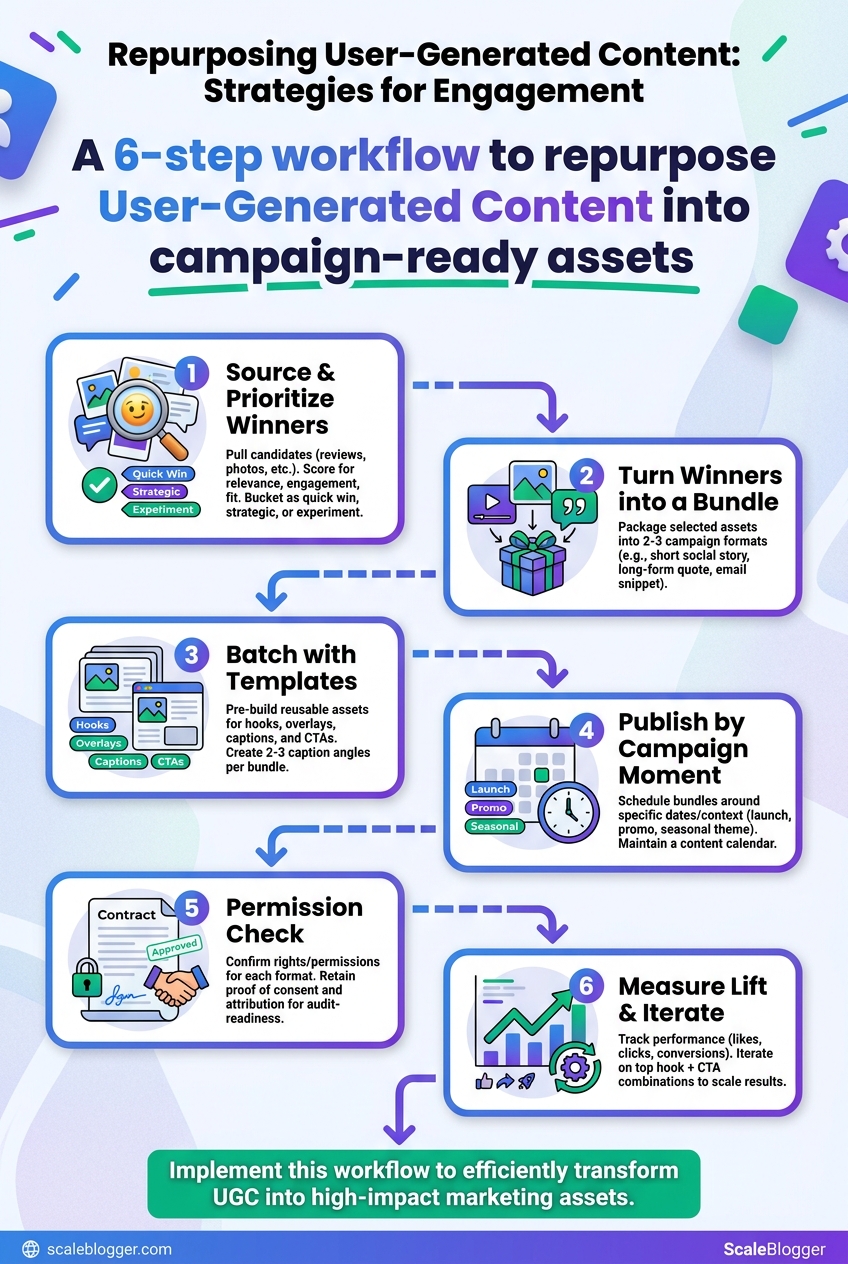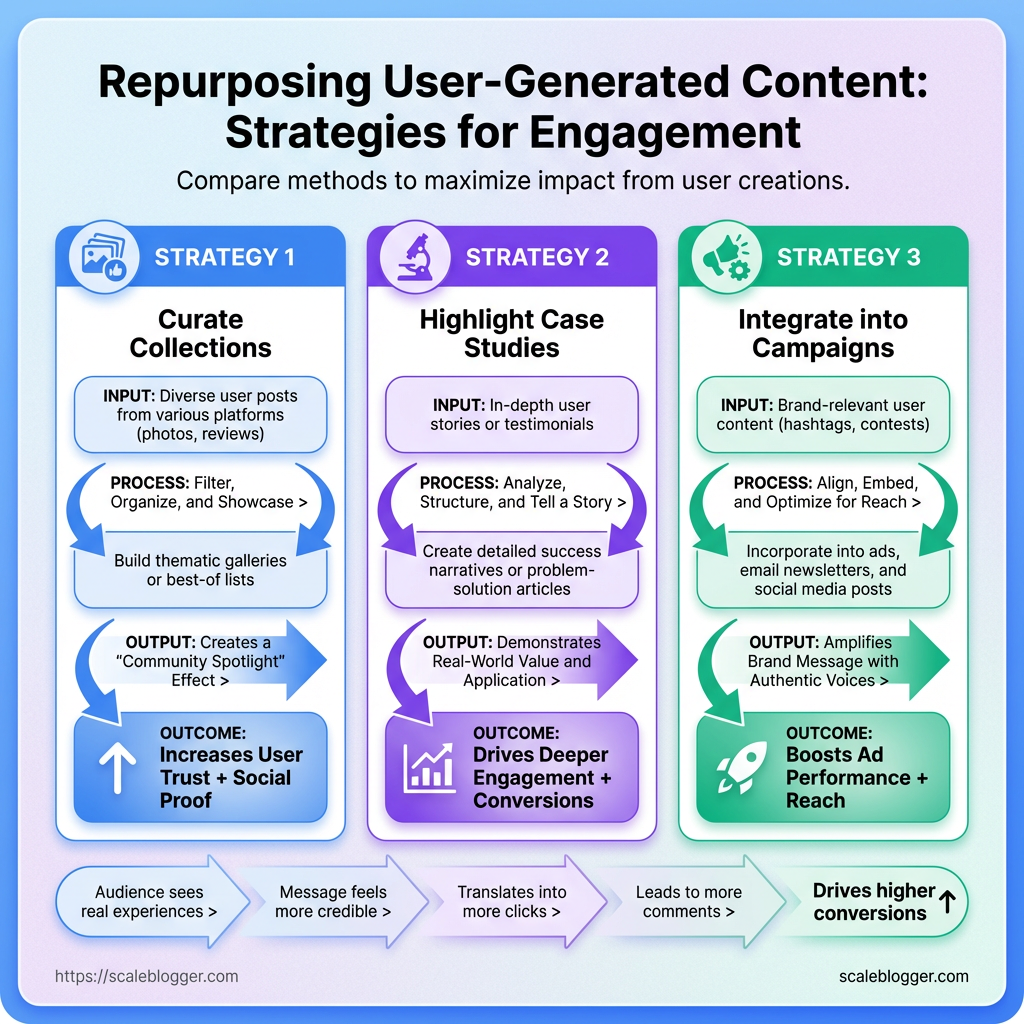
Marketing teams often sit on a trove of customer stories but lack systems to turn those stories into steady engagement. Repurposing user-generated content quickly and systematically converts scattered moments into a predictable content engine that fuels social proof and ongoing conversations.
Here’s the short answer: transform community-driven content into layered assets — short video clips, testimonial cards, threaded social posts, and email snippets — and automate tagging, rights management, and distribution. Doing this increases visibility while reducing creative overhead because the team reuses authentic material across formats and channels. Use AI to transcribe, tag, and crop assets, then map them to a weekly distribution cadence so each piece earns multiple touchpoints without manual repetition.
Industry approaches show that organizing UGC around themes, platforms, and conversion stages lifts engagement and retention more than sporadic resharing. Picture a product team that turned five customer videos into 25 microclips for Reels, Stories, and emails, creating consistent social momentum and higher comment rates. Practical next steps cover rights workflows, creative templates, and scheduling automation.
How to audit and categorize existing user-generated content quickly
Ways to automate tagging, cropping, and captioning with AI tools
Channel-specific repurposing tactics for higher share and comment rates
Rights and attribution workflows that protect brand and creators
Automate your UGC repurposing with Scaleblogger — explore how to scale these engagement strategies at https://scaleblogger.com
## H2: Why Repurpose User-Generated Content (UGC) Repurposing UGC converts authentic customer moments into a steady content engine that drives trust, reach, and efficiency. When you turn a short customer video, review, or social post into multiple assets — microclips, quote cards, FAQ snippets, or blog examples — you multiply the value of a single piece of social proof without the overhead of full production. This matters because audiences increasingly prefer peer voices over polished brand messages, and search engines reward diverse, high-intent content that answers real user questions. UGC repurposing is effective for four practical reasons. First, authenticity: real customers signal credibility faster than brand messaging. Second, velocity: UGC is available constantly, so teams can produce more content per month with the same headcount. Third, cost-efficiency: turning existing assets into derivative formats cuts production time and budget. Fourth, SEO leverage: UGC often contains natural language and long-tail phrases that match search queries, unlocking organic traffic for niche intents. Operationally, this means shifting from single-format campaigns to a pipeline: capture → curate → transform → publish. Tools and automation can streamline that pipeline; for example, platforms that extract best lines, auto-generate captions, and schedule multi-channel distribution significantly reduce manual steps. If you want a practical place to start, consider workflows that integrate creative briefs with automation — services that help you Scale your content workflow can shorten the learning curve while preserving creative control. H3: Benefits of UGC Repurposing for Engagement Repurposed UGC increases engagement by combining authenticity with distribution scale. It keeps messages fresh across channels, reduces creative friction, and leverages social proof where prospects convert. Authenticity and trust: real voices = quicker credibility Social proof boosts conversions: featuring customer outcomes increases intent Faster content cycles: reuse reduces production time from days to hours Lower production cost: less budget per asset versus fully produced media SEO and long-tail wins: natural phrasing captures niche searches Engagement outcomes and resource costs between original UGC, repurposed UGC, and brand-produced content | Metric/Dimension | Original UGC | Repurposed UGC | Brand-Produced Content | |—|—:|—:|—:| | Authenticity (perceived) | Very high | High | Medium | | Production Time | Minutes–hours | Hours–1 day | Days–weeks | | Cost | Low (user-created) | Low–Medium (editing) | High (studio + talent) | | Engagement Rate | High on social channels | Medium–High across channels | Medium on owned channels | | SEO Longevity | Low (ephemeral posts) | Medium–High (optimized assets) | High (cornerstone content when done well) | Key insight: Repurposed UGC strikes a balance — it keeps the authenticity of original posts while adding production and SEO polish to extend lifespan and reach. That makes it the most efficient option for teams needing volume without losing credibility.* H3: When (and What) to Repurpose — Prioritization Framework Use an Impact × Effort matrix to decide what to repurpose first. Quick wins are high-impact, low-effort assets like five-star reviews, short how-to clips, and customer quotes — these convert well and require minimal editing. Strategic investments are high-impact, high-effort pieces such as long-form case studies or compiled testimonial videos; they take more resources but serve as flagship assets. Finally, experimentation covers low-impact, high-learning items (A/B tests of formats, platform experiments) that uncover what resonates. 1. Map assets by impact: conversion influence, social reach, SEO potential. 2. Estimate effort: editing time, legal clearance, format adaptation. 3. Prioritize: start with high-impact/low-effort, schedule strategic investments, and slot experiments into cadence. Applying this framework helps teams deliver measurable wins quickly while building toward strategic content pillars. When implemented consistently, repurposing UGC lowers cost-per-asset and scales trust across channels. This is why many content teams pair process templates with automation — it speeds execution and keeps quality predictable. Understanding these principles helps teams move faster without sacrificing quality.
Practical Formats to Repurpose UGC
User-generated content becomes far more valuable when you choose formats that match audience attention and platform mechanics. Start with the simplest rule: short-form social assets drive discovery and quick engagement, while long-form and evergreen assets convert attention into authority and search traffic. Repurposing means extracting the most compelling moments — a strong hook, a specific proof point, and a clear next step — then reshaping them for platform constraints and audience intent. For teams, this creates a repeatable workflow: capture UGC, tag moments by theme (testimonial, how-to, surprise reveal), then map those moments to short-form social variants and one or two long-form pieces that add context and SEO lift.
What works in practice is a template you can apply across assets. For short clips use a Hook → Proof → CTA micro-structure (3–10s hook, 5–20s proof, 1–3s CTA). For long-form reuse the same proof clips as embedded media inside a structured post: intro with its keyword angle, curated quotes and screenshots, context and methodology, outcomes with metrics, and an endpoint CTA that drives a next action. Automating the export of tagged clips, captions, and timestamps speeds this at scale — tools for AI-assisted trimming and captioning make the process repeatable. If you want a turnkey approach to stitch UGC into SEO-driven content pipelines, consider how AI content automation can standardize tagging, caption drafts, and publishing schedules.
Short-form Social Assets & Stories
Short-form needs immediacy and platform-native polish. The Hook - Proof - CTA template works everywhere: lead with curiosity or contrast, show a credible moment (user reaction, before/after), finish with a micro-CTA (reply, poll, save). Platform style matters: vertical, loud caption, and captions on-screen for silent autoplay. Micro-CTAs like polls, reply prompts, and swipe-up/save actions convert passive views into interactions.
Hook-first: open with visual or textual curiosity (≤3s).
Proof-second: authentic user moment or metric (5–20s).
CTA-last: poll, reply, or link (1–3s).
Hook: "You won't believe this 10-second fix…"
Proof: 10s clip with caption "+45% efficiency"
CTA: "Vote: Would you try this? ⬇️"
Short-form social formats across platforms for ideal length, features, and engagement hooks
Platform | Ideal Length/Duration | Best UGC Type | Engagement Hook |
|---|---|---|---|
Instagram Feed | 15–60s (Reels preferred) | Short demos, testimonials | Save/Share prompts, sticker CTA |
Instagram Stories | 5–15s per card | Behind-the-scenes, quick polls | Polls, question stickers, swipe-up |
TikTok | 9–30s (up to 60s for narratives) | Trend-driven clips, challenges | Duet/stitch invites, hashtag CTA |
Facebook Feed | 15–60s (native video performs best) | Customer stories, product use | Comment prompts, link in post |
X/Twitter (short video) | 15–45s | Snappy reveals, demo snippets | Reply-to-vote, quote tweet CTA |
Key insight: Short clips need to be platform-native — vertical, captioned, and framed around a single idea. Prioritize Reels/TikTok for reach and Stories/FB feed for direct response; tailor the CTA to how users interact on each platform.
Long-form and Evergreen Assets (Blog Posts, Case Studies)
Long-form turns scattered UGC into a coherent story that ranks. Structure posts with an SEO-focused intro that combines UGC keywords with product/solution terms, then embed curated quotes, screenshots, and short video clips. Provide context (who, when, conditions), a clear outcomes section with measurable results, and finish with a CTA that aligns with the content’s intent (download, signup, demo). For SEO, combine UGC phrases (e.g., “user review of X”) with your solution keywords and use canonical tags when republishing the same UGC across formats.
Intro: state the problem and SEO angle.
Curated media: embed clips, quotes, images.
Context & method: explain how UGC was collected.
Outcomes: real metrics and before/after visuals.
CTA & republishing notes: link to next action, set canonical URL.
Republish cadence: refresh evergreen posts quarterly with new UGC, and use canonical tags when the same asset appears on social landing pages. Understanding these principles helps teams move faster without sacrificing quality. When implemented correctly, this approach reduces overhead by making decisions at the team level.
## H2: Workflows & Tools for Scaling Repurposing Scaling repurposing depends less on a single tool and more on a repeatable pipeline: capture assets reliably, verify rights and quality quickly, then automate rendering and distribution so creators spend time on ideas, not file wrangling. Start by defining submission channels and a minimal metadata schema, then enforce simple moderation rules and a rights-release workflow that ties to each asset. Once assets are trusted and tagged, feed them into templated render steps (audio → clip, long-form → social snippets, transcript → blog post) and schedule distribution with analytics handoff so you can measure lift from each repurposed piece. ### Collection, Moderation, and Rights Management Begin with clear, low-friction collection. Use dedicated submission forms and social listening to capture UGC, then apply a tight moderation checklist. Clear submission channels: Provide a short web form, email alias, and monitored hashtag to gather content. Moderation criteria: Define accept/reject rules for quality, brand safety, and legal concerns; train a small team on edge cases. Branding guidelines: Supply contributors templates for logos, fonts, and voice to keep output consistent. Rights release template: Use a one-click release that records contributor name, date, scope, and usage duration. Record-keeping: Store releases and assets together in a DAM with versioning and searchable metadata. Practical example: a webinar recording is uploaded to cloud storage, an entry in the DAM includes a checked release form and #webinarhighlight tag, and the file moves automatically to the render queue. This reduces back-and-forth legal review and gets clips out in hours, not days. ### Automation and Publishing Pipelines Automation scales when tagging, templates, and scheduling pass work between systems and teams without manual touchpoints. 1. Standardize metadata: Require title, source, rightsexpiry, language, campaign tags. 2. Automated rendering: Use templates to export 16:9 clips, 1:1 social cuts, transcript-based blog drafts, and captioned shorts. 3. Scheduling & analytics handoff: Push published assets to a scheduler with UTM parameters; ensure analytics feed back to a performance dashboard for content scoring. Tagging best practice: Use controlled vocabularies and taxonomy_id fields to enable programmatic filtering. Template reuse: Maintain a library of rendering presets per channel to guarantee consistent output. Analytics loop: Map KPIs (CTR, watch-time, conversions) back to original asset IDs for optimization. Understanding these practical building blocks lets teams automate routine tasks while preserving creative control. Tools and platforms for UGC collection and rights management with core features | Tool/Platform | Primary Use | Key Feature | Ideal For | |—|—|—|—| | Brandwatch | Social monitoring | Enterprise social listening & sentiment | Large brands needing trend signals | | Sprout Social | Social listening & publishing | Unified inbox, scheduling | Mid-market teams publishing UGC | | Mention | Real-time alerts | Keyword/hashtag monitoring | Rapid response social monitoring | | TINT | UGC aggregation & licensing | Collect + license UGC at scale | Campaigns using influencer posts | | CrowdRiff | Visual UGC curation | Image discovery and rights tagging | Travel & retail visual marketing | | Yotpo | Reviews & UGC on-site | Review-to-product integration | Ecommerce brands with product UGC | | Bynder | DAM / asset management | Centralized assets + metadata | Enterprise asset governance | | Cloudinary | Media management & delivery | On-the-fly image/video transforms | Teams needing automated rendering | | DocuSign | Legal signatures | Secure e-signature & audit trail | Rights releases and contracts | | Adobe Sign | Legal signatures | Integrates with Adobe workflows | Creative teams using Adobe tools | | OpenText Media Management | Enterprise DAM | Workflow automation & compliance | Heavily regulated industries | | Hootsuite | Scheduling & monitoring | Social publishing + listening | Small teams centralizing posts | Key insight: This mix balances social listening, UGC licensing platforms, DAMs, and e-signature tools so you can capture, clear, store, and publish without gaps. Market leaders handle scale and compliance; mid-market tools offer faster setup; cloud-native media platforms (Cloudinary, Bynder) simplify automated rendering. When implemented correctly, these workflows move content from raw submission to published asset with predictable SLAs and measurable ROI, which frees creators to focus on storytelling rather than repetitive tasks. If you want, I can map this pipeline to specific automation recipes and a sample metadata schema you can paste into your DAM or scaleblogger intake form.
Creative Repurposing Techniques to Boost Interaction
Remixing user-generated content (UGC) turns one-off posts into ongoing conversations — done well, it multiplies reach and invites participation without creating entirely new assets. Focus on formats that lower friction for viewers (short, snackable, mobile-first) and on mechanics that encourage attribution and sharing. Prioritize clear templates, platform-specific technical specs, and respectful creator tagging so the original posters feel recognized and motivated to re-share. Below are practical, production-ready techniques and measurement ideas you can apply immediately.
Remixing UGC: Overlays, Montages, and Reaction Content
Start with a repeatable template: a simple quote overlay, a montage sequence, and a short reaction clip unlock most engagement benefits with predictable production cost. Use overlays to surface powerful lines, montages to show patterns, and reaction videos to humanize your brand response.
Template — Quote overlay:
16:9video base,1080x1080crop for Instagram, 6–8s per quote, bold sans-serif, 3-line max caption.Template — Montage: 6–12 clips, 2–4s each, 2:1 audio-to-video rhythm, B-roll fades, end card with CTA and original creator tags.
Tagging rule: Always ask or credit: use @handles on-platform and include creator name in caption.
Technical specs per platform:
Instagram Reels: vertical
1080x1920, max 90s, keep primary action centered1080x1340.TikTok: vertical
1080x1920, high-contrast thumbnails, captions short.YouTube Shorts: vertical
1080x1920, quick hook within first 2s.
Code snippet — quick caption overlay CSS for templating:
.quote-overlay {
font-family: "Inter", sans-serif;
font-weight: 700;
font-size: 48px;
color: #ffffff;
text-shadow: 0 2px 4px rgba(0,0,0,.6);
max-lines: 3;
}
Practical examples: stitch a top customer quote into a 30s montage highlighting three product use cases; film a 20–30s reaction from a product manager responding to a user’s creative hack and link back to the original post. These techniques scale because they reuse source clips and require minimal new shooting.
Takeaway: Use consistent templates and platform specs so remixing becomes a low-cost, high-engagement part of your content rhythm.
Interactive UGC — Polls, Quizzes, and Community Challenges
Design interactions that are easy to join, visible, and repeatable. Polls and quizzes should be one-tap actions; challenges need clear mechanics and a simple hashtag to aggregate entries.
Design for scale: create a 3-step entry flow — see prompt → record or respond → tag with hashtag.
Incentives and rules: offer small, visible rewards (feature, coupon, shoutout); publish explicit rules and deadlines in the pinned post.
Measure impact: track entries, use engagement rate (likes+comments+shares ÷ impressions), and measure downstream KPIs like click-throughs or form signups.
Example challenge: Ask users to show a 10-second “before/after” using your product, tag @brand, add
#BrandFlip, winner featured in weekly montage.Quiz idea:
3-questionStories quiz that ends with a tailored CTA (shop, sign up, learn more).
Measuring participation:
Quantitative: entry count, hashtag reach, referral traffic.
Qualitative: sentiment sampling, highest-performing UGC formats for future reuse.
You can automate collection and basic scoring with an AI-powered content pipeline to route top entries into editorial queues and publishing schedules — useful if you want to scale challenges without manual overhead (consider AI-powered content automation to streamline this). When implemented thoughtfully, these interactive formats grow both reach and community investment. This is why teams prioritize simple, repeatable UGC formats that feed content engines and free creators to focus on creativity.
Remix techniques by required effort, engagement potential, and best platform uses
Technique | Effort (Low/Med/High) | Engagement Potential | Best Platforms |
|---|---|---|---|
Quote Overlay | Low | Moderate — quick social shares | Instagram, LinkedIn, Twitter |
Highlight Reel | Med | High — keeps viewers watching | YouTube, Facebook, Instagram Reels |
Reaction Video | Med | High — personalizes brand voice | TikTok, Instagram Reels, YouTube Shorts |
Before/After Compilation | High | Very High — strong social proof | Instagram, TikTok, YouTube |
UGC-driven Polls | Low | Moderate — boosts comments & shares | Instagram Stories, Twitter, Facebook |
Key insight: Low-effort overlays and polls are great for frequent engagement and reach, while montages and before/after compilations demand more production but deliver stronger social proof and watch-time. Prioritize a balanced mix so daily touchpoints feed into larger, higher-impact pieces.
## H2: Measurement: Metrics That Prove UGC Value UGC moves the needle when you can link it to specific, repeatable outcomes — not just impressions. Start by tracking platform engagement and downstream behaviors (clicks, signups, watch time) with UTM tagging and social pixels so each piece of UGC becomes a measurable asset. Pair platform-level KPIs with micro-conversions and A/B tests that compare repurposed UGC against branded creative; that comparison shows whether UGC is driving distinct lift or simply replacing paid reach. ### H3: Primary KPIs and Tracking Methods | KPI | Definition | Sample Target (Awareness Stage) | Tracking Method | |—|—:|—:|—| | Engagement Rate | Interactions (likes/comments/saves) ÷ impressions or reach | 1.5%–6% (social posts; higher on niche communities) | Platform analytics (Meta/IG/TikTok), exported API metrics | | Share Rate | Shares ÷ impressions — virality proxy | 0.1%–1% | Native share metrics, content dashboards | | Click-Through Rate (CTR) | Clicks on CTA ÷ impressions | 0.5%–2.0% | UTM tagged links → GA4 or server logs | | Conversion Rate (micro-conversions) | Lightweight actions (email opt-in, product page visit) ÷ clicks | 2%–8% | GA4 events, Pixel conversions, CRM capture | | View Completion Rate | % of video watched to end (short-form focus) | 45%–75% | Video platform analytics (YouTube Studio, TikTok Insights) | Key insight: These ranges reflect typical awareness-stage performance where reach is prioritized over direct sales. Use UTM parameters on every repurposed asset to trace traffic back to the original UGC and compare against matched brand creative using consistent landing pages. ### H3: Reporting Cadence and Optimization Loops Weekly pulse for social: Track engagement, CTR, and share rate weekly to catch creative trends early. Biweekly for experiments: Run A/B tests (repurposed UGC vs. brand creative) for 2–4 weeks to gather statistically useful data. Monthly performance review: Aggregate micro-conversions and view completion rates; adjust creative mix and targeting. Quarterly strategic audit: Reassess channels, reset KPI targets, and reallocate budget toward top-performing formats. Optimization loop (practical steps): 1. Collect: Ingest platform metrics and UTM-tagged downstream events into a central dashboard. 2. Analyze: Compare repurposed UGC vs. brand creative across CTR and micro-conversions. 3. Hypothesize: Identify why winners performed (tone, length, CTA). 4. Test: Iterate creatives or targeting with small-scale A/B tests. 5. Scale or pause: Scale creatives that exceed decision thresholds; pause those below them. Decision thresholds (common rules of thumb): Scale if CTR and micro-conversions outperform brand baseline by ≥20%. Pause if engagement and CTR are both below baseline after two test cycles. If you want to operationalize this into an automated pipeline that tags UGC, runs A/B comparisons, and surfaces performance signals, tools and workflows from scalable providers can help — for example, integrating UTM standards and reporting automation through an AI content operations partner like Scaleblogger.com to predict performance and automate scheduling. Understanding these measurement practices helps teams act fast and invest confidently in the UGC that actually drives outcomes.
H2: Governance, Ethics, and Community Relationships
Good governance and ethical guardrails are the scaffolding that let content programs scale without burning community trust. Start by treating permissions, attribution, and creator compensation as systems—recordable, auditable, and repeatable—rather than one-off favors. That means clear consent records, visible attribution templates, and a predictable approach to when you pay or license content. Doing so protects your brand, reduces legal risk, and makes contributors more likely to work with you again.
H3: Consent, Attribution, and Legal Best Practices
Set up a simple, auditable permission workflow that every contributor passes through before their content is published. Typical elements include a time-stamped consent record, the exact rights granted (e.g., republish, edit, sublicensing), and whether the license is exclusive or non-exclusive. Use visible attribution templates so every piece of user-generated content (UGC) carries the same clear credit line.
Record permissions: Store consent forms and screenshots of DMs with timestamps.
Visible attribution: Use a consistent credit line like
Photo: Jane Doe (@janedoe) — used with permission.Licensing decision rule: Pay for exclusivity; request permission for non-exclusive, low-risk content.
When to pay: Offer monetary payment for commercial uses, long-term campaigns, or exclusive rights.
When to request permission: For one-off blog embeds, community quotes, or low-value images.
Practical templates and tracking:
Use a short consent form in the CMS with fields:
Contributor Name,Handle,Content ID,Rights Granted,Expiration.Example attribution string:
Image: [Creator Name] (@handle). Used with permission. License: Non‑exclusive, perpetual for site and social.
Store records in an attachments folder and index them by
Content IDand date.
Outline sample compensation models and licensing approaches for creators (non-monetary vs. monetary)
Model | When to Use | Typical Compensation | Pros/Cons |
|---|---|---|---|
Attribution + Exposure | Micro UGC, community quotes | Free or credit | Pro: Low cost. Con: Limited incentive for creators |
Gift or Discount | Product fans, small exchanges | Gift value $10–$200 | Pro: Builds goodwill. Con: Hard to standardize value |
Flat Fee per Asset | Professional assets, photography | $50–$2,000 per asset | Pro: Predictable rights. Con: Higher budget impact |
Revenue Share / Affiliate | Ongoing partnerships | 5–30% commission | Pro: Aligns incentives. Con: Administrative overhead |
Exclusive License | Campaigns, paid ads | $500–$50,000+ | Pro: Full control. Con: Expensive, legal complexity |
Key insight: The right model balances your usage needs with creator expectations—low-cost attribution works for casual UGC, while exclusive or long-term commercial use typically requires clear payment. Building predictable compensation rules reduces negotiation time and preserves relationships.
H3: Building Long-term Community Relationships
Sustained community relationships come from recognition, reciprocity, and opportunities to co-create. Treat contributors as collaborators, not one-off content sources.
Recognition: Publicly credit contributors in posts and quarterly spotlights.
Reciprocity: Offer early access, feedback, or analytics to active contributors.
Co-creation: Invite creators into briefs, co-branded series, or editorial planning.
Practical program elements:
Start an annual contributor roster with tiered perks (early access, small fees, feature stories).
Run periodic co-creation sprints: ideation call → draft → publish, where creators get clear credit and shared promotion.
Measure contributor value via
referral traffic,engagement lift, andrepeat contributions.
When you standardize permissions, compensation, and recognition, relationships scale naturally and contention fades. Implementing these systems—combined with automation for tracking and publishing—lets you grow content output while keeping community trust intact. This is why teams that automate rights management and creator workflows move faster without losing credibility.
Conclusion
You’ve seen how a steady system for repurposing customer stories turns scattered clips and testimonials into reliable engagement: map content formats to distribution channels, batch simple edits, and automate routine publishing. A retail brand that converted weekly product unboxings into daily short-form clips and a SaaS team that fed onboarding emails with converted testimonial snippets both saw more consistent reach and higher engagement. If you’re wondering how long this takes, start with one workflow (five assets → three platforms) and expect measurable lift in 4–8 weeks; concerned about resources, focus on templates and lightweight automation to protect quality.
To move forward, create a single content map, batch one week’s assets, and set up an automation to publish to two platforms. If you want to streamline the entire process—scheduling, repurposing rules, and content templates—platforms like this can help. For teams ready to scale that workflow, consider this next step: Automate your UGC repurposing with Scaleblogger. That page is a practical place to explore automation options and trial workflows that match the examples above. When you’ve tested one cycle, iterate on format performance and expand—small, repeatable wins compound into dependable growth.