

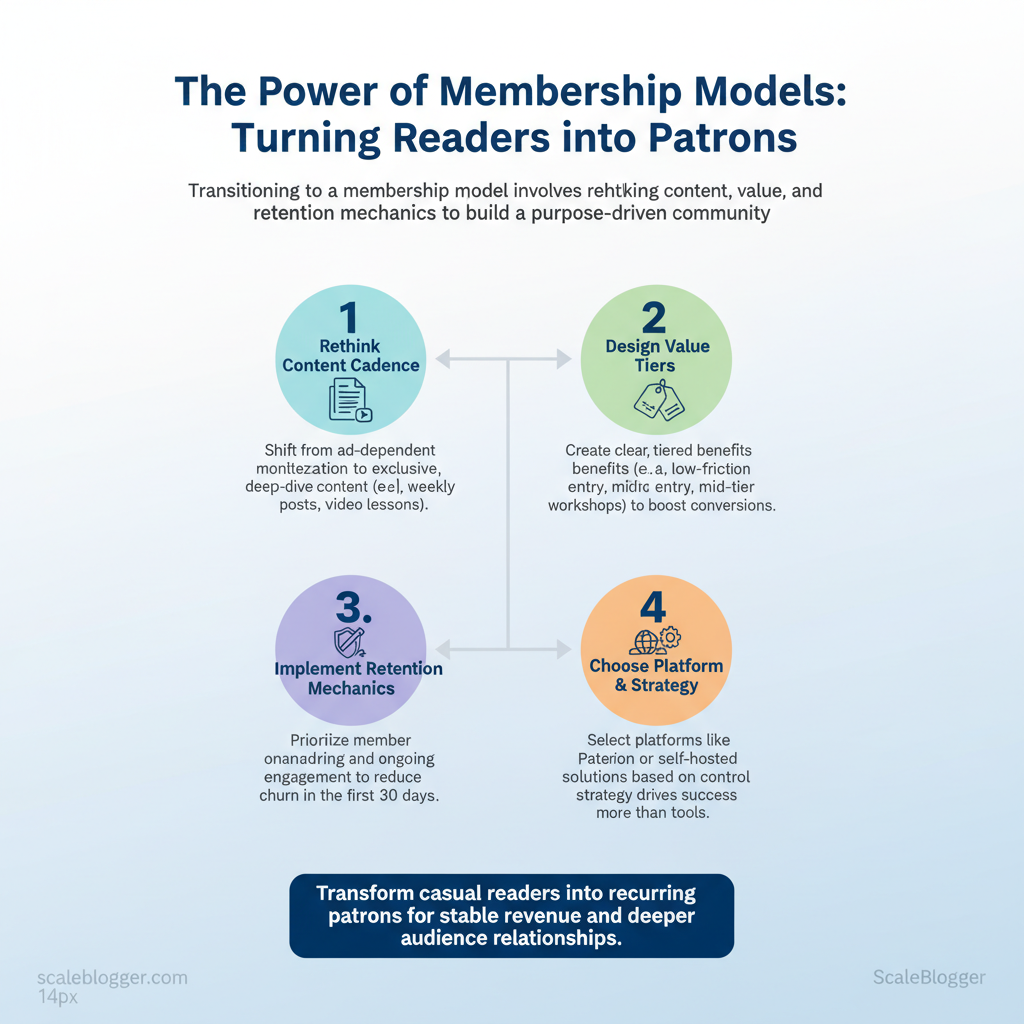
Most blogs stall at steady traffic because monetization remains transactional and ad-dependent. Shifting to membership models for bloggers converts casual readers into recurring patrons, stabilizing revenue and deepening audience relationships. Memberships don’t just earn; they create purpose-driven communities that reward exclusive content and ongoing engagement.
A successful transition involves rethinking content cadence, value tiers, and retention mechanics. Picture a newsletter that unlocks weekly deep-dive posts behind a paid wall, or a niche cooking blog offering members-only video lessons and recipe files — both models increase lifetime value and predictability. Using platforms like `Patreon` or building a bespoke platform for `creating a membership site` depends on control needs and scale, but strategy drives outcomes more than tools.
Industry research shows creators who prioritize member onboarding and clear tiered benefits see stronger retention. Practical tests consistently prove small, high-value offerings outperform broad, vague promises. Scaleblogger helps teams map content funnels, pricing experiments, and automation so membership launches scale without constant manual work.
- How to choose between `Patreon` for blogs and self-hosted membership platforms
- Designing three simple tiers that boost conversions and retention
- Onboarding flows that reduce churn in the first 30 days
- Automation tactics to free editorial time while increasing revenue
— Why Membership Models Work for Bloggers
Memberships convert episodic readers into ongoing customers by turning attention into a predictable revenue stream. Instead of chasing CPMs or one-off product launches, a membership sells access: to community, to exclusive content, to tools and templates. That shift changes planning, prioritization, and metrics — forecasting becomes months-ahead instead of week-to-week, LTV (lifetime value) rises because members compound value over time, and editorial choices tilt toward retention and depth rather than virality. For creators who want independence from platform algorithm swings, recurring payments are a structural hedge: fewer surprises, more strategic runway.
How this plays out practically – Predictable cashflow: Monthly or annual subscriptions smooth income, making hiring and investment decisions safer. – Higher LTV: Members who stay 6–12 months typically deliver multiples of a single-course sale. – Control over audience: Memberships shift leverage from platforms to the creator-owned list or community. – Retention-driven product development: Prioritise features that keep members engaged rather than one-time conversions.
Why people actually pay
Practical examples and signals – Offer a low-friction entry tier with exclusive posts plus a mid-tier that adds monthly workshops and a private forum. – Measure churn monthly and run exit surveys to segment why members leave — content mismatch or lack of time are common.
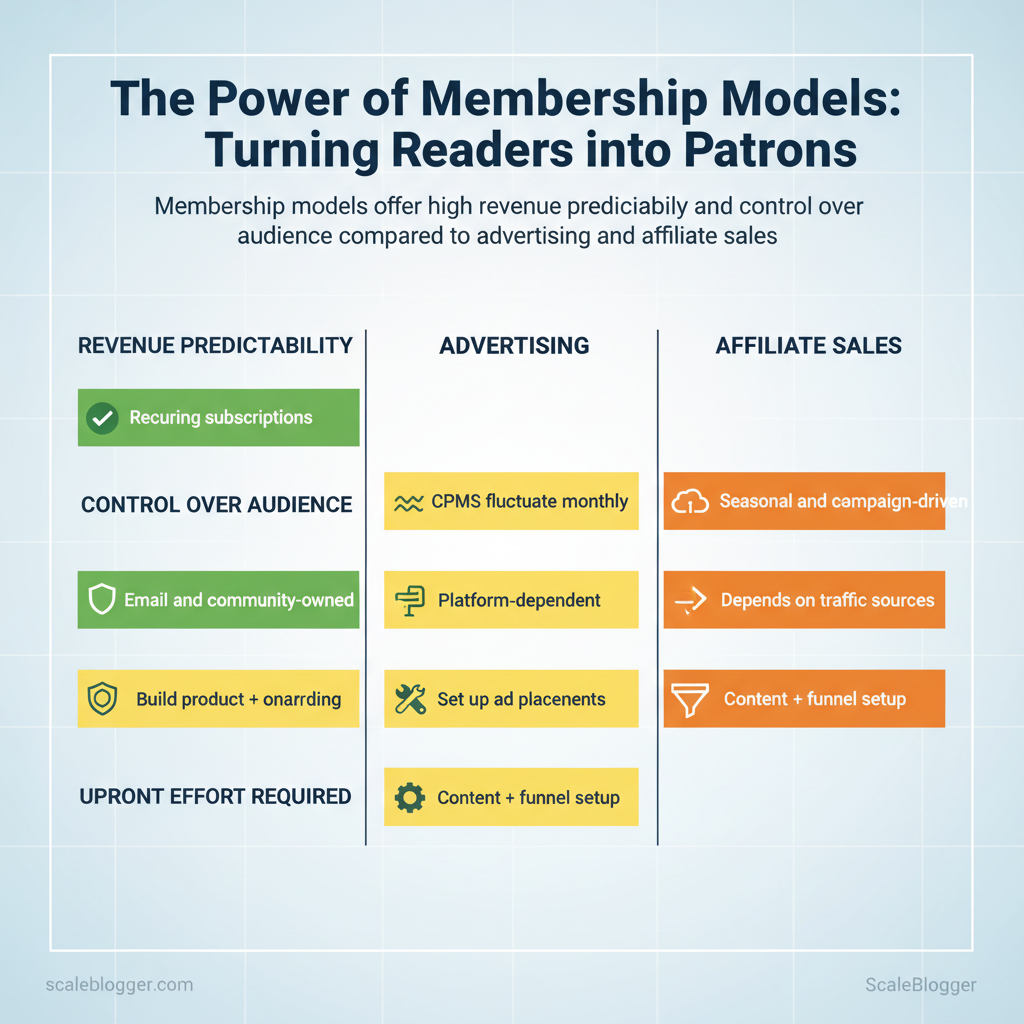
| Metric | Memberships | Advertising | Affiliate Sales |
|---|---|---|---|
| Revenue predictability | High — recurring subscriptions | Low — CPMs fluctuate monthly | Medium — seasonal and campaign-driven |
| Control over audience | High — email and community-owned | Low — platform-dependent | Medium — depends on traffic sources |
| Scalability | Medium-high — content + community scales | High — audience scale raises impressions | High — traffic scale raises conversions |
| Upfront effort required | High — build product + onboarding | Low — set up ad placements | Medium — content + funnel setup |
| Typical margin | High after fixed costs | Variable — publisher fees, ad ops | High per sale but variable with commissions |
Understanding these dynamics makes it easier to design tiers, incentives, and retention loops that actually move the needle for both revenue and reader loyalty. Consider using an AI content automation workflow like those at Scaleblogger.com to streamline member-only publishing and performance tracking.
— Choosing the Right Membership Model
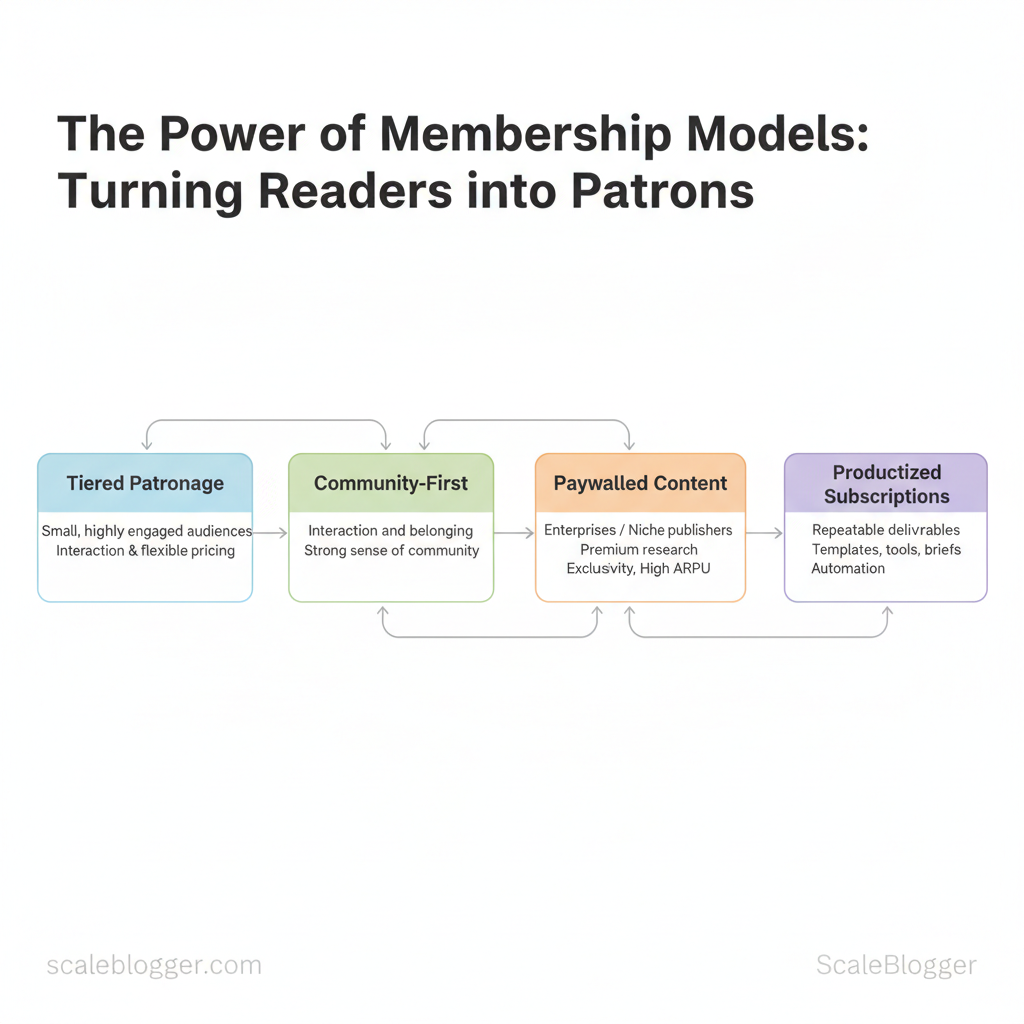
Start by matching your audience behavior and team capacity to a membership model — the wrong fit wastes marketing energy and frustrates members. For creators with small, highly engaged followings, tiered patronage or community-first approaches win because they prioritize interaction and flexible price points. Enterprises or niche publishers with premium research should prefer paywalled content when exclusivity and high ARPU matter. Productized subscriptions are best when you can package repeatable deliverables (templates, tools, weekly briefs) and scale delivery with automation.
Common signals to watch: audience size, willingness to pay, frequency expectations, and content production overhead. Build simple experiments that validate price elasticity and engagement before committing to a model, and use automation (for example, an AI-powered publishing pipeline) to cut operating cost per member as you scale.
Common membership types and when to use them
| Feature / Metric | Paywalled Content | Tiered Patronage | Community-First | Productized Subscriptions |
|---|---|---|---|---|
| Ideal audience size | 1k–50k niche readers | 500–20k engaged fans | 200–10k active members | 1k–100k buyers |
| Technical complexity | Medium (paywall + CMS) | Low–Medium (Patreon/Memberful) | Medium–High (forums, events) | High (delivery & billing automation) |
| Content cadence required | Weekly–Monthly | Variable (exclusive drops) | Daily–Weekly interaction | Weekly–Monthly deliveries |
| Monetization ceiling | High per-seat ARPU | Moderate (volume-based) | Moderate (retention-driven) | High (scalable product margins) |
| Engagement intensity | Low–Medium | High | Very High | Medium |
| Typical price range | ` $10–$200+/month` | ` $3–$50/month` | ` $5–$100/month` | ` $10–$500/month` |
| Best platforms | Substack, Memberful | Patreon, Ko-fi | Circle, Discourse | Gumroad, Stripe Billing |
| Retention drivers | Fresh exclusive content | Creator relationship | Peer value + events | Product value + updates |
| Resource intensity | Content production | Creator time | Community managers | Automation & ops |
| Pivot difficulty | Medium | Low | Medium–High | High |
Decision checklist: pick a model in 7 steps
How to validate quickly: use landing pages, one-off paid webinars, or limited pilots. Pivot when tests consistently miss revenue or engagement targets, or when marginal cost per member exceeds forecasted LTV. Understanding these principles helps teams choose a model that fits audience expectations and operational reality.
— Setting Up the Technical Foundation
A robust technical foundation reduces friction for content teams and keeps editorial velocity high. Start by choosing a platform that matches your goals—full ownership and extensibility for a large editorial operation, or hosted simplicity for rapid launch—and then stitch together essential integrations that handle payments, membership, email, analytics, and caching. The initial focus should be on minimizing manual handoffs: automate content ingestion, scheduling, and performance tracking so writers and SEOs can iterate quickly. Practical trade-offs matter: DIY stacks require more engineering but offer lower long-term cost per user and richer SEO control; hosted platforms remove maintenance overhead but impose functional limits and vendor lock-in.
Prerequisites
- Team capacity: engineering hours or managed-provider budget
- Primary objective: community, paid subscriptions, newsletter-first, or course delivery
- Compliance needs: GDPR, CCPA, PCI (if taking payments)
- Hosting/Platform (see comparison table below)
- Payment gateway: Stripe or PayPal
- Email automation: ESP like Mailgun, SendGrid, or ConvertKit
- Analytics: GA4, server-side tracking or Snowplow
- CDN/cache: Cloudflare, Fastly, or Vercel
- Access control: JWTs, OAuth, or membership plugins
Platform options: DIY vs. hosted solutions Platforms on control, cost (low/med/high), setup complexity, best use case
| Platform | Control | Typical Cost | Best For |
|---|---|---|---|
| WordPress + plugins | High (full extensibility) | $5–$200+/mo (hosting; plugins premium) | SEO-first blogs, complex integrations |
| Ghost | Medium (open-source, opinionated) | $0 self-host / $9–$199/mo hosted | Paid newsletters, membership sites |
| Substack | Low (hosted, limited customization) | Free / revenue share | Newsletter-first creators |
| Patreon | Low (hosted membership platform) | $0–$12+/mo + fees | Creator memberships, patron community |
| Kajabi | Low-Med (all-in-one) | $149–$399+/mo | Courses + memberships + marketing |
Minimum viable stack vs. scalable stack
- MVS: Managed WordPress host, Stripe, MailerLite, GA4, Cloudflare.
- Scalable: Self-hosted WordPress/Ghost on Kubernetes, Stripe Connect, full-featured ESP, server-side analytics, multi-layer CDN, RBAC and SSO.
- Use `JWT` for session tokens and short-lived cookies for paid content.
- Cache public pages aggressively; bypass cache for authenticated content using `Cache-Control` and edge rules.
- Monitor cache hit ratio and purge on publish events.
- If membership payments fail, test webhooks in `Stripe` dashboard and inspect server logs.
- If SEO drops after migration, audit canonical tags and sitemap delivery.
— Pricing, Tiers & Launch Strategy
Design pricing so value is obvious and friction is low: anchor the middle tier, offer a clear premium differentiator, and use scarcity or time-limited incentives for early adopters. Pricing psychology matters more than exact numbers — people buy contrast, certainty, and perceived ROI. Below are tactical tier templates, actionable pricing rules, a 6-week launch timeline with ready-to-send messaging, and a week-1 onboarding checklist that reduces churn.
3 pricing psychology tactics that convert
- Bold anchoring: Lead with a high-value Gold tier to make the middle tier feel like a bargain.
- Decoy pricing: Introduce a near-identical Silver with one missing feature so Gold looks clearly better.
- Time-limited incentives: Offer `20%` off for the first 100 members or a `14-day` trial to remove signup friction.
When to offer annual discounts or trials
- Annual discounts: Offer `2 months free` (≈16% off) when lifetime value justifies upfront payment; ideal when churn risk is low and onboarding is strong.
- Trials: Use a `7–14 day` trial when the product demonstrates immediate, measurable value in the first session (e.g., access to analytics or a starter resource pack).
| Tier | Monthly Price | Key Deliverables | Target Audience |
|---|---|---|---|
| Bronze | $5/month | Monthly newsletter, community access, 1 guide | Casual readers/new subscribers |
| Silver | $15/month | Weekly articles, searchable archive, monthly Q&A | Regular readers, hobby bloggers |
| Gold | $49/month | Weekly premium content, workshops, 1-on-1, early access | Power users, pro bloggers |
| Annual Plan (Gold) | $490/year (2 months free) | All Gold deliverables, priority support | Committed power users |
6-week launch timeline with weekly milestones
Email subject line templates and short bodies Subject: “Early access: join the new [Blog] membership at 20% off” Body: Short: explain exclusive benefit, state limited availability, CTA to claim spot.
Onboarding checklist to reduce churn in week 1
- Welcome email + what-to-expect roadmap (within 1 hour)
- Immediate access item (download or lesson) to deliver instant value
- Orientation email explaining community rules and how to get help (day 1)
- Automated milestone nudges (days 3 and 7) with tips and popular content links
- Quick feedback prompt at day 7 to catch issues early
— Growing and Retaining Members
Start by making the first month unbearable to leave: design an onboarding and engagement flow that delivers immediate, repeatable value and then layers habit-forming engagement. Focus the first 30 days on quick wins that prove the membership’s ROI, use ongoing content and events to create social proof, and instrument simple KPIs so teams can spot slippage early and act fast.
Prerequisites
- Membership product defined: clear benefits, pricing, and tiers.
- Onboarding assets ready: welcome email, quick-start guide, 1–2 high-value resources.
- Analytics in place: event tracking for activation, engagement frequency, churn.
- Basic automation: email sequences and an event calendar.
KPIs to track and why
- Activation rate: whether new signups realize value.
- Weekly active members: measures habit formation.
- Churn rate: ultimate health signal for long-term viability.
- Average revenue per member (ARPM): monetization efficiency.
| Metric | Week 1 Target | Month 1 Target | Month 3 Target |
|---|---|---|---|
| Activation Rate | 50% | 65% | 75% |
| Weekly Active Members | 30% | 45% | 60% |
| Churn Rate (monthly) | 8% | 6% | 3% |
| Average Revenue per Member | $6 | $12 | $25 |
Growth channels: content, partnerships, paid acquisition
- Organic content: use lead magnets, gated mini-courses, and a newsletter funnel that maps topics to membership benefits.
- Partnerships and guest appearances: co-host webinars, podcast swaps, and cross-promotions with aligned creators to acquire high-intent audiences cheaply.
- Paid acquisition + referral tests: start with small, audience-specific campaigns (social ads targeted by interest + lookalike), measure CAC and 30-day LTV; run a referral program with tiered rewards.
Tools and automation
- Content automation: use AI to scale member-facing content and synthesize member questions into new resources — consider `AI content automation` solutions like Scaleblogger.com for workflow scaling.
- Engagement tools: in-app notifications, email automation, and event platforms.
- If activation stalls, simplify the first task and remove friction.
- If churn spikes after month 1, survey churned members and test a re-engagement offer.
- If paid CAC is high, tighten targeting and increase the value of the gated offer.
📥 Download: Membership Model Launch Checklist (PDF)
— Legal, Taxes & Long-Term Monetization
Start by treating legal and tax foundations as operational features of the membership product: get the paperwork right, automate routine compliance, and sequence monetization so member trust increases alongside revenue opportunities. Membership creators who lock down policies, clear invoicing, and tidy records early remove friction for scaling — and protect the business when a tax agency or unhappy customer shows up.
Legal & tax checklist: what to secure first
- Terms of Service: Draft clear usage rules, prohibited behavior, and content ownership.
- Privacy Policy: Declare data collected, retention, third-party processors, and cookies.
- Tax collection (VAT/sales tax): Determine nexus, register in required jurisdictions, and enable tax calculation at checkout.
- Refund/Cancellation policy: State `time-bound` refund windows (e.g., `30 days`) and prorated cancellations.
- Data security measures: Implement TLS, secure backups, and access controls.
“Treat legal and tax foundations as product features — they reduce churn and build trust.”
| Legal Item | Action Required | Urgency | Who to Consult |
|---|---|---|---|
| Terms of Service | Create and publish on site footer; include membership rules | High | Contract attorney or legal template vetted for creators |
| Privacy Policy | Publish, update for processors (Stripe, Mailchimp), include GDPR clauses | High | Privacy attorney or compliance consultant |
| Tax collection (VAT/sales tax) | Configure tax engine (Stripe/TaxJar); register where required; collect at checkout | High | Tax advisor or sales tax service (TaxJar/Quaderno) |
| Refund/Cancellation policy | Publish clear window (e.g., `30 days`) and refund mechanics | Medium | Business attorney; customer success lead |
| Data security measures | TLS, encrypted backups, 2FA, role-based access controls | High | Security consultant / managed hosting provider |
Practical invoicing and record-keeping
Example invoice template: “`text Invoice #2025-001 Date: 2025-01-01 Description: Annual membership — Premium Tier Amount: $240.00 VAT (20%): $48.00 Total: $288.00 “`
Scaling revenue: adjacent products & sequencing launches
- Member-driven ideation: Use quarterly surveys and in-product polls to generate 8–12 adjacent product ideas (workshops, templates, micro-courses).
- Protect member value: Launch new paid offers to non-members first, then offer members early-bird discounts or bundled upgrades.
- White-label/licensing decisions: License content when a partner can scale distribution without cannibalizing membership; white-label only if quality control and attribution are contractually enforced.
For automation and scaling, integrate an AI content pipeline to test adjacent offers faster — Scaleblogger.com helps design those systems and automate sequencing while preserving member value. Understanding these principles helps teams move faster without sacrificing quality.
Conclusion
Moving a blog from ad-dependent traffic to a sustainable membership model means rethinking value, onboarding, and measurement. Successful transitions blend three elements: clear member value (exclusive posts, courses, or community), an easy first-month experience that proves worth, and metrics that track engagement and churn. For example, niche newsletters that introduced tiered benefits saw predictable monthly revenue within six months, and a technical blog that launched member-only tutorials doubled retention by focusing onboarding on outcomes. Common questions — “How fast will revenue ramp?” and “Which content should go behind the paywall?” — are answered by piloting a small paid tier and measuring conversion and engagement before wider rollout.
Start with two concrete actions: define member personas and map the first 90-day onboarding to reduce early churn. Then run a pilot for one content series, track MRR and retention, and iterate. Useful immediate next steps: – Audit your top-performing posts to identify membership candidates – Design a low-friction signup with one clear promised outcome – Measure engagement weekly and adjust tiers accordingly
To streamline this process, platforms like Explore Scaleblogger’s membership launch services can help teams automate onboarding and scale offers. Take the pilot live, learn from early members, and expand offers based on what drives retention and recurring revenue.
