

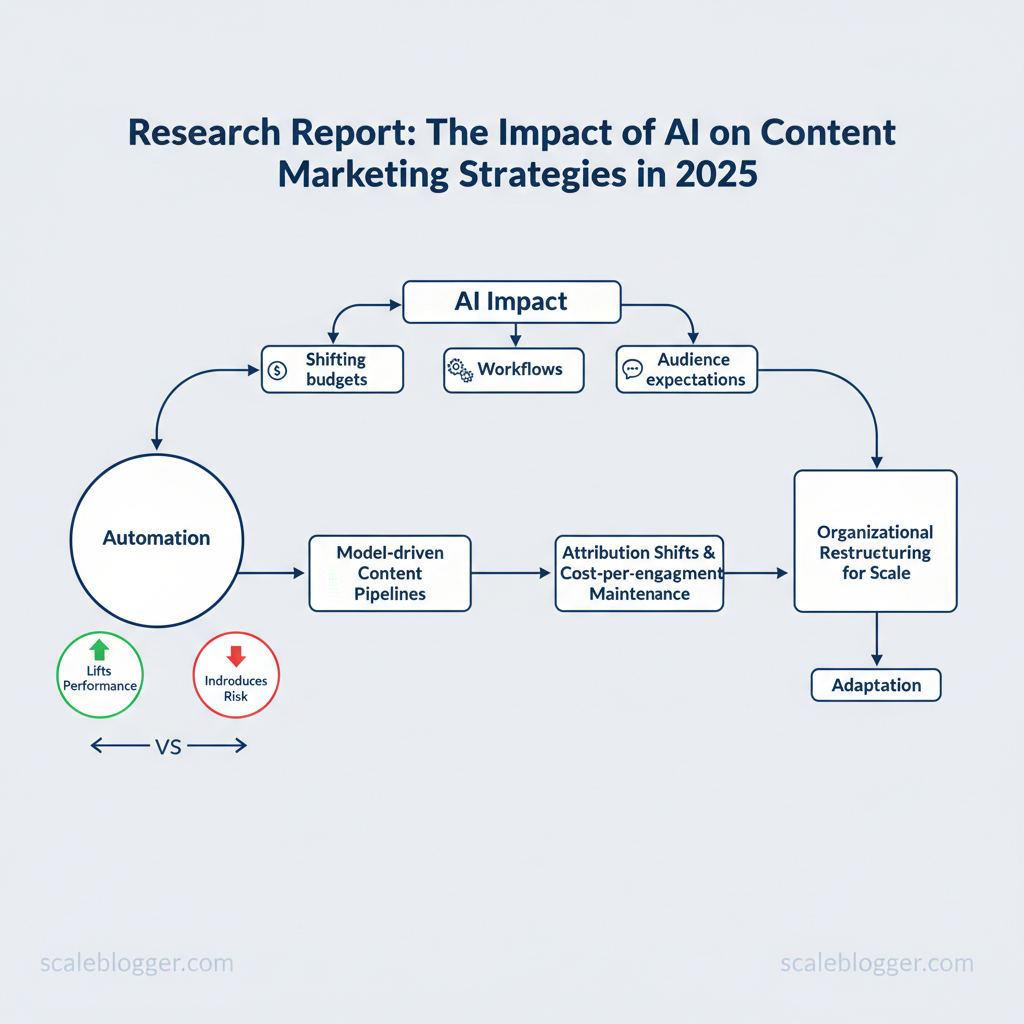
Marketing teams still spend vast hours on repetitive tasks while strategic content falls behind. Industry observations show the AI impact is shifting budgets, workflows, and audience expectations faster than many organizations can adapt.
Faster production without governance creates short-term gains and long-term brand drift if unchecked.
- How AI tools streamline content workflows and reduce manual scheduling
- Where measurement frameworks must change to capture model-driven influence
- Practical guardrails to maintain brand voice at scale
- Organizational shifts required to integrate AI into content ops
The Current Landscape of Content Marketing
Content marketing has shifted from discrete campaign bursts to continuous, systematized programs that blend editorial craft with automation. Teams now combine search-first content, social amplification, and lifecycle email with measurement loops that feed creative priorities. Technology — especially AI — is no longer optional; it accelerates research, scales production, and improves targeting without replacing editorial judgment.
Common approaches in active use:
- Search-driven content for high-intent acquisition and pillar pages.
- Short-form social for distribution and topical amplification.
- Lifecycle email to convert and retain audiences.
- Content-as-a-service: modular assets that serve web, social, and email.
- Data-driven optimization using analytics and test frameworks.
Industry analysis shows integrated programs that couple content production with automated measurement outperform ad-hoc efforts on organic traffic and retention.
AI appears across the stack: `NLP` for topic discovery, `embedding` models for semantic clustering, and automation for editorial workflows. Practical examples include AI-assisted outlines, automated tag mapping for taxonomy management, and predictive scoring to prioritize content that will outperform. The tactical shift is toward pipelines: ingest signals, generate prioritized topics, produce drafted assets, and close the loop with performance data.
| Strategy | Description | Effectiveness | AI Role |
|---|---|---|---|
| SEO | Long-form, intent-driven pages and topic clusters | High for sustained organic growth | Topic discovery, content briefs, SERP intent analysis |
| Social Media | Short, native assets for reach and engagement | Moderate-to-high for awareness | Caption generation, content repurposing, scheduling |
| Email Marketing | Segmented sequences and newsletters for conversion | High for retention and monetization | Personalization, subject-line optimization, send-time prediction |
| Content Creation Tools | Platforms that assist drafting, editing, and asset production | High for scale and speed | Draft generation, style tuning, `semantic optimization` |
| Analytics | Measurement stack (GA4, BI tools, A/B testing) for decisions | Critical for ROI and iteration | Automated reporting, anomaly detection, predictive modeling |
Teams that integrate these elements create predictable pipelines rather than one-off wins. This reduces time-to-publish and improves content ROI while preserving editorial quality. For organizations ready to operationalize this model, adopting `AI-powered content automation` and a content scoring framework will materially increase output consistency and search performance. Understanding these principles helps teams move faster without sacrificing quality.
Predicted AI Developments by 2025
AI will stop feeling experimental and become a standard capability embedded in content systems, analytics, and personalization layers. Expect models to move beyond single-task outputs into coordinated pipelines that draft, test, and iterate content with measurable SEO and engagement goals. This section outlines the technologies most likely to change content strategy and how teams should prepare.
- AI content generation shifting from one-off drafts to `multi-step pipelines` that produce topic clusters, meta assets, and variant testing content.
- Chatbots evolving into persistent session agents that retain context across channels and hand off to humans with full conversation state.
- Predictive analytics combining first-party signals and model-based forecasts to prioritize content topics and distribution timing.
- Personalization engines delivering real-time micro-personalization based on intent signals and content performance.
| Technology | Expected Features | Potential Impact |
|---|---|---|
| AI Content Creation | `Multi-step pipelines`, SEO-aware prompts, variant generation | Faster content velocity; 30-50% reduction in time-to-publish for template content |
| Chatbots | Persistent context, multimodal inputs, escalation handoffs | Improved self-service rates; higher conversion on conversational funnels |
| Predictive Analytics | Time-series forecasting, topic prioritization, cohort-level lift estimates | Smarter editorial calendars; better ROI per article |
| Personalization Engines | Real-time intent signals, content recomposition, micro-segmentation | Higher engagement and retention through tailored journeys |
Understanding these developments helps teams move faster without sacrificing quality. When implemented correctly, this approach reduces overhead by making decisions at the team level and letting automation handle repetitive workflows. Scaleblogger.com’s AI-powered content pipeline can fit into this architecture to automate scheduling and content scoring where relevant.
Impact of AI on Content Creation
AI has shifted content production from a handcrafted, linear process into a rapid, iterative pipeline where ideas, drafts, and optimization happen in parallel. Automated content generation accelerates output, standardizes structure, and reduces marginal cost per asset, but it also introduces new quality-control needs and changes the role of human writers toward strategy, editing, and creative leadership.
- Speed: AI drafts blogs, outlines, and meta assets in minutes, turning what once took days into hours.
- Cost efficiency: Automated workflows lower per-article cost by replacing repetitive drafting work with templates and models.
- Scalability: Teams can publish at higher frequency and test topical variations without proportional headcount increases.
- Consistency: Style guides and content rules can be embedded into prompts for uniform tone across large programs.
- Data-driven optimization: AI can surface semantic keywords, internal linking suggestions, and headline variants at scale.
- Quality control: AI produces fluent text but can hallucinate facts and misrepresent sources; human verification remains essential.
- Search intent alignment: Drafts may look complete yet miss nuanced intent—editorial oversight is required to map content to user journeys.
- Brand voice fidelity: Maintaining authentic voice across AI outputs requires fine-tuned instruction sets and editorial rules.
- Ethical and legal risk: Copyright, attribution, and privacy risks increase if models reuse or infer proprietary information.
- Skill shift: Roles move from writing drafts to prompt engineering, editing, and data analysis.
Market leaders adopted AI-first drafting in enterprise blogs to cut time-to-publish by up to an order of magnitude.
| Aspect | Traditional | AI-Generated |
|---|---|---|
| Time to Produce | 8–40 hours per long-form article | Minutes–1 hour per draft |
| Cost | $150–$1,000+ per article (writer+research) | $0–$50 per article (subscription or credits) |
| Quality Control | Human editing ensures factual accuracy | Requires human fact-check + edits; hallucination risk |
| Scalability | Limited by writer headcount | High; pipelines support large volumes |
AI in Content Distribution
AI has shifted distribution from manual scheduling to data-driven, audience-first orchestration. Rather than treating distribution as an afterthought, teams now use AI to match content formats, timing, and channels to segments that convert — turning one long-form asset into dozens of optimized touchpoints automatically.
Practical approaches and steps:
| Tool Name | Function | Benefits |
|---|---|---|
| OpenAI (ChatGPT) | Conversational copy + repurposing | Fast variants, headline generation, conversational ads |
| Buffer | Social scheduling + analytics | Channel scheduling, optimal time suggestions, team approvals |
| Hootsuite | Enterprise social orchestration | Cross-channel publishing, bulk scheduling, reporting |
| Mailchimp | Email automation with segmentation | Behavioral targeting, A/B testing, send-time optimization |
| HubSpot | CRM + content automation | Lead-based workflows, multi-channel sequencing, attribution |
| Lately.ai | Automated content repurposing | Converts long-form into social posts, AI summarization |
| Zapier | Workflow automation | Connects CMS→social→email, no-code triggers |
| OneSignal | Push notifications + segmentation | Real-time push, audience segments, A/B send tests |
| Sprout Social | Insights-driven social management | Listening, optimal posting, team collaboration |
| SocialBee | Content recycling + categories | Evergreen scheduling, category balancing, RSS automation |
Integrating these capabilities with content production ensures distribution reflects audience intent, not guesswork. For teams looking to operationalize this, consider combining an AI repurposing engine with `API`-driven scheduling and a content-scoring loop — or adopt an end-to-end solution like the AI-powered content pipeline at Scaleblogger.com to scale execution and benchmarking. Understanding these principles helps teams move faster without sacrificing quality.
Challenges and Ethical Considerations
AI-driven content changes the work, not the values behind it. Transparency around AI use, actively managing misinformation risk, and embedding practical ethical guidelines into workflows are the structural issues that determine whether AI scales trust or amplifies harm.
Begin with transparency. Readers expect to know when content is machine-assisted. Label AI-generated material clearly, document what parts were automated (research, first draft, editing), and keep a version trail that captures `model`, `prompt`, and `temperature` or other key parameters. This reduces reputational risk and allows teams to audit decisions.
Misinformation is a constant operational hazard. Generative models can confidently produce plausible but incorrect facts. Mitigate by making fact-checking a mandatory stage:
Practical ethical controls to implement immediately include these eight items:
- Labeling policy: Clear rules for when and how to disclose AI involvement.
- Attribution standards: Require citations for data, quotes, and proprietary assertions.
- Fact‑check checklist: Minimum verification steps for statistics and historical claims.
- Bias testing: Routine prompts designed to surface demographic or cultural bias.
- Privacy safeguards: Redact or anonymize PII before training or prompting.
- Quality thresholds: Minimum pass/fail metrics using content scoring frameworks.
- Human-in-the-loop: Gatekeeping roles that cannot be bypassed by automation.
- Escalation path: Clear procedure for disputed edits or potential legal exposure.
Industry analysis shows responsible AI programs perform best when governance is embedded at the workflow level rather than left to ad hoc review.
Operationalize those controls with a short sequence:
Tools can help enforce the rules — from content scoring systems to automated redaction — and organizations that want to move quickly should consider platforms that `Scale your content workflow` while retaining control. Balance is the objective: use automation to accelerate repetitive work and measurement while preserving human judgment for credibility, context, and ethics. When implemented well, ethical guardrails turn AI from a compliance headache into a reliability multiplier for content teams.
📥 Download: AI-Driven Content Marketing Strategy Checklist (PDF)
Final Thoughts and Recommendations
Adopt an operational mindset where content strategy becomes a repeatable system rather than a sequence of one-off projects. Treat AI and automation as production-line improvements: they remove routine friction, increase throughput, and surface higher-value creative work for human teams. Immediate gains come from aligning tooling, measurement, and skill development so each piece of content feeds measurable objectives.
- Invest in AI tooling → Prioritize platforms that automate research, outline generation, and optimization while preserving editorial control; integrate `SEO APIs` and content scoring to keep quality consistent.
- Create a single source of truth → Centralize briefs, style guides, and performance thresholds so models and contributors use the same signals.
- Standardize content templates → Use modular templates for recurring formats (how-tos, pillars, roundups) to accelerate production and A/B test variants.
- Implement continuous learning → Run monthly skill sessions on prompt engineering, analytics interpretation, and writing for intent.
- Measure outcomes, not outputs → Track engagement, conversions, and topical authority instead of raw post counts.
- Automate where it reduces rework → Apply automation to tagging, publishing, and metadata insertion to save hours per post.
- Protect editorial integrity → Use human review gates for nuance, legal checks, and brand voice to prevent drift.
- Scale with governance → Define guardrails for model use, data privacy, and content accuracy to mitigate risk.
Industry analysis shows teams that pair automation with clear governance shorten time-to-publish and improve engagement consistency.
Where appropriate, integrate platform capabilities that match specific needs. For organizations focused on scaling blog production and performance benchmarking, consider AI content automation and systems that let teams `predict your content performance` while retaining editorial oversight. Scaleblogger.com offers AI-powered content pipeline services that align with these priorities and can accelerate implementation when internal capacity is limited.
Adopting these steps reduces operational friction and raises content impact across channels. When implemented deliberately, automation shifts the team’s energy from tactical tasks to strategic storytelling and growth.
Across the sections we explored how AI reduces repetitive work, refocuses teams on strategy, and accelerates content velocity while preserving quality. Practical patterns emerge: automating briefs and templates frees senior writers for higher-impact narratives; repurposing top-performing assets multiplies reach with modest effort. One marketing team described shifting 40% of weekly hours from production to strategy after introducing automated workflows, and content operations that standardized topic models saw steadier organic growth.
For next steps, audit one workflow to automate this quarter—choose briefing, editing, or distribution—and measure time saved over four weeks. To streamline that process, platforms like Discover how Scaleblogger can enhance your content marketing strategy. offer ready-made templates and automation playbooks for teams looking to scale without adding headcount. Implement the smallest change that delivers measurable time savings, then iterate toward broader transformation. Start with a single, high-frequency task and quantify the gain before expanding.
