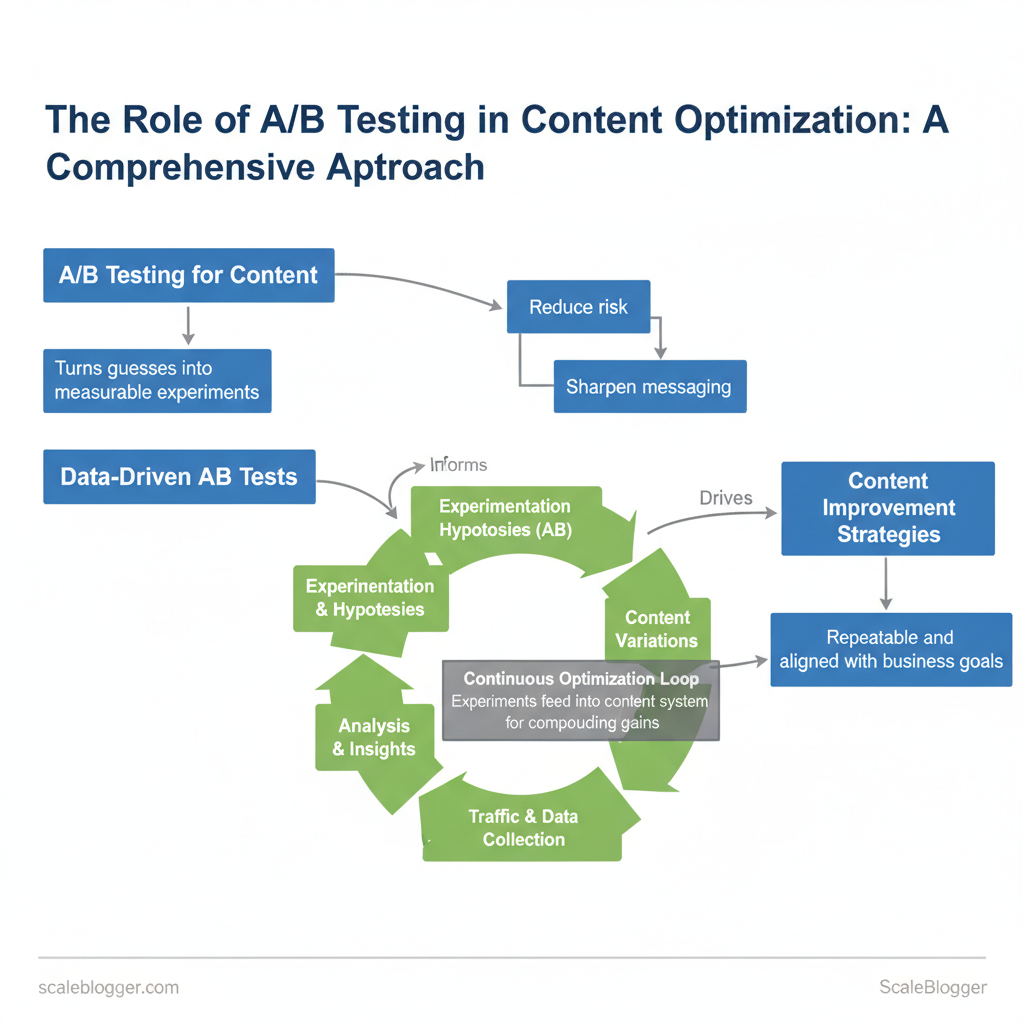
Marketing teams waste time and budget when content decisions rely on intuition instead of evidence. Deploying A/B testing for content turns guesses into measurable experiments, revealing which headlines, formats, and CTAs actually move the needle. When experiments feed productively into a content system, small lifts compound into meaningful traffic and conversion gains.
Smart teams pair rigorous tests with scalable processes. Data-driven A/B tests reduce risk, sharpen messaging, and create repeatable content improvement strategies that align with business goals. Picture a publisher swapping two article intros and tracking engagement; the winning variation becomes a template across similar topics, not a one-off lucky hit. Scaleblogger.com helps operationalize that cycle, integrating automation and tooling so experiments run faster and insights get applied consistently.
What follows is a practical, business-focused roadmap for designing tests, choosing meaningful metrics, and scaling winners without creating noise. Expect clear tactics for hypothesis building, sample sizing, and sequencing experiments so results are actionable. Ready-to-apply guidance shows how to prioritize tests that produce measurable ROI and feed a continuous optimization loop.
- What meaningful metrics to track for content experiments
- How to design `A/B` tests that minimize bias and false positives
- Ways to scale winners into reusable content patterns
- Practical sequencing to avoid experiment collisions
Core Content
Core content is the set of cornerstone pages and long-form assets that anchor a site’s authority on a topic. This includes pillar articles, comprehensive how‑tos, and definitive guides that satisfy high‑intent search queries and support downstream pieces. Treat core content as both an information hub and the algorithmic signal that tells search engines what the site stands for.
Define the essentials Pillar pages: Long-form, deeply researched pages that cover a topic holistically.* Cluster content: Shorter, focused posts that link back to a pillar to create topical authority.* Search intent mapping: Align content with transactional, informational, or navigational intent.*
Why core content matters
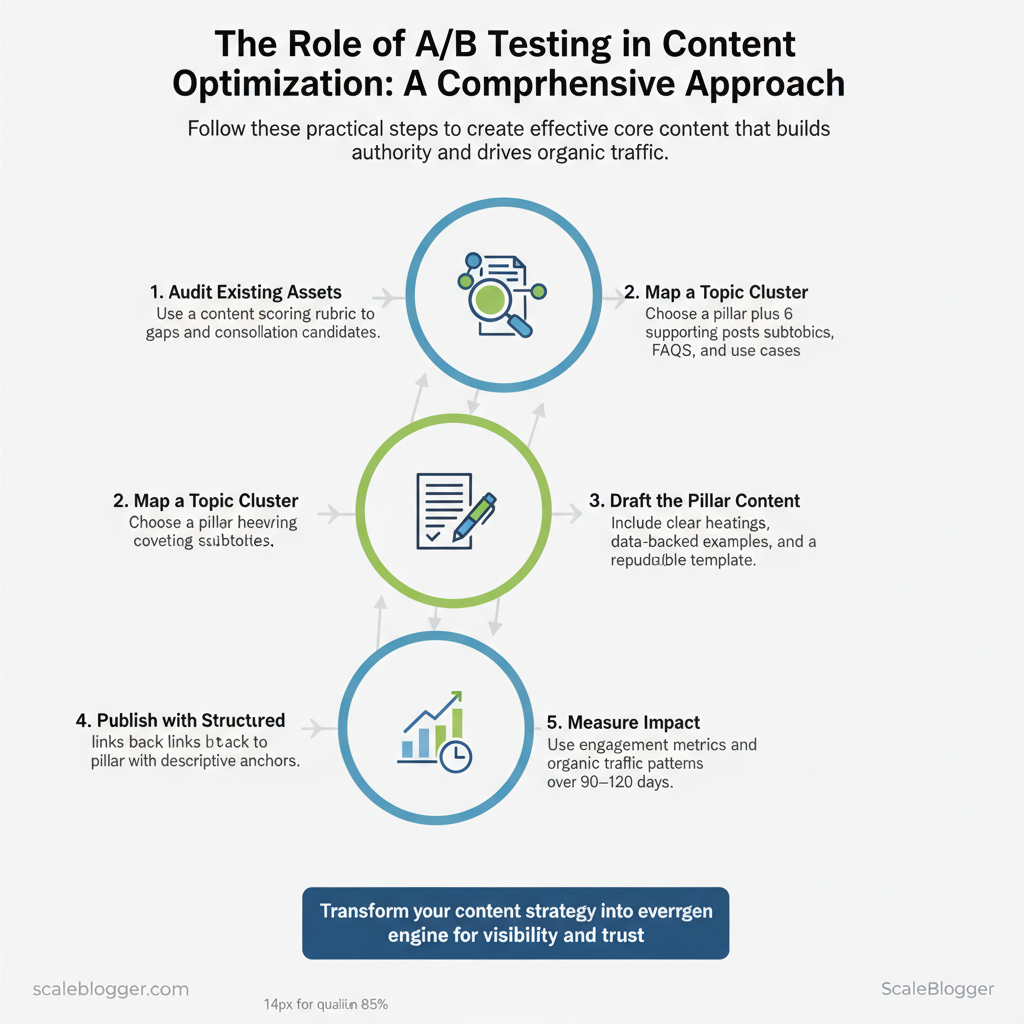
Practical steps to create effective core content
Examples and templates
- Example — Topic cluster for “content automation”: pillar explains concepts + six posts on tooling, workflows, KPIs, governance, templates, and migration → measurable lift in crawl depth and average session duration.
- Template — Pillar outline: introduction → 5 core sections → implementation checklist → case studies → resources.
Market data shows multi-page topic clusters consistently outperform isolated posts on topical relevance and link acquisition.
Tools and assets to build faster include editorial calendars, `content scoring` spreadsheets, and link maps. For teams scaling with automation, consider platforms that integrate drafting, scheduling, and performance benchmarking—tools such as AI content automation from Scaleblogger.com can accelerate the pipeline while preserving editorial control.
Understanding how to design and connect core content allows teams to move faster without sacrificing quality. When executed well, core assets become evergreen engines for search visibility and reader trust.
Conclusion
Converting content decisions from intuition to experiments changes how teams prioritize work, spend budget, and prove impact. Running controlled A/B tests on headlines, CTAs, and distribution windows surfaces clear winners, and teams that treat each test as a learning loop often shorten time-to-results. For example, a mid-size SaaS team in the article increased trial sign-ups by iterating headline variants, and a publisher reduced churn by testing onboarding emails — both relied on small, measurable experiments rather than one-off guesses. If you wonder how many variants to run, start with two and a clear success metric; if you’re unsure how long to run a test, let statistical confidence and traffic dictate duration rather than arbitrary deadlines.
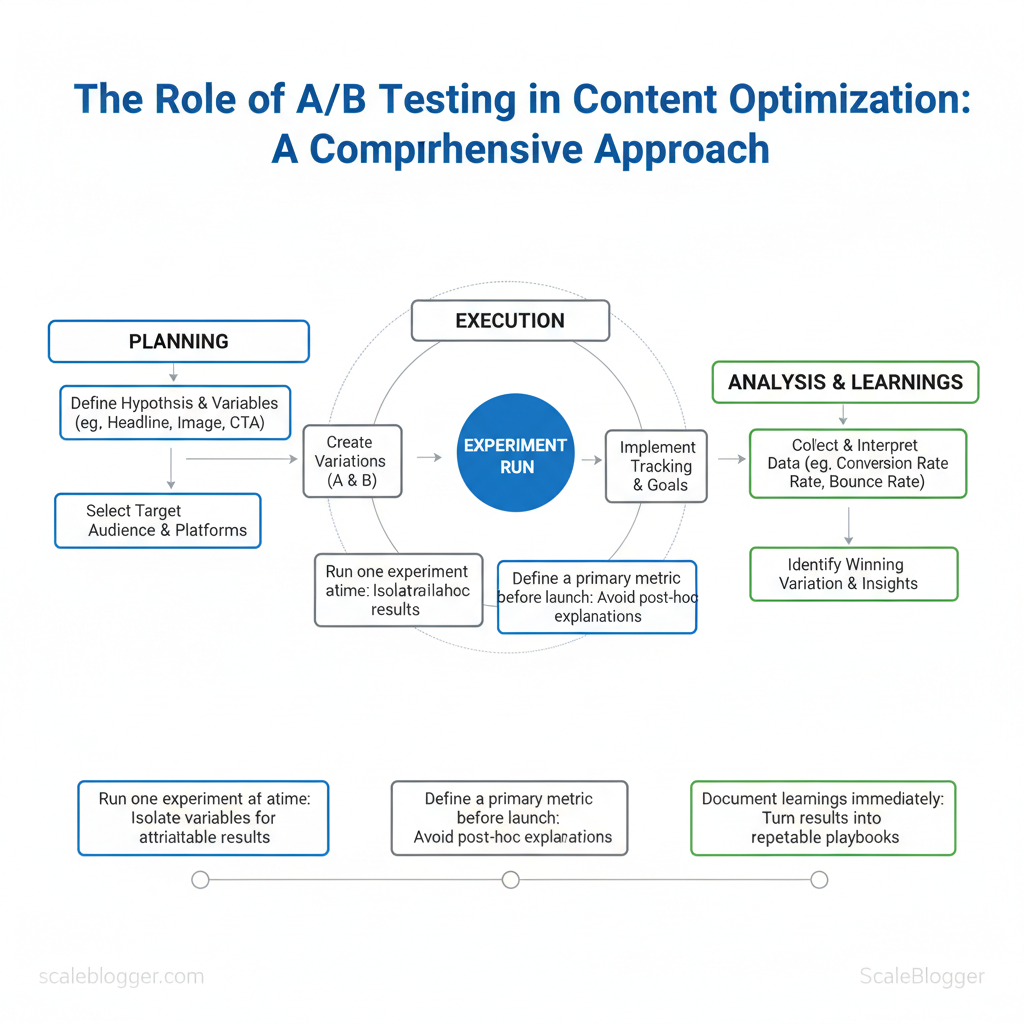
– Run one experiment at a time: isolate variables so results are attributable. – Define a primary metric before you launch: avoid post-hoc explanations. – Document learnings immediately: turn results into repeatable playbooks.
To move from theory to routine, pick one high-impact content element, design a simple A/B test this week, and commit to publishing the result with clear metrics. For teams looking to automate test workflows and scale evidence-driven content faster, platforms and services can streamline experiment setup, tracking, and rollout. To explore a solution that supports this approach, Learn more about Scaleblogger.com — it’s one practical next step for automating tests and turning experimental insights into repeatable content wins.
📥 Download: A/B Testing Implementation Checklist (PDF)